reviewing Black Doves; Dark Matter; Dept. Q; Detective Hole; Dexter: Resurrection; Fauda; For All Mankind; Foundation; Hijack; Memory of a Killer; MobLand; Outlander; Paradise; Presumed Innocent; Reacher; Severance; Silo; Slow Horses; Smoke; Star City; Star Trek: Strange New Worlds; Tehran;The: Day of the Jackal, Diplomat, Night Agent; Your Friends & Neighbors +books, films, music, podcasts, politics
George Santayana had irrational faith in reason - I have irrational faith in TV.
Chuck Todd interviews me about alternate histories
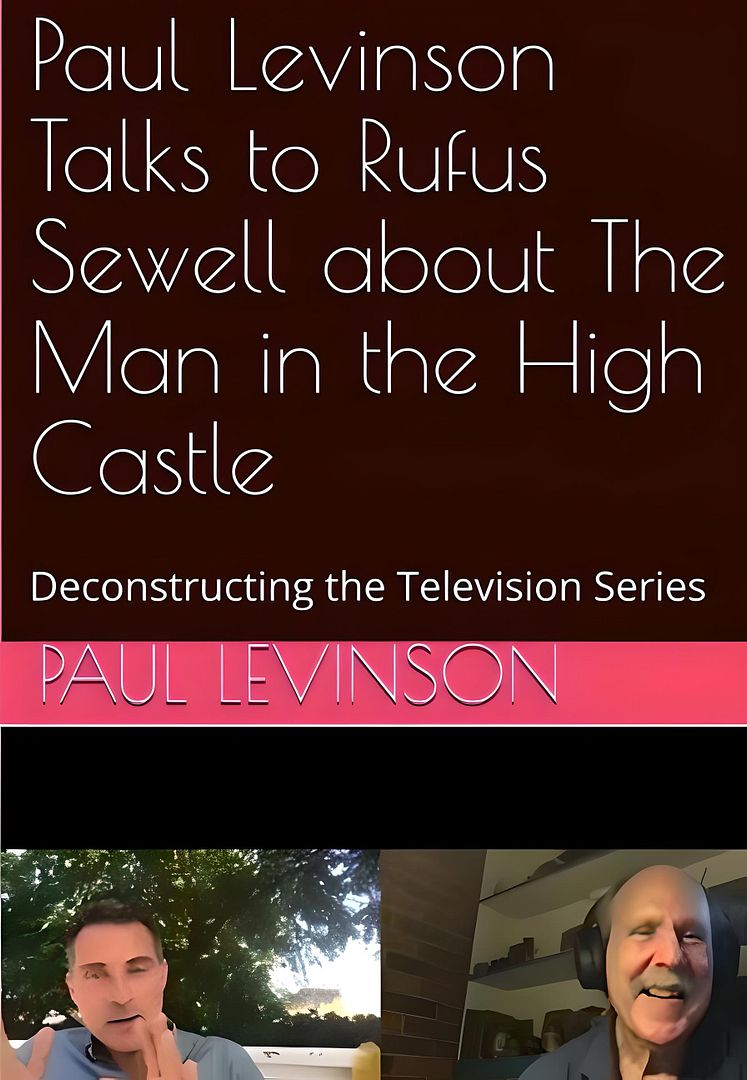
Couldn’t be a better time for The Man in the High Castle to show up on Netflix — here’s the 90-minute conversation I had with Rufus Sewell about his deeply thought-out performance in the lead role, in July 2021, shortly after the conclusion of the pathbreaking series on Amazon.
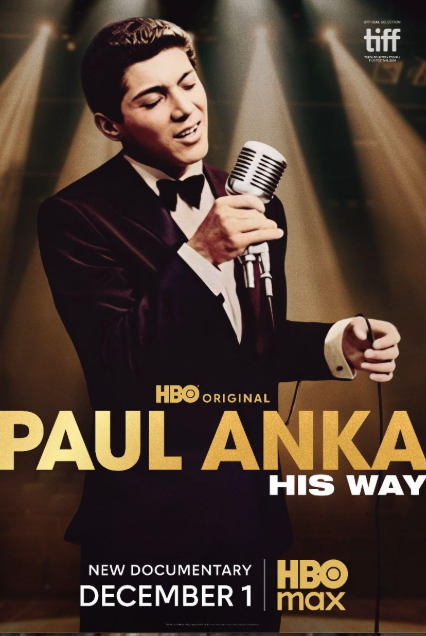
My wife and I saw Paul Anka: His Way, a 2024 documentary, last night on HBO. Why did we wait so long to see it? I don't know. Probably because we weren't paying enough attention.
I've been a fan of Anka since 1957, when I was in 5th grade in PS 96 in The Bronx, and Anka had a great hit, "Diana". Joel Iskowitz, Jordan Axelrod, Steven Auerbach, and Paul Gorman were in my class. I started an acapella group, Little Levi and the Emeralds. I don't think we sang much of "Diana" -- we were more into The Five Satins, The Harptones, and The Del Vikings -- but we sure loved it.
Anka explains and demonstrates at the beginning of the documentary that the ease of playing those 4-chord songs -- C, Am, F, G -- when he sat down at the piano was what drew him into singing and then writing. And he progressed in extraordinary ways, writing "My Way" for Sinatra, the Johnny Carson theme song, and even some songs with Michael Jackson. He also wrote "It Doesn't Matter Anymore" for Buddy Holly and "She's a Lady" for Tom Jones, and those are just a fraction of the more than 900 songs Anka has written!
Of course, no documentary can play even small parts of most of that number of songs, but the question always arises (for me, at least) of what songs would I have liked to hear and see Paul Anka perform in His Way? And, yes, there is one, in particular. It's a song that played a crucial role in Amazon's adaptation (by Frank Spotnitz) of Philip K. Dick's The Man in the High Castle, which ran for four seasons (2015-2019) and helped establish streaming as the titan it is today, The first episode of the second season in 2016 opens with an extended mise-en-scène of protagonist John Smith's (Rufus Sewell brilliantly portrays Smith) young teenage son Thomas getting off the school bus and walking into class. Everything seems so normally, happily, suburban American, as Thomas Smith (good job Quinn Lord) looks at the girls and walks into school. We begin to get a disquieting taste of this alternate history in which the Nazis beat America in the Second World War when we see the Nazi insignia on Thomas's arm and then a kid in the class asks Thomas how many slaves George Washington and Thomas Jefferson had. Thomas Smith then looks at a girl in the class in that certain way, she looks back at him when he isn't looking, but the joy of that budding teenage romance is shattered to pieces for the TV viewer when Thomas is called up to the front of the class to give a Nazi pledge of allegiance that he does with pride.
Now, this is one of Spotnitz's best conceived and realized scenes, and he hammers it home playing Paul Anka's 1960 hit song, "My Home Town," loudly and softly in the background until Thomas begins the pledge. This is an upbeat, zestful song, brimming with the enthusiasm and pleasures of living that is a hallmark of Anka's music, especially his early recordings -- the perfect background for the unnerving perversion of American life that the Nazi conquest has wrought.
So, yeah, I missed "My Home Town" in Paul Anka: His Way -- especially given the steps to fascism our country is currently taking -- but the documentary is titled "His Way", that is, Paul's way, and/or the movie's director and writer John Maggio's way, not my way, and as I've been known to say to someone who tells me that they would have had a character in one of my novels do or say something different than what I had them do or say: hey, go write your own novel. :) And all in all, there's not much I would change in this rendition of Anka's incredible inspiring life and journey. At 84 years old, he's still going strong, hasn't reached the top of the mountain yet (as he says), and I'm looking forward to hearing and hearing about the rest of the climb.
It was a golden age, right before Columbus's voyages to the New World - literally. Italy was still 400 years away from becoming a unified nation. But, in some ways, it was better. It consisted of city states, many in their own ways as great or greater in art, philosophy, and even predictive science than any nation would ever be. Rome was flourishing, as the capital of the powerful Papal states. Florence was home to Botticelli, Michelangelo, Machiavelli, and the greatest of them all, Leonardo da Vinci. The superb and riveting second season of Medici features only Botticelli, who plays a significant role in Lorenzo de' Medici's - aka Lorenzo the Magnificent - early years of power. We'll likely see Leonardo in the third season, already in production.
Lorenzo was head of a potent banking family who, in effect, ruled the city. The Renaissance was throbbing and thriving and new ideas were bursting out all over. The countryside and city bore signs of the glory of the Roman Empire, would didn't seem quite as ancient to Lorenzo and his contemporaries as it does to us. But life was not easy - not for the people, whose lives Lorenzo had a sincere desire to improve, and not for Lorenzo and his family, beset by cunning enemies on all sides, and dependent on alliances with other city states like Milan and Venice and most of all, Rome and the Pope.
I enjoyed this second even more than the first, which was excellent, too, and looked at Florence when Lorenzo was a boy. Now he's feeling and enjoying his power, though how that power and his equanimity is tested is the mainspring of this narrative. Technology is not quite in the modern age, and Lorenzo and his contemporaries can communicate long distance only by letters delivered on horseback or riding themselves to other cities. Weaponry is swordplay, knives, and fire, but they can do plenty of damage.
An intrinsic problem with any historical drama is that, if you know the history, you know how crucial events in the narrative turn out. To make matters worse, you might know the outcome of crises even from watching a previous historical drama that covers the same period. I suppose Medici 2 suffers from such problems, but they didn't bother me in the slightest. Superb acting by Daniel Sharman as Lorenzo, Bradley James as his brother Giuliano, and Sean Bean as their chief antagonist Jacopo de' Pazzi - indeed, everyone, including actors of smaller roles, like Synnove Karlsen as Lorenz's wife Clarice, Matilda Anna Ingrid Lutz as Giuliano's true love Simonetta, and Matteo Martari as Pazzi's nephew Francesco, was great - carry the story, and I was not at all surprised to see Frank Spotnitz, who produced the first season as well as The Man in the High Castle, back as one of the creators, along with Star Trek's Nicholas Meyer, who likewise always does a fine job.
Well, I couldn't resist watching the rest - the last four episodes - of The Man in the High Castle, Season 2, and I'm glad I did. Much as I love a good night's sleep, it isn't all it's cracked up to be, especially when there's a series like this to be binge-watched.
Let me start this review by saying my favorite scene in the final four episodes - well, maybe not my favorite, but the one I enjoyed most in a perverse sort of way - was when that Nazi newscaster in New York was shot dead on the air right in the middle of his announcing that Hitler had died. He was actually telling the truth, and didn't want to make that announcement (he was blackmailed into doing it), but, boy, there's a satisfying example - in fiction, of course, where it should stay - of a propagandist newscaster getting a just desert. (A less over-the-top way of silencing him would just been to cut the power - but, hey, this is alternate reality, and a Nazi alternate reality at that.)
Now on to the major plot: the use of a tape from our reality, showing a hydrogen bomb test conducted by the US in the Pacific Ocean, in what would have been Japanese territory had it won the war, was a brilliant twist and an ingenuous, unpredictable use of alternate reality. And it didn't even come from the man in the high castle.
Which gets us to Tagomi. As I said in an earlier review, he's a fabulous character - literally, because he can travel back and forth between our reality and the one in which the Axis powers won the Second World War. One slight hole in the plot is why he wasn't missed more, especially in such crucial times, when he was away from the Axis-victorious reality and at home with his family in ours. But that's a small quibble. On the plus side, we find out that one his colleagues also made the trip, and that possibly the US atom-bombing of Japan was the trigger. I like that a lot better than the I-Ching.
The doings in Nazi Germany were outstanding television, especially the evolution and devolution of Joe's father. One point, though, that I'm not 100% clear about regarding Berlin: Did Hitler die of (a) natural causes, (b) Japanese poison, or (c) part of a plot pulled off by Joe's father? Smith cleverly uses "evidence" of (c) to get Joe's father out of the acting Chancellorship, which therein saved the world (for now), but I certainly wouldn't put it past Smith to have concocted some or all of this evidence.
And speaking Smith - an Emmy-worthy performance by Rufus Sewell, and memorable work by Alexa Davalos, too. Frank Spotnitz left the show-running after episode 5 - did I notice a difference before and after? Maybe a little - after was a little less metaphysical, a little more large in terms of big developments and important characters killed, and the ending with Abendsen and Julianna was a little mawkish. Also, I don't know whose fault this is, but we basically learned everything we would about the man in the high castle - and not very much - in the very first episode, with not much in any later episode. We still don't know the all-important source of Abendsen's news reels - fake news, of sorts, in today's parlance, with the twist that the news is real in our reality. But all together, the 10 episodes continue what I thought after the first season: The Man in the High Castle is the best series on television this year, and in many ways the best science fiction television series ever made (Star Trek the original series and the next generation are the only competition, in very different ways).
I reviewed the pilot of The Man in the High Castlehere, and the rest of the series here, but refrained as much as possible from comparing the extraordinary television series to the extraordinary novel, and from putting any spoilers in the review. But there are two very significant differences between the book and the TV series, which can't be discussed without giving away some important events in the television series, so I'll do that here with a spoiler warning. Read on, if you're interested, and have seen the television series and read the novel, or know neither or just one, and are interested anyway.
There couldn't be a better time to see The Man in the High Castle - actually, any time would be great - but recent events make this weekend an especially chilling and resonant time to see the 10-part television series on Amazon, based on the Philip K. Dick justifiably lionized novel of the same name. The United States and the civilized world are involved in a 21st century version of a world war, this time against DAESH aka ISIS, with the latest atrocity committed in France last week; Donald Trump is calling for registration of Muslims in the United States, a move that recalls how Nazis began their persecution of Jews; and DAESH regularly releases videos which show what they expect to be doing to the world in the near future.
The Man in the High Castle debuted its pilot in January of this year, and I thought it was superb. My review is here. I found the rest of the season in some ways better than the pilot, in a few ways not as good, but altogether also superb and deserving of being called a masterpiece.
Since this isn't a comparative media paper, I won't get into the differences and similarities between the novel and the television series,* other than to say there indeed significant differences and similarities, I liked most but not all of the changes, and you can 100% enjoy the television series without having read the novel, if that's what you'd like to do.
Germany and Japan winning World War II and splitting up the United States remains a brilliant alternate history tableau, as is the peek into the alternate reality of that alternate reality in which we won after all - i.e., the reality which you and I inhabit. The attention to alternate reality detail is riveting, ranging from 1962 American hit records sung in Japanese in San Francisco, to the Nazi celebration of "VA Day" as in a nightmarishly twisted 4th of July, firecrackers and all, at the Long Island home of Obergruppenführer John Smith, well played by Rufus Sewell (Alexa Davalos was also especially good as Juliana, as was Cary-Hiroyuki Tagawa as Tagomi - and Rupert Evans was strong as Frank, so was Luke Kleintank as Joe - there wasn't an off-key note in any performance, even the minor characters were memorable). The palpable impact of these details is more than enough to make you suspend your disbelief and contemplate how profoundly horrendous it would have been had we lost the war, and those words don't even scratch the surface. Any American who isn't shaken to the core by these details has ice water in his veins.
There are lots of unexpected but motivated twists in the plot, which works well on both the macro and micro levels. The tension between Germany and Japan - worried about the Nazis now dropping the a-bomb on them - provides a plausible backdrop to the narrative. Germany is more advanced than Japan - with not only atomic weapons but rocket passenger planes - and this flows logically out of the technological sophistication in our own reality.
But the ultimate backdrop and mystery is the source and content of the newsreels that everyone - including an aged Hitler (played by Wolf Muser, who looks an aged Peter Graves) - is intent on getting in their hands. The source is not revealed, and the content ...
Well, it starts off showing the Allies winning the war (what the book does in the novel - I'm making just this one comparison), with the implication that ours is the more prime reality, a very cool Philip K. Dick ingredient. But the newsreels morph into a selection of alternate realities - also interesting in its own way (and disturbingly reminiscent of what Donald Trump has been saying about seeing videos of Muslims in Jersey City cheering as the Twin Towers fell on 9/11, which didn't happen in our reality).
And, in the end of The Man in the High Castle-- well, that's the part - the very end - which I thought was not too good, and not really explained, and even could be interpreted as everything we've seen in the narrative being a given character's bad dream. But see it yourself. Whatever you think of the ending, you'll be treated to what has set a standard for alternate reality brought to television, in the same way the novel did that for alternate reality in writing.
Hats off not only to Philip K. Dick, but Frank Spotnitz, who created the series - and presented a visual tableau in many ways evocative of Hitchcock - and Ridley Scott, one of the executive producers, who even put in an origami-making character, a nice shout-out to his other masterwork, Bladerunner.
*Ok, here's a very significant difference between the novel and the television series - which is actually the second comparison I'm making, if you've read this far in the review and are keeping track. In the book, the alternate history which is our reality is told in a book - a secret book, like Goldstein's in 1984 (and this device in the Philip K. Dick novel was likely inspired by Orwell's). In the television series, however, the alternate histories which start as ours are in movie reels - news reels - and this gives them a chilling verisimilitude, especially when the characters themselves begin appearing in them near the end. Seeing yourself in a newsreel, doing things you didn't do, or didn't do yet, is the ultimately effective way of telling an alternate history narrative. (Read here for further analysis, with spoilers.)
What if the Soviet Union had survived into the 21st century





 Well, I couldn't resist watching the rest - the last four episodes - of The Man in the High Castle, Season 2, and I'm glad I did. Much as I love a good night's sleep, it isn't all it's cracked up to be, especially when there's a series like this to be binge-watched.
 I reviewed the pilot of The Man in the High Castle


