Chuck Todd interviews me about alternate histories
Showing posts with label Rob Reiner. Show all posts

Sunday, May 5, 2024

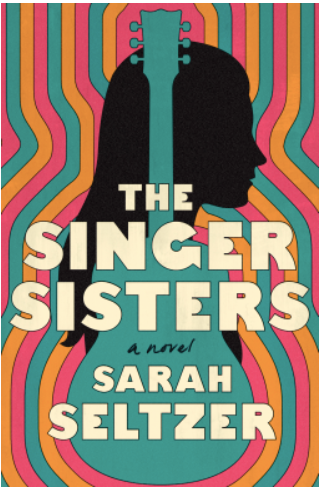
Review of Sarah Seltzer's The Singer Sisters: The Musical Mystique


There's a meta-genre of fiction epitomized in different but overlapping ways by Eddie and the Cruisers, Rob Reiner's This Is Spinal Tap, and Daisy Jones and the Six -- the first and the third adapted to the screen from novels -- that helps us understand what those who make music that lights up our nights are doing when they're off-stage and not in the studio.  Sarah Seltzer's The Singer Singers, a debut novel to be published this August, not only fits well in that narrative family, but in some ways exceeds it.  I'd expect to see it adapted on some kind of screen before too long.

The Singer Sisters actually tells us two stories, deftly interwoven.  One is a moving snapshot of the folk-rock music scene,  and therein the larger music venue in which folk-rock played, in the last third of the 20th century.  The other is a tableau of upper middle class Jewish culture, in New York City, Boston, and beyond, in the same period of time.

The Singers -- aka the Zingleman sisters -- strive to succeed across two tempestuous generations along with other fictional singers and writers, against a backdrop of real superstars that even non-devotees of folk-rock will instantly recognize.  The characters worry about "stealing from Dylan".  One of the singers concludes that "Joan Baez was right and Dylan wrong, that kindness mattered more than genius" (I would say that both are crucial).  There's a quote from Gordon Lightfoot's "Early Morning Rain" -- "see the silver bird on high" -- and a mention of Phil Ochs (not a superstar but shoulda been).  And there are fictitious characters that the cognoscenti will surely know, like the rock critic who uses his way with words to unfairly lambaste brilliant work (as the real rock critic did to Phil Ochs -- not to mention Paul McCartney). Meanwhile, the Singer songs are not only spoken of by the characters, but Seltzer actually delivers more than a dozen sets and snippets of original lyrics, demonstrating a considerable talent not only as a novelist but a lyricist, and leaving the reader yearning to hear them put to music and fulfilled in song.  In addition to a movie or a limited TV series, The Singer Sisters also has the makings of a Broadway musical.

The Zingleman sisters are Jewish, and their Yiddishkeit permeates the novel, not only in cream sodas, but their parents' wise view that they'd rather see their children fed with goishe food than go hungry without it. In this sense, The Singer Sisters has a kinship with Philip Roth's Goodbye Columbus, and I hope the novel is recognized as the compelling portrait of Jewish culture in America that it is.  It's especially important, given the rising wave of anti-Semitism that's afflicting our country and the world.

In case it's not obvious, The Singer Sisters is very much a woman's novel, explored in sisterhood, motherhood, and daughterhood, with love, heartbreak, pain, exultation, and a panoply of uniquely female emotion in every chapter.  But men might well get a necessary education from this novel too, and I heartily recommend it to any human being.

more about The Singer Sisters here.

============


my interview with Sarah Seltzer

============


"Paul Levinson's It's Real Life is a page-turning exploration into that multiverse known as rock and roll. But it is much more than a marvelous adventure narrated by a master storyteller ... it is also an exquisite meditation on the very nature of alternate history." 

-- Jack Dann, Fiction Writer's Guide to Alternate History


Tuesday, January 16, 2024

Podcast Review of the Who Killed JFK podcast, Episodes 9-10


Welcome to Light On Light Through, Episode 369, in which I review the Who Killed JFK? podcast, episodes 9-10.

Read this review (written review of episode 10, with link to written review of episode 9)

Podcast reviews of Who Killed JFK? Episodes 1-5 and 6-8


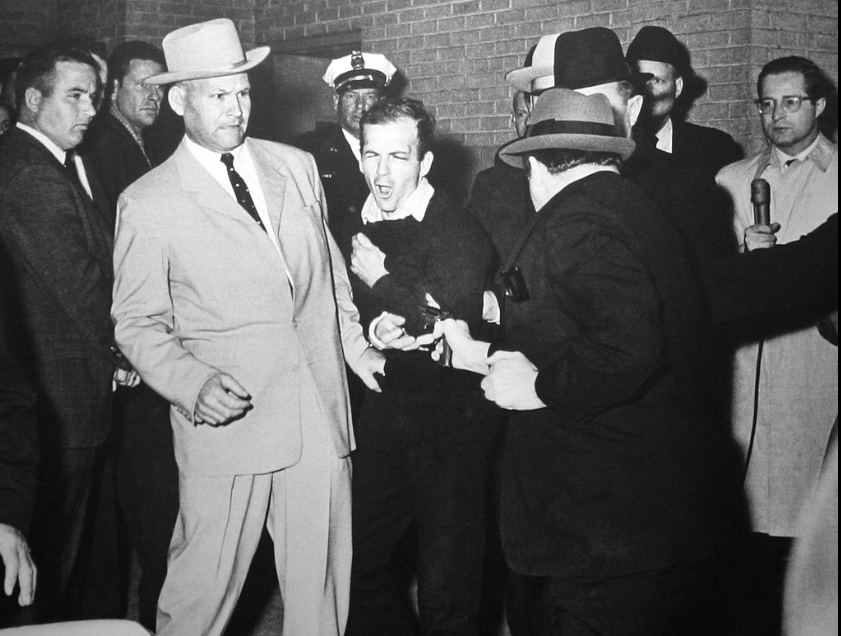
Photo by Robert H. Jackson. Originally published in the Dallas Times Herald, November 25, 1963. Winner of the 1964 Pulitzer Prize for Photography.


Check out this episode!

Wednesday, January 10, 2024

Who Killed JFK? Episode 10: Blueprint for Continuing the Inquiry

The Who Killed JFK? podcast with Rob Reiner and Soledad O'Brien concluded today with a satisfying episode that wrapped up this enduring, searing mystery almost as good as it could have.

Reiner and O'Brien's final comments get to the point: this podcast arose from the question that has been nagging at Reiner's soul since 1963.  Who killed the President?  Although the podcast didn't and couldn't have provided the complete story, wrapped in a package with a bow, which we and the world could now rely on without needing answers to still-unanswered questions, the podcast provided some important signposts, and even some answers, and this is a worthy thing indeed to forward to future researchers and generations.  Like Reiner, I've felt lied to about the JFK assassination all these years, angered and aggravated, and I'm glad this podcast can serve as a blueprint for the uncovering of further lies, and the wiping away of at least some of the lies that have plagued us -- all over this planet -- all these many years.  We and our descendants deserve nothing less than the truth, or as much of it as we can get, about this monstrous act that stole our future and warped our relationship to the cosmos.

The biggest specific takeaway that this concluding episode gives us is that there were four shooters.  I know almost nothing about ballistics and forensics, but this takeaway is convincing.  And coupled with it is the fact that Lee Harvey Oswald was not one of the four shooters.  As Reiner has said over and over again, why would Oswald say he was the "patsy," if he had really killed JFK?  If he had thought the assassination was saving the country, wouldn't he proudly have proclaimed it, as John Wilkes Booth had done with his killing of Lincoln?  Or, if Oswald had nothing whatsoever to do with the assassination, wouldn't he have repeatedly proclaimed that, as well, shouting from the rooftops to the media that he was innocent, the wrong man?  Instead, the word "patsy" strongly suggests that he knew something about the assassination and how it happened, and that he realized he was the fall guy.

What Oswald knew a lot about was the CIA and how it operated.  The podcast stops short of saying the CIA, the Mafia, or Cuban exiles specifically ordered the assassination.  But there's ample evidence that they all participated, maybe more as individuals in some cases than formal members of their organizations like the CIA.   One the one hand, the passage of time makes it increasingly difficult to identify specific culprits.  On the other hand, the players in the assassination had families, maybe children, who might have heard something important, some additional key to unlocking this jagged puzzle, and this very podcast points in the right directions.  Hats off to Reiner and O'Brien, to Dick Russell who did a lot of the research for the podcast, and to David Hoffman who did the writing.  (I heard in the credits that some of the recording was done at CDM Studies.  I've done some work with them myself, so hats off too to Charles de Montebello.)

The big question that I'd still like to see addressed, as I mentioned in my very first review of this podcast, is why JFK's brother, Robert F. Kennedy, sat still for the Warren Commission's bundle of lies about a lone shooter, etc.  And RFK, of course, was then assassinated himself in 1968, likely on his way to becoming President of the United States.

Perhaps all the talented people who put together this crucially important podcast could do another podcast on Who Killed RFK?


See also Who Killed JFK?  A Review of the First Three Episodes of this Podcast ... Episode 4: The Real Manchurian Candidate ... Episode 5: Sheep Dipped ... Episode 6: The Richard Case Nagell Case ... Episode 7: The Assembled Killers ... Episode 8: Not Lee Harvey Oswald ... Episode 9: Jack Ruby


Tuesday, January 2, 2024

Podcast Review of the Who Killed JFK podcast, Episodes 6-8


Welcome to Light On Light Through, Episode 367, in which I review the Who Killed JFK? podcast, episodes 6-8.

Read this review (written review of episode 8, with links to written reviews episodes 6 and 7)

Podcast review of Who Killed JFK? Episodes 1-5

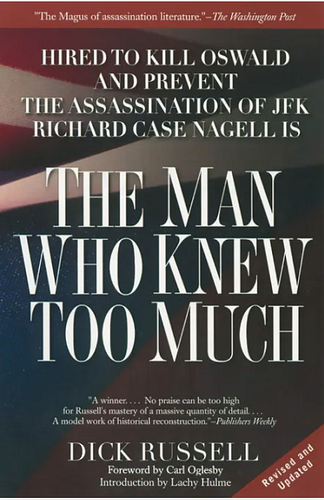
Dick Russell's The Man Who Knew Too Much

Screen Shot 2023-12-14 at 11.50.23 AM


Check out this episode!

Wednesday, December 27, 2023

Who Killed JFK? Episode 8: Not Lee Harvey Oswald


A short but powerfully informative Episode 8 of the Who Killed JFK? podcast with Rob Reiner and Soledad O'Brien that makes a convincing case that Lee Harvey Oswald couldn't possibly have done it.

Here are the highlights:

  • The package that Oswald carried into the Texas Book Depository on the day of the assassination was too small to fit the rifle that killed JFK, even if disassembled, according to a witness (interviewed by Reiner in 2023) who traveled with Oswald to work that day.
  • More than one witness places Oswald in the cafeteria at a time too close to get back up to the 6th floor, from where at least some of the three bullets were fired.
  • Oswald's behavior after the assassination makes no sense from someone trying to get away.
Now these details, added to what we heard in earlier podcast episodes about why some highly placed people at the CIA, the Mafia, and Cuban exiles wanted to see JFK dead, plus the forensic evidence of at least one of three bullets coming from in front of the JFK Limo, i.e., not from the Texas Book Depository, where Oswald was, make a case that, if I were on a jury trying Oswald for this crime, I would have more than enough evidence or lack of evidence to find him not guilty.

But, of course, as we know, Oswald never got to trial, because Jack Ruby killed him.  So Oswald turned out not just to be just a patsy -- a troubled but innocent man blamed from the assassination of John F. Kennedy -- but a patsy who paid for that role with his life.  Next week, we'll learn more about Jack Ruby's role in all of this.

And as I said before, I hope, by the end of these riveting podcast episodes, that we learn why the President's brother, Robert F. Kennedy, put up with all of this, only to be assassinated himself.

See also Who Killed JFK?  A Review of the First Three Episodes of this Podcast ... Episode 4: The Real Manchurian Candidate ... Episode 5: Sheep Dipped ... Episode 6: The Richard Case Nagell Case ... Episode 7: The Assembled Killers

Sunday, December 24, 2023

Who Killed JFK? Episode 7: The Assembled Killers


Given the depth of the pain I and everyone I know felt about the assassination of JFK in November 1963, it's hard to fathom how many different people fervently wanted it.  The seventh episode of the Who Killed JFK podcast with Rob Reiner and Soledad O'Brien makes the case for three groups, in particular: the CIA, Cuban exiles, and the Mafia.

The animus that the CIA and exiles from Castro's Cuba had for JFK has already been convincingly presented in prior episodes of this pathbreaking podcast.   In episode 7, the focus is on the Mafia, which had two reasons to hate JFK.  First, Castro's takeover of Cuba resulted in the Mob's Caribbean Las Vegas being extinguished, which cost them untold millions of dollars.  JFK's move towards peace and defacto acceptance of Castro in Cuba after the Cuban Missile Crisis thus angered the Mob almost as much as it did the Cuban exiles and the bellicose CIA.  Second, Robert F. Kennedy, appointed Attorney General by his brother, pursued an escalating attack on the Mafia, giving it a reason all its own to want JFK removed from office.

As this episode amply details, members of all three groups -- the CIA, Cuban exiles, and the Mafia -- were in Dallas the day that JFK was assassinated.  Are we to believe that that was just coincidence?  Not likely.  And one CIA operative in particular is especially notable:  E. H. Hunt, who achieved infamy a decade later as one of the architects of the Watergate break-in that brought down Nixon.

As Reiner aptly has put it more than once, lots of chess pieces were being moved around in the months preceding JFK's assassination.  All of which to insure that JFK was killed, and the blame placed with none of the three groups that were responsible.

The proposition that Lee Harvey Oswald was indeed the patsy that he proclaimed himself to be right after the assassination rings ever more true.

See also Who Killed JFK?  A Review of the First Three Episodes of this Podcast ... Episode 4: The Real Manchurian Candidate ... Episode 5: Sheep Dipped ... Episode 6: The Richard Case Nagell Case


Thursday, December 14, 2023

Who Killed JFK? Episode 6: The Richard Case Nagell Case


Episode 6 of the Who Killed JFK? podcast with Rob Reiner and Soledad O'Brien really hit paydirt with an account of Richard Case Nagell, given to Dick Russell, which provides the most convincing evidence I've heard so far that Lee Harvey was indeed a patsy, set up to take the fall for the assassination of JFK on November 22, 1963.

Who was Nagel?  He was a CIA double agent -- same as Oswald (according to Russell and this podcast), tasked by the Soviets, whom he wasn't really working for, to kill Oswald.  Why?  Reiner and Russell explain that the Soviets knew of the CIA plan to kill Kennedy and blame it on them (the Soviets), as a pretext for the U. S. to then invade Cuba and once and for all get Castro out of power.  Extensively interviewed by Russell over a period 20 years before Nagell's death from a "heart attack" in 1995, Russell tells us in the podcast (and in his 2003 book about Nagell, The Man Who Knew Too Much) that Nagell was ordered by the Soviets to kill Oswald to prevent the assassination of JFK.  This put Nagell "between a rock and a hard place," as O'Brien aptly puts it.  If he follows the Soviet orders and kills Oswald, the CIA will likely kill him.  If he doesn't follow those orders, the Soviets will do the same.  Nagell tries to let Oswald know he's being set up, without being too specific, because Nagell doesn't want to bring CIA down on him.  Oswald shrugs him off. So in a move that seems crazy if you don't know any of this background, Nagell walks into a bank in Dallas two months before JFK's assassination, and fires a gun in the air, twice.  He wants to get arrested, because he figures that prison is the safest place to be, with potentially CIA and Soviet assassins both apt to kill him.

The CIA does eventually get Nagell with a "heart attack gun" (not science fiction, check it out online) in 1995, one day after the Assassinations Records Review Board (established by Congress in the President John F. Kennedy Assassination Records Collection Act of 1992) sent Nagell a request for information.  Fortunately for the truth, Nagell had already talked extensively with Russell in the preceding decades.

So where does this leave us?  Well, as I said in reviews of earlier episodes of this podcast, it convinced me early on that, at very least, Lee Harvey Oswald was not the sole shooter in Dallas on November 22, 1963.  I'm now convinced that Oswald was far more than not the only shooter that day: he was indeed the "patsy," as Oswald after the assassination said he was, in the murder intricately plotted and carried out by the CIA to punish JFK for his failure to provide support for the Bay of Pigs invasion, prevent him from furthering detente with the Soviet Union, and we can now add to provide a pretext for a US all-out attack on Cuba.

I'm looking forward more than ever to the next episodes in this crucially important podcast.

See also Who Killed JFK?  A Review of the First Three Episodes of this Podcast ... Episode 4: The Real Manchurian Candidate ... Episode 5: Sheep Dipped


Screen Shot 2023-12-14 at 11.50.23 AM

Tuesday, December 12, 2023

Podcast Review of the Who Killed JFK podcast, Episodes 1-5


Welcome to Light On Light Through, Episode 364, in which I review the Who Killed JFK? podcast, episodes 1-5.

Read this review (written review of episode 5, with links to written reviews episodes 1-4)

Links to some of what I mentioned in the podcast:


Check out this episode!

Wednesday, November 29, 2023

Who Killed JFK? Episode 4: The Real Manchurian Candidate


Episode 4 of Who Killed JFK, the podcast with Rob Reiner and Soledad O'Brien, was just put up today.  It's all about Lee Harvey Oswald, prior to his day in the Texas Book Depository, or wherever he was on that day in 1963 when JFK was assassinated.  It tells us of his conditioning or brainwashing by the CIA, resulting in his false defection to the Soviet Union.  A lot of this reminded me of The Manchurian Candidate.

In case you haven't seen it, I highly recommend this 1962 movie, based on 1959 novel by Richard Condon of the same name.  In the movie, Lawrence Harvey (Oswald's middle name, an awful coincidence?) plays a Korean War veteran who comes home to America, brainwashed by the North Koreans. He's now an assassin, programmed to kill -- in this case a nominee for U. S. President -- with no conscious knowledge of what he's doing.  (Yes, this is similar to Homeland, which clearly was inspired by The Manchurian Candidate.)

Episode 4 of Who Killed JFK presents a variety of evidence that Oswald was "brainwashed" by the CIA in the late 1950s.  Whatever happened to Oswald, the CIA's infamous MK-Ultra program -- which used LSD, hypnosis, sensory deprivation, and other nefarious methods to program its subjects to do whatever the CIA wanted -- is established fact.  (Candy Jones, one-time model and later co-host with her husband, Long John Nebel, of their widely popular late-night radio talk show, claimed to have been given the MK-Ultra treatment in the 1950s.) Episode 4 of Who Killed JFK presents the case that Oswald was put through the program and sent to the Soviet Union as a double agent.  The title of the episode, "The Patsy," comes from what Oswald himself said when he was between the time JFK was killed and Jack Ruby in turn killed Oswald.  The next episode will present the further case that Oswald, still under the influence of MK-Ultra program, was set up to take the sole rap for killing JFK.

So here's where we stand at the end of 4th episode:  The CIA has it in for JFK.  They pressured doctors to change their reports in order to support the preposterous single-bullet theory.  And they programmed Lee Harvey Oswald to do their bidding -- at this point, to pretend to defect to the Soviet Union.

I'm looking forward to learning all about the continuation of Oswald's trajectory in the fifth and subsequent episodes of Who Killed JFK?  I do have one question at this point.  What was the reaction in the Soviet Union of Oswald being named the sole killer of JFK?  In Episode 4, we're told that maybe, likely, the Soviets were suspicious of Oswald's defection, and likely were playing their own game with Oswald, seeking to use him for their own ends.  I hope Who Killed JFK -- which has become must listen-to audio for me -- tells us a little more about what Reiner at al may have learned of what the Soviets thought of Oswald being labeled as the sole assassin of JFK.  Given what we found out in previous episodes about JFK and Khrushchev drawing closer after the resolution of the Cuban Missile Crisis, driven by their mutual desire to make sure that the U.S and the USSR never came so close to the precipice of nuclear Armageddon again, it makes sense that the Soviets would have been very interested in who really killed JFK, even after Khrushchev was put out of power.

See also Who Killed JFK?  A Review of the First Three Episodes of this Podcast


Tuesday, November 21, 2023

Who Killed JFK?: A Review of the First Three Episodes of this Podcast


Rob Reiner and I have a lot in common regarding the assassination of John F. Kennedy on November 22, 1963 -- the awful anniversary of which is tomorrow, as I write this.  Reiner first learns about the assassination, as he tells us in the podcast he's doing with Soledad O'Brien, in his high school physics class, when he was 16.  I first found out about the assassination in my calculus class, which I was taking as a freshman in the City College of New York, when I too was 16.  (In fact, we were both born in March 1947 in The Bronx. I was in the "SP"s, which New Yorkers might recall meant that you skipped 8th grade, which would explain why I was a year ahead of Reiner.)   We both read and were very impressed by Mark Lane's Rush to Judgement, the 1966 book that attacked the Warren Commission's conclusion that one man, Lee Harvey Oswald, had been responsible for killing JFK.  And most important, Reiner and I both felt and feel to this very day that the Warren Commission and the American government has been lying to us all these years about who killed JFK.

To be clear about the impact that assassination had on me, Reiner, and who knows how many more Americans and people around the world, that assassination was "the end of the innocence," to quote one of Don Henley's best songs, about the end of a true love affair.  All of us 16 and younger and no doubt at least some years older found we instantly had a new view of the world, a sad, wise, and cynical view, the moment we heard Walter Cronkite or whoever it was deliver this terrible news.  Cynical because, well, it's tough to see your optimism shattered, leaving you feeling naive to have had it in the first place.  No amount of Beatles and landing on the Moon could change that, and the murder of John Lennon in 1980 only reinforced that horror in the soul.

Reiner seeks, if not to remedy that (it can never really be remedied), at least perhaps to reduce it, by getting at the truth of what really happened on November 22, 1963.  In the first two episodes of his podcast, which O'Brien helps him deliver, Reiner explains how and why the CIA came to loathe and fear JFK.  He didn't back it up to its satisfaction when it tried to wrest Cuba from Castro, and he let that attempt end in the Bay of Pigs.  He started working hard to get a real peace with the Soviet Union, when he saw how close we came to destroying our civilization in the Cuban missile crisis.   Reiner tells us of the note the newly widowed Jackie sent to Khrushchev.  That's all in the first episode.  And in the second, we learn of the various attempts, from people ranging from Geraldo Rivera and Dick Gregory, and others I hadn't heard of before, like Dick Russell, to get at the truth.

I'll be listening to every remaining episode of this important podcast.  Its tone and intelligence scratch an itch that will always be there. I have no idea if Who Killed JFK? will address a question I've had since that day in Dallas when the curtain came down on my unbridled optimism about the good guys always winning.  Why didn't Robert F. Kennedy, who remained Attorney General until September 1964, do everything in his power to find out what happened to his brother?  Perhaps he would have, as President, if he hadn't been murdered himself in 1968.

Added 22 November 2023:  Review of Episode #3

And today is the 60th anniversary of JFK's assassination.  I would have thought about him and that heinous event on this day, anyway, but having listened to and reviewed the first two episodes of Rob Reiner and Soledad O'Brien's podcast last night, the assassination and the government "narrative" about it has been especially on my mind.

In the third episode, Reiner says "narrative" is a good word for what our government told us about the assassination, because so much of the government's story was fiction.  Coincidentally, I've been thinking and reading a lot about alternate history recently -- and writing some of it -- and I found myself agreeing with the authors quoted in Jack Dann's Fiction Writer's Guide to Alternate History that a lot of our so-called real history is fiction.

In the third episode of Who Killed JFK?, Reiner details how the findings of what he aptly calls "the most important autopsy in American history" were not only kept from the American people, but deliberately bent to support what the government didn't want us to know -- that more than one shooter was firing at JFK in Dallas 60 years ago.  We learn that Dr. James J. Humes, one of the two pathologists who performed the JFK autopsy, burned his first autopsy report, presumably because it contradicted the "single bullet" theory that our government was pushing.  Reiner, O'Brien, and the experts they interview systematically explain why the single bullet theory is absurd -- way too much damage was done to Kennedy and John Connally, who was sitting in the front seat of Kennedy's limousine.  We also hear convincing testimony that some of JFK's wounds came from the front, obviously impossible if Lee Harvey Oswald, firing from behind, was the only shooter.

So, today, November 22, has been and always will be a sad day for those of us who were cognizant the day that JFK was assassinated.  But the Who Killed JFK? podcast is a welcome ray of hope that maybe we're finally getting close to the truth of what happened 60 years ago.

See also: Who Killed JFK? Episode 4: The Real Manchurian Candidate


Here's an interview I did with Walter Herbst, who published a book on this subject two years ago.

And here's an alternate history I wrote, "It's Real Life," in which John Lennon was not murdered.


InfiniteRegress.tv