Chuck Todd interviews me about alternate histories
Showing posts with label Impressionism. Show all posts

Tuesday, September 26, 2023

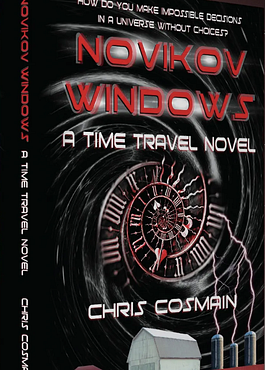
Review of Chris Cosmain's Novikov Windows

Novikov Windows


I'm going to here review a a very recently published, nearly 500-page time travel novel -- Chris Cosmain's Novikov Windows: A Time Travel Novel (that's the sub-title) -- I've just read, in two days.  That should give you an idea of how compelling I think this novel is.  

Because of that, I'm not going to give you any big spoilers in this review.  If you haven't yet read this novel, and doubt or would like further elaboration on any of the points I make below, my best advice is: read the novel.  (You can buy a copy over here.)

Now as to the narrative.  It has a 19th-century flavor.  In fact, important parts of the story take place back then.  But more than that, its style and pace feel as if it could have been written by H. G. Wells.  And it combines that ambience with all the mod-cons:  3-D printing, DNA and junk DNA, computers, and rockets all play a role.

I've said many times that I can't enjoy or take seriously any time-travel tale which ignores the paradoxes that time travel engenders, and gives the intellect (or at least mine) so much to deal with.  The one that comes up most often is the so-called grandfather paradox -- if I go back in time and accidentally kill my grandfather, before he sleeps with my grandmother, I wouldn't exist, so how have I gone back in time in the first place?  (By the way, that's not only so-called, but called in a way that's unnecessarily violent and sexist -- I can trigger the paradox by going back in time and obstructing either set of my grandparents from ever meeting.  The obstruction doesn't have to be death, and I don't need to divert one of my grandfathers, it could be one of my grandmothers.)  But Cosmain has a daring way of positing why this paradox would never arise.

Another favorite time-travel paradox is what I think of as the "where did it come from" paradox.  A man, somewhat older than me, who looks very familiar, knocks at my door with a package.  He advises me to open the package then walks away.  The package contains explicit instructions on how to build a time machine.  The instructions say it will take me ten years to build it, and after I build it, I need to travel ten years back in time and give myself the package.  So ... where did the package and its instructions come from in the first place?   That kind of paradox plays a crucial role in Novikov Windows.

Here are ten more specific elements I especially enjoyed in this novel (the enumeration reflects not where they appear in the story, but just the order I felt like putting them in):

1. Novikov Windows has one of the most ingenious time travel methods I've ever come across in a novel, story, movie, or TV series: the person or object is scanned down to the atomic level, the scan is sent back in time, in a device that recreates the person or object at the destination.

2. Vincent van Gogh makes an appearance. There's something about that Impressionistic Age and its love affair with light that just cries out time travel, isn’t there.

3. There's a refreshing, almost boyish, Tom Swiftian quality in the descriptions of the science and the tech necessary for time travel.  That's part of what I meant when I said H. G. Wells could have written this.

4.  The novel also has romantic passion ... deep kisses, deeper feelings, more.  That's why I didn't say the novel was Asimovian (my favorite science fiction author, but portraying love wasn't his strong suit).

5. Cosmain deals with the problem of not only traveling through time, but to the intended place.  You often don't find this in time travel stories.

6. The addition of new, important characters throughout the novel gives the characters we already know the need to explain to the new characters what's really going on, i.e., how the time travel works, its limits and specifications, which in turn provides us, the readers, another chance to understand this.  Yes, the science and effects of time travel in this novel are complex, but time travel that isn't is usually not worth reading.  And the time travel in this novel is something you likely haven't seen before, which also makes the story commendable, and worthy of Aristotle's advice to the teacher to teach the lesson three times: tell the students what you are going to teach them, teach them, then tell the students what you just taught them.  We all are students when it comes to time travel.

7. Speaking of education, we also learn some new words in this story, including the Australian larrikinism (rebelliousness) and the Japanese shouganai (a cross between the French c'est la vie and the Yiddish bashert).

8. Biology plays a major role in this novel (its author is a medical doctor), as indeed it should in a time travel story that transports living things across time. So does medical care.   If traveling in a plane can get you dehydrated, who can say what being scanned, sent back in time, and recreated would do to the body and mind.     

9. And time travel literally and figuratively becomes a bedfellow for these characters, often animating but also taking its toll, especially on the very composition of their families.

10. This story also has lots of nice little touches, including one involving Stephen Hawking and another the extinction of dinosaurs (well, that certainly doesn't seem nice, but you know what I mean, and it did leave our planet open for the success of mammals, including human beings).

I could go on, but I've already veered all too close to spoilers, and I don't want to spoil any of the fun for you.  Novikov Windows is a remarkable combination of hard science fiction, probing philosophy, ethical argument, and sheer adventure.  If you're not already a fan of time travel, chances are you'll become one after you read this novel.  If you are already a fan, this novel will go to the top of your list, and stay there as an accomplishment against which past and future time travel stories you may read will be judged.

====

My best-known time travel works:  The Plot to Save Socrates, Unburning Alexandria, Chronica (the Sierra Waters trilogy); The Chronology Protection Case; The Loose Ends Saga; Ian's Ions and Eons; Marilyn and Monet


And you can read my short story, "Slipping Time," free, any time!


Thursday, December 23, 2021

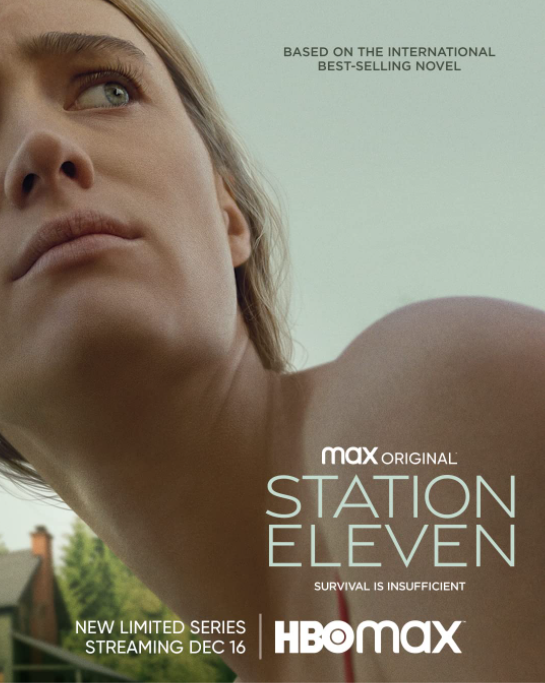
Station Eleven 1.4-5: Shakespearean Prophet


Well, if you thought Station Eleven wasn't dead serious, you'll give up any hope that it wasn't after you've seen episodes 1.4-5, up on HBO Max today.  No, only kidding, of course.  This is a series about the near extinction of the human species, so how could it not be deadly serious?  But I wasn't really kidding, if that makes any sense.   As serious and to-the-core frightening as this narrative was from the get-go, it's even more, a lot more so, after these two new episodes.

Before getting into why, let me say that the cinematography and music in this television series is an Impressionistic triumph.  The images range from the watercolor fields of Monet to the rage and confusion in oil of Van Gogh (nice phrase, right?).  And the music is some kind of riff on Debussy, though as far as I know none of the music in this TV series that is more like a movie was actually written by him.

[Ok, time for just one big spoiler ... ]

I guessed pretty early on in 1.5 that Tyler was, or would grow up to be, David aka the Prophet.  And in 1.4, we learn why Kirsten tried to kill him, and why he deserved to be.  I said in a review of the Succession season 3 finale that that ultra-contemporary series was Shakespearean.  Not to throw too many compliment bouquets, but the post-ultra-contemporary Station Eleven is Shakespearean, too.  It shouts that out literally from the stage at the beginning of the very first episode with King Lear.  And it continues that, with actors who speak as if they are on stage not screens,* in situations which are exquisite human tragedies.

Tyler's voyage in that airport was a sight to behold.   Although Station Eleven had this quality all along, that airport story for the first time tipped the balance from science fiction to horror, though the action was psychological, not blood and gore.  I'll also say, as the series completes its midpoint, though I know already that I'm going to think the series will conclude its first season far too soon.  And that's because it's taking so much time to tell its story, and I'm luxuriously bathing in, with a wary eye, every minute.

Station Eleven is quickly shaping up, with not much time left to contest it, as the best new science fiction series from a non-classic source on 2021 television.

*You can hear my Bronx accent in the audio podcast of this review:


See also Station Eleven 1.1-3: "Looking Over the Damage" Well Worth Seeing ... Station Eleven 1.6-7: Time, Blake, and Bosch


Thursday, February 13, 2014

Dimensions: Watercolor Time Travel

 photo Dimensions_zps05deebab.jpgWith another winter storm howling on the doors of New York, I took refuge in Dimensions tonight, a lushly beautiful 2011 British time travel movie, recently made available on iTunes and Amazon Instant Video.

The director, Sloane U'Ren, has previous credits as a set designer in television shows ranging from Alias to Six Feet Under, and it shows in Dimensions.  The movie, which tells a close-up story of a young scientist in 1920s England obsessed with time travel, moves like an Impressionistic painting from scene to scene, with images and textures and lenses that brush the soul.

There is a palpable innocence in the movie, which almost makes it akin to Primer, though Dimensions is barely about paradox and time loops.   It is rather about love, sought and lost, accidental and deliberate.   The movie also resonates with Daniel Faraday and Lost, which also has the charm of the young man as scientist -- though, again, Dimensions is manifestly not about the world-changing implications of the time travel we find in Lost.

The first part of the movie is indeed so uncontrived - a rarity for any time travel story - it almost seems like a YA or younger tale.  As the movie progresses, we get a romantic triangle of characters in their twenties.  The acting in this section is very good -  the most memorable coming from Olivia Llewellyn and Camilla Rutherford's quietly powerful performances, and good work from Henry Lloyd-Hughes as the scientist, too - and this more than the storyline makes this part of the movie blossom.   Antony Neely, whose main previous movie credits are in music, wrote the screenplay for Dimensions, and the story indeed progresses like a song, with versus and repeated chorus and bridge - an apt form for a time travel tale - or maybe an etude from Debussy.

Watercolors and tears, a story that moves like Donovan's "Wear Your Love Like Heaven," make Dimensions an unusual and even remarkable time travel story, which not only takes place in the 1920s but almost feels as if it was written and filmed back then, had such evocative color cinematography been available.  See it if you'd like a compelling introduction to what time travel could be, or the sense of wonder you had when you encountered your first time travel story at 12 years of age.

Other reviews of off-the-beaten-track recent time travel movies: 95ers: Time Runners: Original and Entertaining and I'll Follow You Down: Excellent Time Travel Movie

                ~~~ +++ ~~~

Enjoy time travel stories? check out


"one of those extremely rare sequels that end up better than its predecessor ... worthy of the title, blockbuster, if this were a movie ... by far the best time travel story I've ever read" - Scott Sandridge, SpecMusicMuse 


"resonates with the current political climate . . . . heroine Sierra Waters is sexy as hell . . . . there's a bite to Levinson's wit" - Brian Charles Clark, Curled Up With A Good Book

#SFWApro


And The Chronology Protection Case movie


podcast review of Dimensions and two other time travel movies

Tuesday, November 27, 2007

Further Genesis of "The Light That Time Forgot"

I now know what I think of as the "furniture" of this story. The metaphor comes from my editor at Tor for The Silk Code through The Plot to Save Socrates - David G. Hartwell - who likes to talk about "rearranging furniture" when plot elements and/or characters in a draft novel need a major overall. I'm using it here more in the sense of what you put in an empty house or room, after you've constructed it.

The house is "The Light That Time Forget" - otherwise known as the title. I know the story, anthology, novel, whatever will be about time travel. That's where I was a few days ago.

But yesterday afternoon, driving to Fordham University, I realized what the furniture would be - what the texture, characters, vehicle of the story were all about.

Watercolor. Impressionist painters. Better living through captured light. Better living through watercolor. Something like that...

Now, at this point, I'm going to go into sub rosa mode, and not talk about the story. First, I don't like talking about my writing on a blow-by-blow basis. Second, I have no idea how long it will take me to write this - could be tomorrow, could be next year, or much longer...

But I'll definitely keep you posted. And will of course acknowledge the good denizens of Second Life, if and when (ok, I'm pretty confident it's just a question of when) "The Light That Time Forgot" is published.

See also Genesis of a Title: "The Light That Time Forgot"


The Plot to Save Socrates


"challenging fun" - Entertainment Weekly

"a Da Vinci-esque thriller" - New York Daily News

"Sierra Waters is sexy as hell" - curled up with a good book


more about The Plot to Save Socrates...

Get your own at Profile Pitstop.com


Read the first chapter of The Plot to Save Socrates
.... FREE!
InfiniteRegress.tv