Chuck Todd interviews me about alternate histories
Showing posts with label Rob Sawyer. Show all posts

Saturday, December 18, 2021

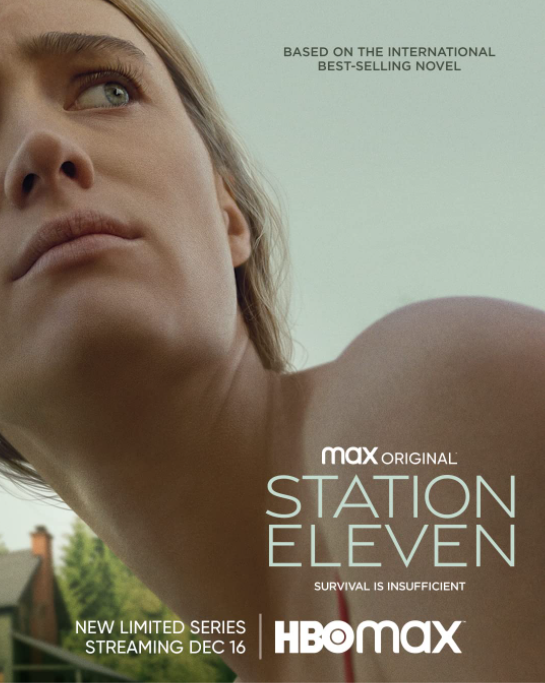
Station Eleven 1.1-1.3: "Looking Over the Damage" Well Worth Seeing


With Apple TV+'s  run of superb science fiction -- Foundation, Invasion, and Finch -- temporarily on pause, it looks like HBO Max has picked up the slack with a powerful new series, Station Eleven, a new Matrix movie up next week, and the first half of Dune this past October.  

The first three episodes of Station Eleven introduce us to a complex, perilous, beauty of a story.  It's a story about the passion and agony of creating art, about bringing a story into being.  And, oh yeah, it's a story about "the end of the world," due to a super-virulent (super-all-too-familiar) flu that kills over 99% of the population.

So, well, almost the end of the world (shows how we’ll we’ve actually done in our real, off-screen world),  and therein lies the heart of Station Eleven.  A heart within a heart, a play within a play, because Station Eleven is not only the name of this series, it's the name of a book that Miranda (outstanding performance by Danielle Deadwyler), a major character in this series, wrote.  (A much more appropriate meta than what Facebook says it's becoming, I would say.)  And the book is no mere prop for a meta-title.  It's something that "ruined my life," as said by Miranda and her husband.

The series unfolds in a mode first perfected in Lost:  now, or close to now, when the extinction-level pandemic strikes, and twenty years into the future, when we see how a small group of survivors struggles and (at this point) perhaps triumphs in a way.  When we're in the now, we see flashforwards (the plural of Rob Sawyer's excellent term); when we're in the future, we see flashbacks to the present.  This makes the story a little difficult to follow, but it's worth that price.  Station Eleven, in just three episodes, has already unfurled a rich, memorable tapestry of characters and humanity, as they "look over the damage," another one of the mantras of the series.

[Spoilers ahead ... ]

It's already left us with all kinds of questions.  Why, exactly, did Kirsten (well played by Mackenzie Davis, with great facial expressions that in themselves tell the story) try to kill that guy (Prophet?) in episode 1.2?  Because he said Kirsten and her troupe were "monsters"?  I doubt it's because she has that thin a skin. Because he told Kristen that some of her friends would start to "disappear"?  He didn't say he would make them disappear. There must be more to that stabbing, but that's good grist for the continuing narrative.  

I'll also mention that this series -- based on the novel by Emily St. John Mandel that I haven't read -- is evocatively photographed and accompanied by outstanding music, including Dylan's "Don't Think Twice."  I'm not going to think twice about continuing to watch this vivid series, and I'll be back here with reviews.


See also Station Eleven 1.4-5 : Shakespearean Prophet   ... Station Eleven 1.6-7: Time, Blake, and Bosch

Saturday, January 30, 2016

Book Salon at McLuhan Centre Coach House in Toronto about McLuhan in an Age of Social Media

I had a wonderful time this past Wednesday evening at the McLuhan Centre Coach House at the University of Toronto.  It was great talking to former students and old friends Ira Nayman and Hugh Spencer center stage, and Marc Belanger,  Paolo Granata (thanks for inviting me), Paul Kelly, Alex Kuskis, Bob Logan, and Dominque Scheffel-Dunand before, during, and after the salon.  And it was a real pleasure meeting Gisela McKay, David Nostbakken,  Joel Alleyne, and Donald Gillies, not to mention  many others whose names I didn't catch.  (And Rob Sawyer and Caroline Clink at the airport.)

Photos of the event follow below.  And you might enjoy this little smorgasbord of Tweets about the discussion, compiled by Leora Kornfeld (Berkman Center for Internet and Society, Harvard University).


Hugh Spencer, Paul Levinson, Ira Nayman


Hugh Spencer, Paul Levinson, Paolo Granata, Ira Nayman


Paolo Granata, 3 people, Dominique Scheffel-Dunand, Bob Logan,
Marshall McLuhan, Alexander Kuskis


Hugh Spencer, Paul Levinson, Ira Nayman, 2 people, doorway,
more people, Paolo Granata, 2 people, Dominique Scheffel-Dunand,
Bob Logan, Alexander Kuskis, and over some heads, Marshall McLuhan


Saturday, May 3, 2014

Jose Antonio Vargas' Documented - A Review

Tina and I had the pleasure of seeing Documented tonight, Jose Antonio Vargas's auto-biographical documentary about the struggle of undocumented Americans - known in the popular culture as "illegal aliens" - to achieve their just place in American society.   Tina and I each have a little good history with Jose.  Tina was interviewed by him about her work on Wikipedia's political pages in 2007, for a front-page article in The Washington Post.  And Jose and I talked politics and the Internet on Dylan Ratigan's MSNBC show in 2011.  Still, if I hadn't liked the movie, I wouldn't be reviewing it.  And if I had any problems with the movie, I'd say so in my review.   As it is, I found the movie nothing but exceptional.

The movie in effect was presented in two intertwining parts - Vargas's political battles after he came out as an undocumented American, and the personal travails of not having seen his mother in 20 years. The political part of the movie is much like Michael Moore's best work, with one big advantage: Vargas is not only investigating how the cards have been stacked against undocumented Americans, he is an undocumented American himself.  Thus, when he objects to being called "illegal," his complaint comes from a directly wounded heart.  Frankly, the term "illegal alien" is idiotic in any case - where I come from, an alien comes from another planet (science fiction writer Rob Sawyer captures this well in his novel Illegal Alien) - but Vargas is able to demonstrate how being called an "illegal" is an insult to any person working hard in this country, regardless of where they were born or how they got here.   We see Vargas's tears when he learns about Obama's giving undocumented Americans a path to citizenship - but only if they're under 30 years of age - and this provides as accurate an assessment as ever I've seen of Obama's Presidency and its failure so far to take the full steps needed to set America on the right path on more than one crucial social issue.

You might be wondering how Vargas got into this country and managed to become a reporter at The Washington Post without the proper work visa.   This gets into the second element of the movie, which shows us how Vargas arrived here as a 12-year-old, to live with his grandparents, with his mother back in the Philippines.   His grandfather arranged for a doctored green card for Jose, who had no knowledge of what had happened until later on.   Meanwhile, Jose's mother was unable to even visit him in America, because she had no employment back in the Philippines to support her visa application.   The impact of this separation on Jose was painful, to say the least, and continues to this very day.   An emotional highpoint of the movie is the healing that begins when Jose has a difficult Skype reunion with his mother and half-siblings on the other side of the world - it's easily the most effective Skype conversation scene I've seen to date in any movie or television series.

What becomes searingly clear as the movie progresses is the absurdity of our immigration policy - an absurdity which is self-destructive not protective of the best in America.  That a man who has lived such a life and made such a movie could be considered either illegal or alien shows how far our country has veered from its original ideal of all people created equal.   We were and are a country of immigrants, and we're fortunate indeed to have an immigrant such as Jose Antonio Vargas bravely working on behalf of our better natures.   In fact, he could be deported any day for his coming out as an undocumented American - Obama does deserve credit thus far for not deporting him - and this movie provides an inspiring testament to this American whose work is still in progress.


Thursday, April 22, 2010

FlashForward 1.17: Mark, Demetri, and Hari Seldon

Robert J. Sawyer - author of the novel FlashForward on which the TV series is based - told me in our interview at the I-Con science fiction convention in Stony Brook, New York at the end of March that, before the season was over, I'd be standing up and cheering for Mark Benford.  I don't know if tonight's episode - 1.17 - was the one Rob had in mind, but I was certainly cheering.

The fate of Demetri hung in the balance tonight.  In FlashForward time, tonight was March 15, 2010, the day foretold and seen by Nhadra (Behrooz's mother from 24) as the day of Demetri's death.   Zoey's flashforward vision of their wedding, after March 15, which she realized was Demetri's funeral, added credence to what Nhadra saw.  So did the fact that Demetri had no flashforward vision at all.

Gibbons/Frost is holding Demetri prisoner, tied-up in a get-up of wires connected to a gun pointed right at his heart.   Any movement by Demetri, any attempt to put something in way of Demetri and the gun, will cause it fire.

It's not 100% clear what Frost wants out of all of this, but it has something to with stopping his own death, which he has also foreseen for this day.    Frost leaves a set of clues with Charlie, whom he talked to on the bench in the amusement park.

Mark first races brilliantly to get to Frost, in the best action sequence so far in the series.   He gets to Frost with just a little time left to save Demetri - Frost has left Mark a literally ticking clock - and Mark gets the drop on Frost-

Only to see Frost shot to death by Alda (female terrorist) who has escaped.   The Frost's death part of Frost's visions for the day has come true.   Will Demetri's?

Mark risks literally fulfilling Nhadra's vision - Mark killing Demetri with Mark's gun - by trying to turn the gun at least a little away from Demetri.   With seconds left - and with Demetri's life literally up for grabs by fate, because we've seen that most of the flashforwards do come true - Mark succeeds.   Demetri's death didn't happen, just as Gough's death did, both contrary to all the flashforward visions that have irresistibly, recalcitrantly,  come to be.  All that's shot is Demetri's picture on the timeline Frost has created on the wall.

It's a timeline that shows events well into the future - teeming with interconnections, like a Hari Seldon psychohistory map (see Asimov's Foundation novels) - come to life in today's Los Angeles.   But as soon as Demetri leaves the chair to which he's been confined, that map turns to sand and dissolves into the instant like an emptying hour glass.   One last trick of Gibbons/Frost.

You couldn't ask for anything more from this top-notch episode - written by David Goyer and Lisa Zwerling - except more tricks to come in the future.


7-min podcast review of FlashForward

See also FlashForward Debuts and Oceanic Airlines as a Portal Between FlashForward and Lost ... 1.2: Proofs and Defiance of Inevitability ... 1.3: Conficting Visions and Futures ... 1.4: FlashForward Meets Shaft and House ... Drunk FlashForwarding in 1.5 ... Across the Universe in FlashForward 1.6 ... FlashForward 1.7: The Future Can Be ... FlashForward 1.8: The Nightie as a Grain of Sand ... FlashForward 1.9: Shelter from the Storm ... Olivia Benford at Harvard in Flashforward 1.10 ... Flashforward 1.12 Parts 1 and 2 ... FlashForward 1.13: Aaron's Daughter, Mark's Gun, and Magpies ... FlashForward 1.14:  Somalia, LA, Fate Irresistible and Resistible ... FlashForward 1.15: Who's That Lady? ... FlashForward 1.16: Mark's Gun and Demetri's Wedding

Listen to 40-minute interview with Robert J. Sawyer

Listen to podcast about Asimov's Foundation series

Save Flashforward!! - Let ABC know you love it!


Special Discount Coupons for Angie's List, Avis, Budget Car, eHarmony, eMusic


The Plot to Save Socrates


"challenging fun" - Entertainment Weekly

"a Da Vinci-esque thriller" - New York Daily News

"Sierra Waters is sexy as hell" - curled up with a good book
 

Thursday, March 18, 2010

FlashForward 1.12 parts 1 and 2

FlashForward came back on ABC tonight with a double episode - two new hours (Episode 12, Parts 1 and 2 - Episode 11 was the recap) - of which the last 20 minutes or so were superb.

Let's talk about that first.   I wrote in my review of the premiere episode about the "mysterious hooded figure who did not black out (he's caught on a video taken at a stadium - I suspect he's the character played by Dominic Monaghan, by the way, but that's just a guess)".   I was glad to see tonight that I was right - he is Simon, played by Dominic Monaghan, indeed.

I also enjoyed Simon's story, and the good twist at the end of the two hours.   His story is that he is being run by the nasty character played by Ricky Jay, who arranged for Simon to be at the stadium with a magic (ok, quantum entanglement) ring that kept Simon and Ricky (who also had a ring on his finger) from blacking out and flashforwarding.   When I say Ricky is nasty, I'm being kind.   He kills Simon's father and teacher (two different people), has Simon's sister kidnapped, tortures Simcoe (Ricky's guys did the kidnapping of Simcoe we saw in December), and faux-tortures Simon, who nonetheless loses a finger in the pretense.   Ricky reps a group who want to use the blackout for their own benefit - whatever that is (we don't yet know) - and are not all troubled by killing millions of people.  And the twist?   Ricky tries to squeeze Simon into further service, and Simon kills him.  Just like that.  Didn't see it coming.  A fine twist.   And I liked when Simon tells Ricky that he doesn't want to deal any more with just "the middle man".

As for the rest of tonight - I thought that FlashForward had some fine ingredients going in.  Characters struggling to prevent the future they saw, others struggling to make sure it happens, and, with one exception, not being able to do anything to stop it - in fact, for the characters trying to stop it, the more they try, the more they seem to be making it happen.   Mark is the best example of this, trying to keep what he saw in his future from happening, but investigating this case in a way, seemingly beyond his control, which usually makes the very pieces of this future fall into place.  The only character who seems to break out of this is Al Gough, who stops the future he doesn't want - he apparently kills an innocent woman - by taking his own life.

I continue to find these ingredients highly compelling - in particular, why Al was apparently able to  stop his future.   Tonight's two hours made the significant move, late in the story, of establishing that Simcoe in his flashforward in Olivia's house was talking on the phone to Mark in his office, thus tying Mark's, Simcoe's, and Olivia's flashforwards provocatively together.  It was also good to see Sleeper Cell's Michael Ealy continue in his CIA-agent role on the show.  But 1.12 otherwise did little to advance the central stories, and instead introduced a new character, a window cleaner who survives the blackout and finds the Almighty.   I think an intelligent discussion of faith and how it could play in the flashforwards could have added a significant element to the story.   But the born-again window cleaner's voice-over narration just didn't do that for me. 

FlashForward has had two show-runners replaced since the Fall.   The show is still based on a tip-top novel by Rob Sawyer, and has taken that story in powerful directions.   But we need to see more of Simon - or stories that have the punch of his - and less of the window cleaner's.


6-min podcast review of FlashForward

See also FlashForward Debuts and Oceanic Airlines as a Portal Between FlashForward and Lost ... 1.2: Proofs and Defiance of Inevitability ... 1.3: Conficting Visions and Futures ... 1.4: FlashForward Meets Shaft and House ... Drunk FlashForwarding in 1.5 ... Across the Universe in FlashForward 1.6 ... FlashForward 1.7: The Future Can Be ... FlashForward 1.8: The Nightie as a Grain of Sand ... FlashForward 1.9: Shelter from the Storm ... Olivia Benford at Harvard in Flashforward 1.10

Listen to 40-minute interview with Robert J. Sawyer

Special Discount Coupons for Angie's List, Avis, Budget Car, eHarmony, eMusic, Nutrisystem


The Plot to Save Socrates


"challenging fun" - Entertainment Weekly

"a Da Vinci-esque thriller" - New York Daily News

"Sierra Waters is sexy as hell" - curled up with a good book
 

Tuesday, January 29, 2008

The Pixel Eye looking at Toronto

And, just to leaven all of this politics with a little science fiction-

My good friend, the dean of Canadian science fiction Rob Sawyer, just wrote to me that

The Merril Collection of Science Fiction,
Speculation and Fantasy is having a special display
called "What Dunnit?", featuring SF detective stories,
and THE PIXEL EYE was prominently displayed, as you
can see.


And he sent along the following photo-

Photobucket
InfiniteRegress.tv