Chuck Todd interviews me about alternate histories
Showing posts with label Albert Einstein. Show all posts

Sunday, March 31, 2024

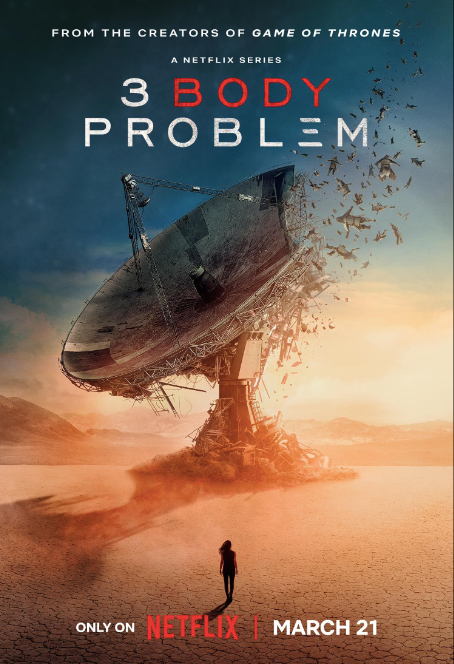
3 Body Problem: The Joke Was Great, and the Last Few Episodes Were Even Better


I haven't read the novel by Liu Cixin and its sequels, and I didn't read much about the series because I wanted to be surprised.  I'd say the first season of 3 Body Problem was superb -- a powerful mix of thought-provoking, stunning action, and heartbreaking human stories, all in support of a story of a life-threatening interstellar intelligent species, the San-Ti, who have been in contact with our planet for more than 50 years and now are approaching us, some 400 years away from arriving, which may mean the end of our species.  And there was a wise and funny joke about Einstein and God which I hadn't heard before.

But almost all of that happened in the last few episodes, and the beginning and middle of the eight-episode first season was bogged down with a computer game the interstellar beings are doling out to various people on Earth for various reasons.   I've always enjoyed science fiction about computer games interacting with reality, beginning with Orson Scott Card's path-breaking and brainy Ender's Game, but its situation in 3 Body Problem was needlessly repetitive.  The heart of 3 Body was closer to Arthur C. Clarke's Childhood's End and Damon Knight's "To Serve Man" (see this collection of Knight's stories), and the first season of the 3 Body television series, whatever may have been done in the novel, should have spent more time on that.  (This slow start is reminiscent of another iconic novel in science fiction, Frank Herbert's Dune, that also took a long time to get going, but once it did was fabulous, and led to not just a trilogy but a whole series, exceeded in excellence only by Isaac Asimov's Foundation novels, in my opinion.)

But speaking of hearts and brains, biology was actually far more the star of the first season than was space travel.  This puts 3 Body Problem in a league with Andrew Niccol's debut motion picture Gattaca.  If I'm making 3 Body sound derivative, that's because it is, but that's ok, because the first season puts all of these perennial elements of science fiction together in an original, compelling way.  It's not every day you see a science fiction series starting in Mao's China and its emphasis on ideology over truth (a problem unfortunately arising now in the United States and other parts of the world, off the fiction screen and for real), moving into a life-and-death James Bondian present fighting for the survival in the future of our very species.  

Ironically, the unflattering depiction of intellectual life in Mao's China at the beginning of the 3 Body Problem television series contradicts the warning that five Republican US Senators sent to Netflix in 2020 that the TV series would just be spreading Chinese propaganda. Of course, those Senators and no one other than the creators of the TV series had any idea what would actually be depicted in the TV series, and thus those Senators based their concerns on the novel. The original Chinese publication of the novel indeed did not begin with the jolting scene of a physicist brutally killed in the throes of the cultural revolution -- because he believes in truth over ideology -- but that scene did appear in the middle of the original Chinese novel, and at the beginning of the English translation (Liu Cixin confirms that he wrote the novel with that scene at the beginning). Apparently those US Senators didn't take the time to read the novel before offering their ill-founded concerns about the TV series.

In any case, I don't recall seeing anything quite like this TV series at all, and I'm eagerly awaiting the second season and more.  The dialog, by the way, was excellent, as was the acting.  Nearly everyone was new to me, other than Game of Thrones' Liam Cunningham, and it was good to see him on the screen again. Kudos to David Benioff, D.B. Weiss, and Alexander Woo for creating the series, and kudos to me for not having to warn you about spoilers in this review, because they really aren't any, are there?


Saturday, May 28, 2016

Outlander 2.8: The Conversation

The most interesting part of the just-concluded Outlander 2.8 - for the devotee of time-travel - is the conversation between Claire and Jamie at the beginning.

Claire tells Jamie that "history dictates" that the Scots will fail in their battle against the English.  She of course knows this from her vantage point from the future - which says all of their work to break free of the English will be in vain.   But Jamie counters that Claire has already changed history - as when, for example, she stopped an outbreak of smallpox in Paris with her knowledge of the illness garnered in the future 20th century.

But the problem with such examples is that they are unknown to us - that is, the viewers.   We have no record of a smallpox outbreak in mid-18th-century Paris stopped by a woman wielding white magic or some kind of 20th-century knowledge of epidemics.   Thus, while Jamie's examples may be impressive - at least, somewhat - to Claire, they aren't to us, upon any kind of more careful consideration.

In order for a time-travel story to be truly impressive about changing the past to change the future, it has to show us a future different from what we know.  Otherwise, it can still be impressive, but it must do that in other ways.

As the conversation between Claire and Jamie continues, she says that their failures to change history and stop the English thus far, and their continuing to try, over and over again, is a sign of "insanity" - more precisely, Claire says "they say" it's a sign of insanity.   Jamie's clever retort is "they" likely never heard of time travel.

Now, in our reality, the definition of insanity as "doing the same thing over and over again and expecting different results" is most often attributed to Einstein.   Which is interesting,  since Einstein certainly knew about time travel - at the very least, of its appearance in H. G. Wells' The Time Machine, which is the effective grandsire of all 20th- and 21st-century time-travel stories, including Outlander - which deserves credit for at least delving into these fascinating metaphysical labyrinths, if not (yet) coming even remotely close to resolving them.  But that's ok - there's still time (travel).


See also Outlander 2.1: Split Hour ... Outlander 2.2: The King and the Forest ... Outlander 2.3: Mother and Dr. Dog ... Outlander 2.5: The Unappreciated Paradox ... Outlander 2.6: The Duel and the Offspring ... Outlander 2.7: Further into the Future

And see also Outlander 1.1-3: The Hope of Time Travel ... Outlander 1.6:  Outstanding ... Outlander 1.7: Tender Intertemporal Polygamy ...Outlander 1.8: The Other Side ... Outlander 1.9: Spanking Good ... Outlander 1.10: A Glimmer of Paradox ... Outlander 1.11: Vaccination and Time Travel ... Outlander 1.12: Black Jack's Progeny ...Outlander 1.13: Mother's Day ... Outlander 1.14: All That Jazz ... Outlander Season 1 Finale: Let's Change History


Sierra Waters series, #1, time travel

#SFWApro


Wednesday, March 26, 2014

Book Review: Redshift Rendezvous by John Stith is Perfect Science Fiction Mystery Hybrid

I've published dozens of reviews of science fiction novels by well-known and little-known authors in the past few decades, in the New York Review of Science Fiction, Tangent, the Journal of Social and Evolutionary Systems, and other places.  I thought it was time to begin putting these reviews up on this blog, one or two a month, right alongside the more numerous reviews of television series.

To start, here's my 1992 review, published in the Journal of Social and Evolutionary Systems, of John Stith's  Redshift Rendezvous (Ace, 1990, 256 pp.), now available on Kindle.   People often ask me to name a science fiction/ mystery hybrid that really works.  Isaac Asimov's robot stories (in contrast to his faster-than-light ships in space) are a good example.   And then there's Redshift Rendezvous, in some ways even truer to the hybrid ideal ...


Faster than light travel has been one of the most intriguing and frustrating challenges of science fiction, which generally distinguishes itself from fantasy by writing about technologies and events that are at least scientifically plausible. But according to Einstein's theory of special relativity, movement at faster than light speeds is flatly impossible, and the slightly more lenient theory of general relativity insists that objects attain infinite mass at light speeds. So how, then, is science fiction to write about human relations across star systems and galaxies in human time frames?

One approach might be to contest Einstein's proscriptions on super-luminary travel on scientific or philosophic of science terms. If we agree with the philosopher Karl Popper that even the best corroborated scientific theories are nonetheless highly fallible and destined for falsification -- as Einstein himself did -- then fiction writers should have little trouble amending Einstein much the same as Einstein amended Newton. But not many science fiction writers seem aware of Popper, or indeed sophisticated discussions of philosophy of science, at least insofar as these might pertain to speed of light.

The result has been a science fiction that by and large has repealed Einstein without much of a hearing. Whether the hyperspace drive of Asimov in the 40s or the warp drive of Star Trek and most else in between, travel at faster than light speeds has been more of an assumption than a challenge in a genre which is supposed to engage rather than subsume technological puzzles. (Cryogenic solutions that posit transport of frozen humans to be wakened upon reaching their destination at least have the merit of not ignoring Einstein. Frank Herbert's approach of beings "folding" space in the Dune series has an Einsteinian plausibility, but relies a bit too much on the quantum mechanical idea of mind pushing matter to be satisfyingly scientific.)

Even more disappointing than the repeal by fiat of Einstein has been science fiction's treatment of human relations in the faster than light environments. That treatment has usually been a simple transplantation of human dynamics from Earth to far vaster realms, with the assumption that travel from here to Tau Ceti and beyond should in principle be no different in terms of human effects than our capacity to easily travel now from New York to Los Angeles. But history and philosophy of technology have shown over and over again that new modes of transportation profoundly transform their passengers -- the medium is the message, as McLuhan pointed out, whether communication or transportation -- and science fiction that treats a trip across the galaxy as no different in human principle than a trip across the country thus shortchanges its readers.

Which is why John Stith's Redshift Rendezvous is so refreshing. The book is in many respects a standard adventure of murder and hijacking in space. But in one crucial regard this book is extraordinary in science fiction: it deals with the human detail of faster than light travel. Indeed, speed of light and its consequences is the real hero of this book.

The "Redshift" is a ship that travels faster than light, and Stith posits that speed of light inside the ship is therefore reduced to some ten meters per second, or 30 million times slower than its usual speed. This is far from always pleasant, and passengers are advised to keep their lifebelts on at all times (in order for their neural chemistry to operate at normal speeds), and trust their kinesthetic rather than optical perceptions.

Simple dining can be very interesting in this environment -- a morsel of fish turns indigo as it enters its eater's mouth and life field -- but committing and solving murders are even more so (the latter can be done by removing the victim's lifebelt). The chief security officer single-handedly manages to nearly disable an entire terrorist crew by virtue of his superior understanding of human movement and vision aboard his ship, and in the end he calls upon the physics of the ship's corridors to quite literally hoist the villain on her own petard.

If you like your science fiction to treat faster than light travel with a bit more respect than Dorothy clicking her heels together three times to go from Oz to Kansas, you'll enjoy this book. I look forward to return voyages on the Redshift and other Stith vessels that speculate on the stretching of natural laws and its effect on humans.


"As a genre-bending blend of police procedural and science fiction,
The Silk Code delivers on its promises." - The New York Times Book Review

#SFWApro
InfiniteRegress.tv