Chuck Todd interviews me about alternate histories
Showing posts with label nuclear weapons. Show all posts

Sunday, October 26, 2025

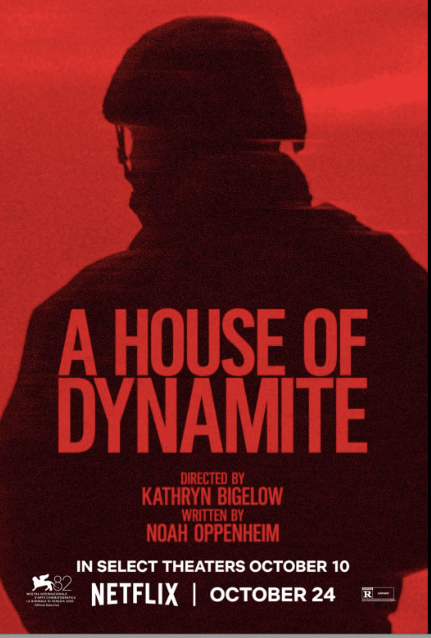
A House of Dynamite: MAD -- Mutually Assured Destruction -- In Our Day and Age


I grew up in a world in which Dr. Strangelove was a plausible movie, a world in which we lived with the Soviet Union, armed to the teeth with nuclear weapons, as were we, and our best chance that we wouldn't blow up the Earth, if not to smithereens, to an uninhabitable planet, was MAD -- the mutually assured destruction that a nuclear war would engender, which would stop we human beings from ever starting such a no-win war.

As A House of Dynamite on Netflix tells us, at the beginning, we the world gradually learned to scale down our armaments, but the world has gone back to at least verbal apocalyptic belligerence in the past decade, with Russia, in particular, refusing to rule out nuclear weapons if the US and NATO attacked it in response to the Russian attack on Ukraine, or maybe if we gave Ukraine too much assistance.

[Spoilers ahead ... ]

A House of Dynamite posits such world in which a missile is launched towards the United States.  Attempts to intercept it with our missiles unaccountably fail.  Maybe our defense system has been compromised by prior surreptitious cyber attacks.  Maybe the system wasn't that effective in the first place. We’re told that stopping a missile like that is like “a bullet hitting a bullet”.

We soon learn that Chicago is the target.  (Here I'll say that the movie was made before Trump unconstitutionally targeted Chicago for National Guard deployment.  Just sayin'.)  We see this story play out from three different simultaneous angles, from the standpoints of American military and political leaders and personnel.  The actors are top notch: Idris Elba as US President (he's been great in everything I've seen since Stringer Bell in The Wire), Jared Harris as Secretary of Defence (Hari Seldon in Foundation), and Rebecca Ferguson as a Captain who finds herself heading the White House Situation Room (Juliette Nichols in Silo), are just three of many examples.

All three stories end with the missile seconds from hitting Chicago, and the President struggling to make a decision.  Retaliate?  Against which country?  Russia, China, North Korea?  And what kind of retaliation -- how much of the presumed enemy will be destroyed?  How much of the Earth will be left inhabitable?

And here the movie ends.  Right.  Just like the last scene of The Sopranos.   We the audience need to fill in the ending.  Or at least think about it.   Is this good movie-making?  I actually thought it worked great in The Sopranos (see my reviews, beginning here, for what I think happened to Tony).  But The Sopranos was clearly a totally fictitious story about familiar characters in our reality.  A House of Dynamite is fiction, too, but somehow seems less a fiction, much closer to our reality, the world I grew up in, the world we now inhabit.

And as a denizen of that world, I found the ending unsatisfying.  But maybe in such a scenario there is no narratively satisfying ending.  A happy ending would have been the missile hitting Chicago with no bomb, or no bomb going off.  Deputy National Security Advisor Jake Baerington (played by Gabriel Basso, who believe it or not played J. D. Vance in Hillbilly Elegy) tells the President this a possibility, in an attempt to caution him not to launch a massive nuclear counter-strike.  This of course goes against the military advice of General Anthony Brady (Tracy Letts, Elvis and Nixon -- hey, it's a movie about a President).

So who would the President listen to?  I'd hope it would be Baerington not Brady.  But maybe that's not realistic, after all.  

Friday, May 10, 2019

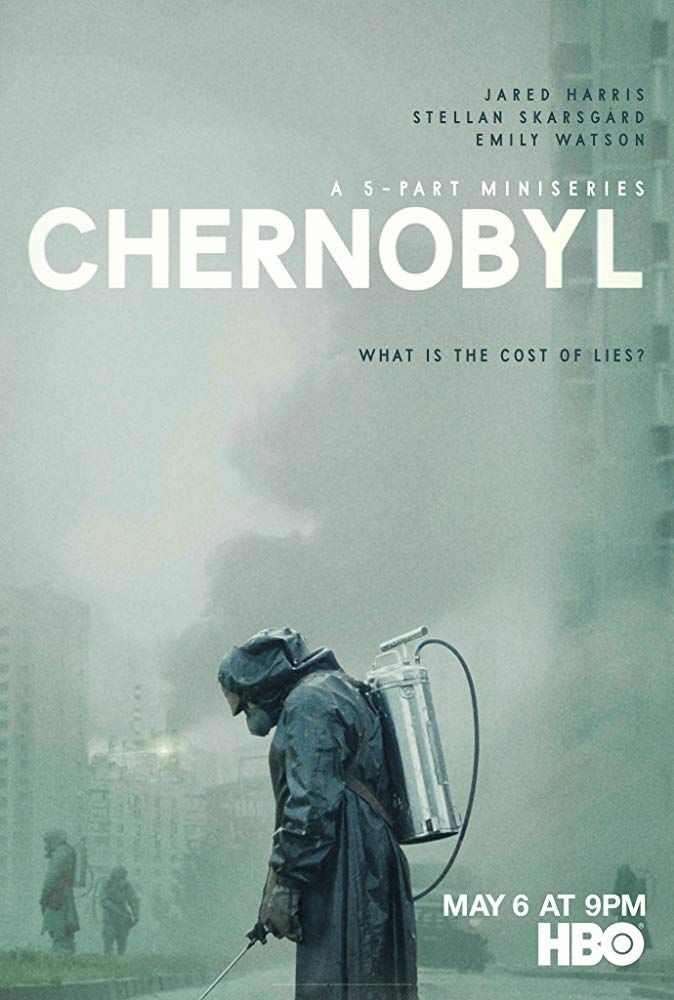
Chernobyl 1.1: The Errors of Arrogance


Tampering with Mother Nature has its risks, and there's probably no greater tampering than messing with the atom.   The stark dangers are paramount not only in the use of nuclear weapons, but, unfortunately, in the attempt to harness the power of the atom for peaceful purposes, such as the production of energy.   Three Mile Island in the US, Chernobyl in the Soviet Union, and Fukushima Daiishi in Japan are examples of what can go very wrong at a nuclear power plant.  Chernobyl, with anywhere from 4000 to 200,000 deaths resulting for the explosion of its core, is far and away the worst.

Its story is therefore manifestly right for docu-drama treatment.   And it's about much more than what can go wrong at a nuclear power plant.  It's about how a totalitarian regime is singularly unfit to deal with the aftermath of a nuclear disaster, and in terms of ultimate loss of life, makes the consequences of the disaster much worse.

In the first episode of Chernobyl, we see this writ large.  All but a handful of people at various levels minimize the destruction of the core, even though they're repeatedly told by close observers that it no longer exists.   The level of roentgens (radiation) is said to be 3.2, even though administrators are repeatedly told that's the highest level on the small device making the measurement, meaning the device can't show a higher level.  And when a more sophisticated device is brought in, with an upper limit of 200 roentgens, the powers that be make the same mistake.

One of the administrators sitting around the table in a bunker says everyone in the area should be evacuated as fast as possible.  He's overruled by a higher up who sees the event as a great opportunity for the Soviet Union to demonstrate its capability of dealing with the accident and keeping the public calm.

Errors like this, self-inflicted, did far more damage that the explosion itself.   The question that all of us in 2019 must ask is:  are we better at avoiding those errors of arrogance now than the Soviet Union was in 1986?


Monday, June 26, 2017

Twin Peaks: The Return 1.8: Atom Bomb and Mr. Homn

Anyone who doubted that Twin Peaks is one bizarre science fiction horror story of a story got their answer tonight in episode 1.8: it is, with a vengeance, spun of gut-wrenching, stomach-churning, searingly mind-blowing wordless narrative the likes of which you don't often see on any television, unless you're maybe watching Donnie Darko someplace the 20th time.

Also - I'm pretty sure we got an answer of sorts to what brought the alternate reality or realities into being: the first atom bomb test in White Sands, New Mexico in 1945.  This indeed was first atom bomb ever exploded (as far as I know) on this Earth, and who knows about the universe.  If I'm getting the silent movie correctly, which was the most powerful part of tonight's extraordinary episode, that first atom bomb brought into being the alternate reality or alternate universe and all the insanity it's brought us in all the Twin Peaks stories.  You could almost hear the atoms crying in anguish as they were torn apart - more than enough to create an alternate reality.  (Come to think of it, that's how Bizarro Superman was brought into being.)

At very least, we saw Laura Palmer's iconic young face in the little globe that was one of the products of what the blast wrought.  Also spawned tonight and a decade after the blast was a homicidal maniac - the woodsman - who only wants a light, but kills the receptionist and dj at the radio station playing The Platters' "My Prayer," and whose talking into the microphone (the woodsman's, that is) in turn kills more people, including a teenager who was just kissed but later has some grotesque insect with maybe human legs crawl into her sleeping or dead mouth (I told you this was horror - of the classic 1950s variety, raised or razed up a notch, to be more precise).

The one thing we can't be sure of is whether the atom bomb brought into being the alternate reality, or whether the alternate world already existed but was understandably agitated and aggravated by the bomb.  Doesn't ultimately matter, though, because it probably all amounts to the same thing.

None of this has any discernible connection to our 2017 story - though, hey, an atom bomb creating an alternate monstrous world should be enough of a story for one hour.  But we do get a significant step forward anyway in that 2017 story, at the beginning, when evil Cooper is killed, but monsters from the alternate world bring him back to life.  It's tough indeed to get rid of bad guys in this nightmare.

I was hoping against hope that the atom bomb would waken good Cooper from his stupor, but I guess it's still too early in our story at this point for that to happen, and since the atom bomb was already exploded in 1945, long before Cooper was put in his stupor, it wouldn't make sense for that same bomb to now bring him out of his stupor.  (There is some underlying logic in this story - at least, I hope so.)  But it was great to see Mr. Homn aka Carel Struycken again, from Star Trek: The Next Generation.

I'll tell you one thing: I'm glad I've been listening these days to Sirius/XM's Beatles channel in my car and not any broadcast radio.   That atom bomb couldn't have an effect on satellite radio - uh, could it??

See also Twin Peaks: The Return 1.1-2: Superluminal Sans Cherry Pie ... 1.3-4: Coffee and Cole ... 1.5: The Mod Squad Meets Big Love in the Diner ... 1.6: Red Door and Childish Scribbles ... 1.7: Lost and Not Lost


FREE on Amazon Prime

Available on Prime

Thursday, May 12, 2016

The Day After The Americans 4.9

A good, even gripping episode of The Americans 4.9 on FX last night, which featured all of our major characters, including the Soviets in Washington, DC, watching The Day After, the movie on ABC which attracted more than 100 millions viewers when it was first broadcast in 1983, still a record for a TV-movie viewing audience.

It was one of the more brilliant strokes in the deft mix of real then-current events, usually via news reports, into The Americans narrative.   It allowed Elizabeth to tell Paige that stopping a nuclear war was what Elizabeth and Philip have been trying to accomplish with their work, and that the only atom bombs thus far used in a war were the ones dropped by the Americans at the end of World War II against Japan.   It's a sobering and important point - and it's good to know that here in 2016 we have managed to not yet do that again.   Another reason to vote for Hillary not Trump in our Presidential election, but I digress.

The other good part of this episode was Elizabeth faking sleeping with the husband of her Korean mark Hee.   She drugs him, comes on to him a little before he passes out, then undresses him, and sees to every detail to make him think he slept with her when he awakes, including putting a little cream on his ... when he's out cold.   You've got to, ah, hand it to Elizabeth, she's a master of making her deceptions real.

And speaking of deceptions, the disguises for Elizabeth and Philip were superb in the episode, so good in fact that William compliments Philip on his, saying it's his best one yet.   William is right. Indeed, this is easily the best disguise Philip has had on all season, and one of the best of the series.

The Pastor story is still simmering, and it will be fun to see what happens with this next week.


Saturday, July 18, 2015

The Bomb: Flirting with the End of the World

I just saw a new documentary about the most powerful technology - nuclear weapons - not only in our lifetime but in all of human history, courtesy of PBS, where The Bomb is set to air for two hours (8-10pm) on July 28.  I always judge a documentary by what I've truly learned from it that I didn't know, or didn't know enough about, before.  There were several such moments in The Bomb including
  • Some historians believe that Truman never ordered the dropping of the first two atom bombs on Japan in 1945 - which fortunately turned out to be only time a nuclear weapon was used in anger, as one of the historians commented in the documentary. Truman instead just let our military continue on the path it had begun under FDR - making the dropping of those first two atom bombs almost an effect of inertia rather the result of a deliberate Presidential command.  (Truman did, however, order the development of the hydrogen bomb, a few years later, in a futile attempt to stay ahead of the Soviets in nuclear weaponry.)
  • It was the hilly terrain of North Korea that was primary reason we didn't use nukes against them in the Korean war - more specifically, our experts thought the hills would blunt or weaken the impact of the nuclear weapons, and we didn't want to advertise to our Soviet adversaries that the weapons had limited capabilities.
  • JFK called his predecessor Eisenhower for advice in the early days of the Cuban missile crisis. I think I knew that, but I hadn't heard the actual recording of their conversation before, in which Kennedy nervously laughs several times, in a tone that says everything about how worried he was.
  • The bikini bathing suit was named after Bikini Atoll, where atomic tests took place shortly after World War II - I knew that, but I liked the quote of the French swimsuit designer that he hoped the name would call attention to the "explosive" effect that the skimpy bathing suit would have.
That last was about the only humor in The Bomb, which is only appropriate, given the grave business of nuclear weapons.  Seen as a connected story, from the discovery of fission in Germany in 1938 to the end of the Cold War in 1991, that narrative could almost have concluded with a happy ending: Kennedy and Khrushchev pulled back from the brink of nuclear war in the Cuban missile crisis, and their successors had the good sense to continue to show restraint and even put a lid on nuclear expansion.   But as The Bomb makes all too clear, the US and Russia are now and have long been not the only countries on Earth with nuclear arms.

Perhaps the agreement reached just a few days ago with Iran will halt that country's development of nuclear weaponry - The Bomb of course was made well before that announcement - but what The Bomb nonetheless tells us is that nuclear capability cannot be unlearned, and, if the human race is to survive, we must continue to learn how not to use it.

See this documentary for a vivid depiction - with breathtaking footage - of how far we have come and how much further we need to go in this life-and-death self-restraint.   The Bomb has never been more timely.

Sunday, October 12, 2008

Welcome to the Hotel California on Mad Men 2.11

A mind-reeling Episode 2.11 of Mad Men tonight - I can't recall if I've said that about Mad Men before - in which-

Well, let's get to the most important development first:

1. Don's out in Los Angeles (with Pete). He gets picked up a 21-year old bright beauty, Joy - and skips out on a meeting with Pete and aerospace clients, jumps in a car with Joy, and goes to some pad she's staying in with some friends. He passes out - likely not from the heat, as some quack doctor tells him - but seems fine when he wakes up. He makes sweet love with Joy, swims with her in the pool. The next day he's on the phone, telling the person he's talking to that he wants to see him or her, and his name is ... Dick Whitman.

Welcome to the Hotel California, it's a lovely place ... Or maybe The Sopranos once more and Kevin Finnerty. In any case, Joy (appealingly played by Laura Ramsey) is indeed bright and fascinating and looks about 10 years closer to our time than Betty...

2. Now speaking of intelligent beauties, we have Jane - Roger loves and wants to marry her. She says yes. Roger's lawyer tells him it's going to cost him a fortune to get a divorce.

3. Which works well for Duck, who pieces together a plan to get his former employer make an offer to buy Sterling Cooper. Well, Cooper's certainly game, and Roger's not objecting ...

Meanwhile ...

4. One of the new young guys at office invites Peggy to a Dylan concert, and when the guys rib him about him and Betty, he tells them no, he likes men. Everyone except Salvatore is scandalized.

5. But back to Dylan - Peggy says she's heard him on the radio. In 1962, Dylan did have his first album out. Nothing from it was played on WABC or WMCA or any of the rock 'n' roll AM stations in New York. There was no FM as we now know it until 1966. Bob Fass and Radio Unnameable didn't get to WBAI until 1963 ... So where did Peggy hear Dylan on the radio? I can't think of any radio station, but I haven't had a chance to do any research, so I'm all ears...

6. And last but certainly not least - back in California, before Don flips out into Dick, he's at a presentation by an aerospace company talking about MIRVs - multi-warhead nuclear missiles. Those were frightening times, indeed. It reminded me that, as frightened as our present often feels, it's nowhere nearly as bad as it was back then...

I have a feeling that we're just at the beginning of a real magic carpet ride in the rest of this season of Mad Men...

See also: Mad Men Returns with a Xerox and a Call Girl ... 2.2: The Advertising Devil and the Deep Blue Sea ... 2.3 Double-Barreled Power ... 2.4: Betty and Don's Son ... 2.5: Best Montage Since Hitchcock ... 2.6: Jackie, Marilyn, and Liberty Valance ... 2.7: Double Dons ... 2.8: Did Don Get What He Deserved? ... 2.9: Don and Roger ... 2.10: Between Ray Bradbury and Telstar ... 2.12: The Day the Earth Stood Still on Mad Men


And listen to my fabulous 20-minute interview last Fall with Rich Sommer (Harry Crane) at Light On Light Through


The Plot to Save Socrates


"challenging fun" - Entertainment Weekly

"a Da Vinci-esque thriller" - New York Daily News

"Sierra Waters is sexy as hell" - curled up with a good book


more about The Plot to Save Socrates...


Read the first chapter of The Plot to Save Socrates
.... FREE!
InfiniteRegress.tv