reviewing Black Doves; Dark Matter; Dept. Q; Detective Hole; Dexter: Resurrection; Fauda; For All Mankind; Foundation; Hijack; Memory of a Killer; MobLand; Outlander; Paradise; Presumed Innocent; Reacher; Severance; Silo; Slow Horses; Smoke; Star City; Star Trek: Strange New Worlds; Tehran;The: Day of the Jackal, Diplomat, Night Agent; Your Friends & Neighbors +books, films, music, podcasts, politics
George Santayana had irrational faith in reason - I have irrational faith in TV.
Chuck Todd interviews me about alternate histories
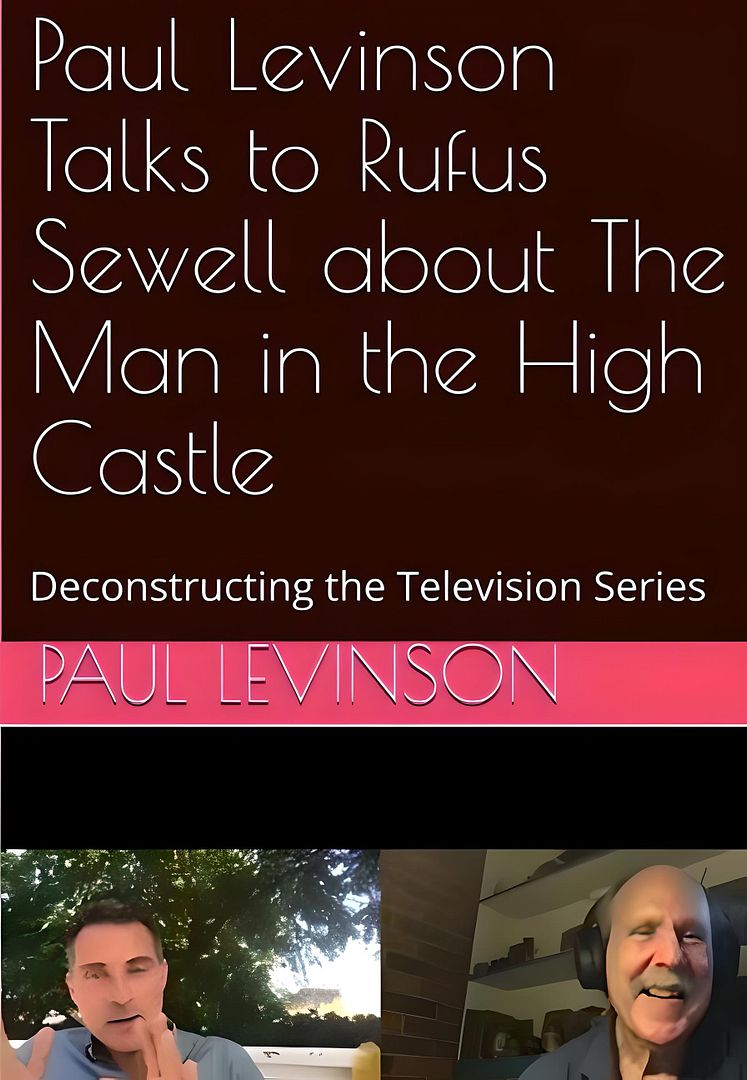
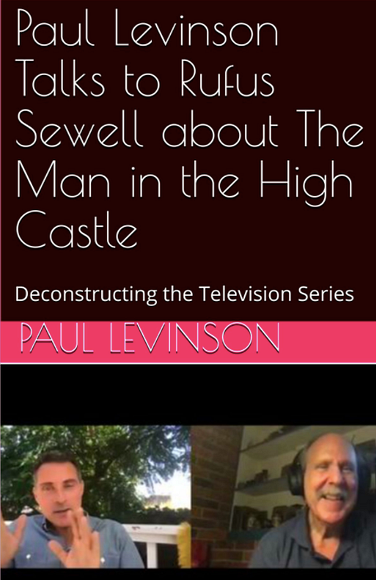
Couldn’t be a better time for The Man in the High Castle to show up on Netflix — here’s the 90-minute conversation I had with Rufus Sewell about his deeply thought-out performance in the lead role, in July 2021, shortly after the conclusion of the pathbreaking series on Amazon.
Welcome to Light On Light Through episode 418, in which I interview Dan Abella about The Philip K. Dick Film Festival to take place in New York City, March 13-14, 2026.
My wife and I saw Paul Anka: His Way, a 2024 documentary, last night on HBO. Why did we wait so long to see it? I don't know. Probably because we weren't paying enough attention.
I've been a fan of Anka since 1957, when I was in 5th grade in PS 96 in The Bronx, and Anka had a great hit, "Diana". Joel Iskowitz, Jordan Axelrod, Steven Auerbach, and Paul Gorman were in my class. I started an acapella group, Little Levi and the Emeralds. I don't think we sang much of "Diana" -- we were more into The Five Satins, The Harptones, and The Del Vikings -- but we sure loved it.
Anka explains and demonstrates at the beginning of the documentary that the ease of playing those 4-chord songs -- C, Am, F, G -- when he sat down at the piano was what drew him into singing and then writing. And he progressed in extraordinary ways, writing "My Way" for Sinatra, the Johnny Carson theme song, and even some songs with Michael Jackson. He also wrote "It Doesn't Matter Anymore" for Buddy Holly and "She's a Lady" for Tom Jones, and those are just a fraction of the more than 900 songs Anka has written!
Of course, no documentary can play even small parts of most of that number of songs, but the question always arises (for me, at least) of what songs would I have liked to hear and see Paul Anka perform in His Way? And, yes, there is one, in particular. It's a song that played a crucial role in Amazon's adaptation (by Frank Spotnitz) of Philip K. Dick's The Man in the High Castle, which ran for four seasons (2015-2019) and helped establish streaming as the titan it is today, The first episode of the second season in 2016 opens with an extended mise-en-scène of protagonist John Smith's (Rufus Sewell brilliantly portrays Smith) young teenage son Thomas getting off the school bus and walking into class. Everything seems so normally, happily, suburban American, as Thomas Smith (good job Quinn Lord) looks at the girls and walks into school. We begin to get a disquieting taste of this alternate history in which the Nazis beat America in the Second World War when we see the Nazi insignia on Thomas's arm and then a kid in the class asks Thomas how many slaves George Washington and Thomas Jefferson had. Thomas Smith then looks at a girl in the class in that certain way, she looks back at him when he isn't looking, but the joy of that budding teenage romance is shattered to pieces for the TV viewer when Thomas is called up to the front of the class to give a Nazi pledge of allegiance that he does with pride.
Now, this is one of Spotnitz's best conceived and realized scenes, and he hammers it home playing Paul Anka's 1960 hit song, "My Home Town," loudly and softly in the background until Thomas begins the pledge. This is an upbeat, zestful song, brimming with the enthusiasm and pleasures of living that is a hallmark of Anka's music, especially his early recordings -- the perfect background for the unnerving perversion of American life that the Nazi conquest has wrought.
So, yeah, I missed "My Home Town" in Paul Anka: His Way -- especially given the steps to fascism our country is currently taking -- but the documentary is titled "His Way", that is, Paul's way, and/or the movie's director and writer John Maggio's way, not my way, and as I've been known to say to someone who tells me that they would have had a character in one of my novels do or say something different than what I had them do or say: hey, go write your own novel. :) And all in all, there's not much I would change in this rendition of Anka's incredible inspiring life and journey. At 84 years old, he's still going strong, hasn't reached the top of the mountain yet (as he says), and I'm looking forward to hearing and hearing about the rest of the climb.
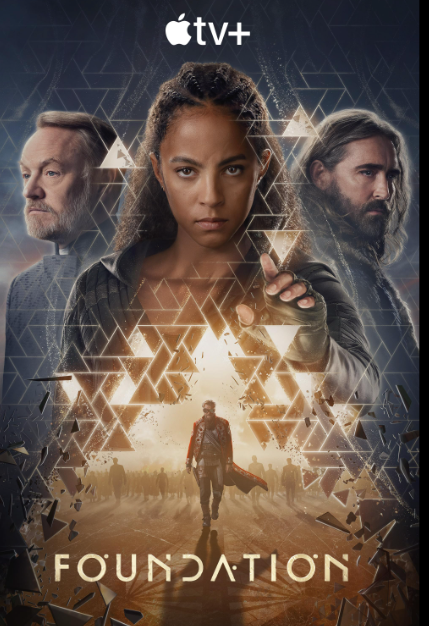
Another superb episode in the third season of Foundation -- 3.4 -- in which the series continues to integrate the Cleon triumvirate story with Asimov's original Foundation trilogy, alternated in many ways but still ringing true enough to Asimov's vision to be expansive rather than smothering of what Asimov put on his pages.
My favorite sliver of a scene has Day chiding Demerzel with a question borrowed and transmuted from Philip K. Dick's 1968 novel, Do Androids Dream of Electric Sheep, brought to the movie screen in 1982 by Ridley Scott as Blade Runner. Day concludes his testy conversation with Demerzel -- he's understandable uncomfortable with her -- with a question, "Do robots dream of wiping their own asses?" Not as elegant as Philip K. Dick, but, hey, a lot of years have passed since he came up with that title.
And it was good to hear Demerzel talk about Asimov's three laws of robotics, and then the zeroth law, as she struggles to understand how she has evolved, who and what she's become and must do. She's an advanced piece of work, indeed. Not only can she think and talk with her head physically detached from her body, she can navigate the complexities of the universe with the best of 'em -- e.g., Hari and Gaal -- and knows that the Second Foundation is the best way of stopping The Mule.
[Spoilers ahead ... ]
Speaking of which -- the Second Foundation and The Mule -- I actually like that Pricher wasn't converted by The Mule (who did manage to read his mind), and is literally in league with Gaal. This is a significant departure from Asimov's story, and I think it's a good one. I've always been at least slightly unhappy about Pricher's conversion to The Mule all those years before their story was streaming on Apple TV+, and it will be fun to see where this twist goes.
Gaal continues to play a vastly more important role in this rendition of the Foundation saga than her male counterpart in the trilogy. Not only is she in bed with Pricher, she has intellectually seduced Dawn, and drawn him into the cause of the Second Foundation. As I said in a previous review, this realignment of the major players in the story of The Mule, in which powerful elements of the Empire are joining the Foundations in their desperate looming war with that demon manipulator of minds, is refreshing and promises some major unexpected developments. As became clear back in the days back when television was just being born as a mass medium, Seldon's psychohistory can only go so far.
Readers of this blog will know that my favorite genre -- as a viewer, reader, and author -- is time travel, and its close relative alternate history. You'll know this because I say it in just about every other post. But you would also know this because, at least by my lights, excellent and even good examples are not easy to find (and, I'll immodestly or modestly say, as an author, to write).
But Aporia, a 2023 movie I saw last night on Hulu, is an excellent example. The heart of its narrative is that a would-be inventor (later, inventors), of a time machine discovers that the clanky machine he's struggling to build in his home can't quite do it -- it's not powerful enough to hurtle a human back in time -- but it can send a subatomic particle back to a specific time and place (the time just a handful of years or a little bit in longer into the past), where it will cause a very minor explosion. And the inventor realizes that if the place in the past where the subatomic particle lands is inside someone's head, well, what he the inventor has created is a gun that can reach back and kill someone in the past, by putting one of these time-travelling particles into the target's head.
[And I'll here I'll tell you that there will be spoilers ahead ... ]
So, there are three main characters in Jared Moshe's movie (which he wrote and directed): Jabir and Mal were working on the time machine in Jabir's home, when Mal was killed by a drunk driver. This of course left his wife Sophie desolate. Jabir is desperate to ease her pain, and restore her life, and comes up with a plan: send one of those lethal subatomic particles back in time, to land in the drunk driver's head, before he gets into the car and accidentally kills Mal. And the plan works!
But that's when Aporia really gets riveting and ethically wrenching, as Sophie struggles with the fact that although she got her husband back, she had to take another human life to do it. She reaches out to the drunk driver's widow. They become friends, and so do their daughters. And here the movie excels in depicting how the people who know the original reality, and know that it has been altered, deal with the new reality they now inhabit. (I tend to like this metaphysics of time travel -- that people who cause the changes in time are aware of the changes, even if the changes affect them -- maybe because I always employ such a narrative structure in my own works.) As Sophie gets to know the drunk driver's family, she finds she can't bear the fact that she was responsible for killing the drunk husband and father, however much he may have deserved it ... but any attempt to change the past again by killing someone else with a time-traveling particle could have unforeseen consequences ...
Aporia resonantes in all kinds of ways. The build-your-machine-at-home continues the tradition started by H. G. Wells' The Time Machine, and furthered more recently by Primer and just a few months ago Quantum Suicide. The idea of sending something rather than people or living things back in time was put to good use by Gregory Benford in his 1980 award-winning novel, Timescape, in which information could be sent back in time. And the idea of apprehending criminals, not because they committed a crime, but because you know they will commit a crime, was of course memorably developed by Philip K. Dick in his novel The Minority Report.
But Aporia has a story and an ambience all its own, brought to life by really excellent acting by Judy Greer as Sophie, Edi Gathegi (who has been great in For All Mankind, and before that, StartUp) as Mal, and Payman Maadi as Jabir. And all of this builds up to a top-notch ending, in which a smile tells us almost everything.
Welcome to Light On Light Through, Episode 355, in which I interview Dan Abella about the upcoming Psychedelic Film and Music Festival he is organizing. The Festival will take place October 20-22, 2023 in New York City, and there will both live and remote events and access.
Links to some of what we discuss in the podcast:
more about The Psychedelic Film Festival, October 20-22, 2023, Producers Club Theaters (358 W 44th St, New York, NY)
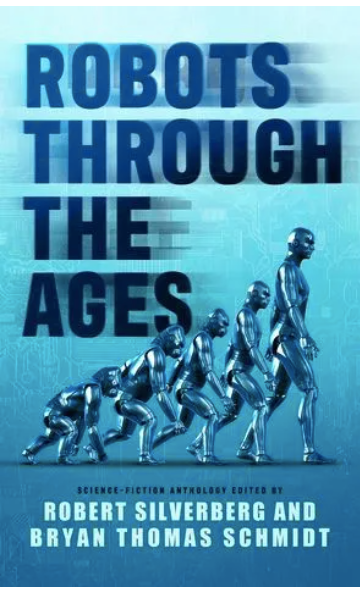
Beyond honored and delighted to announce that my 2019 novelette, "Robinson Calculator," will be in Robots Through the Ages, an anthology with stories by Ambrose Bierce, Philip K, Dick, and other past masters of the genre, to be published by Blackstone Press on July 25, 2023.
Here's the Table of Contents. More details including blurbs, reviews, etc over here.
DEDICATION INTRODUCTION by Robert Silverberg PERFECTION by Seanan McGuire MOXON’S MASTER by Ambrose Bierce WITH FOLDED HANDS by Jack Williamson GOOD NIGHT, MR. JAMES by Clifford D. Simak INSTINCT by Lester del Rey A BAD DAY FOR SALES by Fritz Leiber SECOND VARIETY by Philip K. Dick THE GOLEM by Avram Davidson FOR A BREATH I TARRY by Roger Zelazny GOOD NEWS FROM THE VATICAN by Robert Silverberg DILEMMA by Connie Willis THE ROBOT’S GIRL by Brenda Cooper THAT MUST BE THEM NOW by Karen Haber R.U.R.-8? by Suzanne Palmer ROBINSON CALCULATOR by Paul Levinson OF HOMEWARD DREAMS AND FALLEN SEEDS AND MELODIES BY MOONLIGHT by Ken Scholes TODAY, I KNOW by Martin L. Shoemaker AFTERWARD & RECOMMENDED READING by Bryan Thomas Schmidt ACKNOWLEDGEMENTS
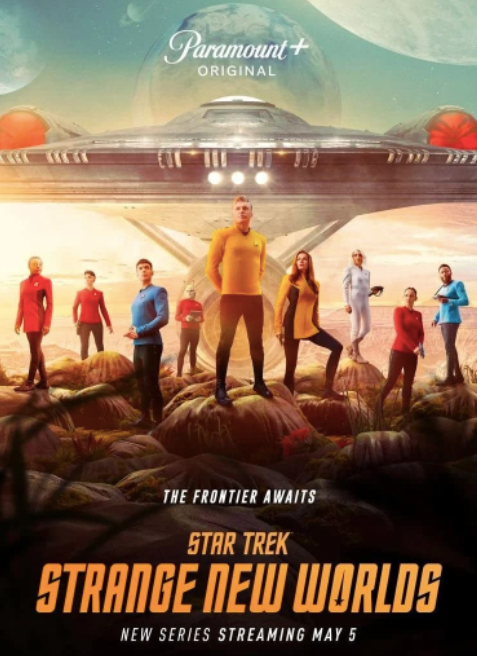
Star Trek: Strange New Worlds continues to be the best Star Trek since the original series, even more like TOS than was TNG, even though both had standalone episodes. Indeed, both had great episodes and great characters, but TOS and SNW both have Spock, who is right up there with the great captains as a transcendent character. And Pike increasingly strikes me as Kirk at his best.
[Spoilers follow ... ]
My favorite moment in this superb episode is Spock smiling, ever so slightly but noticeably, when he and the crew on the bridge learn that Uhura and Hemmer survived. An always timely reminder that Spock is not only Vulcan but human.
And speaking of reminders, let's talk about the Gorn, who first appeared in the original Star Trek. Back then in the 1967 episode "Arena," Kirk's combat with a Gorn captain was evocative of Fredric Brown's 1944 story, also titled "Arena," and Brown received story credit for the episode. In SNW 1.4, the Gorn are evocative of Philip K. Dick's "Beyond Lies the Wub," his first published story, which appeared in Planet Stories in 1952. Both deal, in very different ways, with an intelligent species that hunts another intelligent species as food. I guess that's not enough for Dick to get story credit, but it's worth noting the degree to which Dick's ideas continue to percolate through so much subsequent science fiction.
Noonien-Singh also had another excellent episode, and is now among my favorite new characters in this series. Indeed, she has the potential to be up there with the best characters in all the Star Trek series. Meanwhile, Hemmer is increasingly interesting, and also had a strong, thoughtful episode.
If you're a devotee of classic science fiction, you just can't miss with Star Trek: Strange New Worlds, and I'll see you back here next week with my review of the next episode,
So it occurred to me, as I was watching the enthralling third and fourth episodes of Outer Range, that this new series on Amazon Prime has a lot of Twin Peaks in it. I mean, an investigation of a murder against a backdrop that has a Philip K. Dickian mind-bending vibe is a rare thing, with a pulsing potential to be memorable if it's done up right. If Deputy Sheriff Joy, one of my favorite characters (and being played really well by Tamara Podemski) expresses a joy in cherry pie, I may be on to something.
Outer Range is one strange bird, if I may mix metaphors, and getting stranger by the episode. In the third and fourth episodes, and linguistically evocative also of Twin Peaks, we have a mountain disappearing. This gives the time shifting or time traveling or whatever exactly is going on a much longer timeline. If we're talking about mountains coming and going, we're entering the NBC series La Brea territory, and even further back than that.
Autumn probably has the most knowledge of what's going on at this point, and she's not saying too much, despite her seeming willingness to answer every question. On the other side of the being informative curve, it's not clear how much of what happened to Royal (good portrayal Josh Brolin), when he spent the better (or worse) part of the dead of night in that waterhole, is something he either doesn't really remember or doesn't want to talk about. I hope his wife Cecilia keeps pushing him for a briefing, and he does more than looked pained when she walks away, frustrated, because he's not talking.
He does have a lot on his mind. A dead body is bad news in the most normal of times, and Outer Range is most assuredly not normal. Wayne (well played by Will Patton) knows a little more than what he's saying, too, and the fact that he's more focused on that west pasture than who killed his son, says a lot, too.
But back to that in-and-out mountain: You can't beat Burl Ives singing "Big Rock Candy Mountain," and with Juice Newton's "Angel of the Morning" also playing in episode 1.4, we've got some timeless music in this time warping narrative.
See you back here with my review of the next two episodes next week.
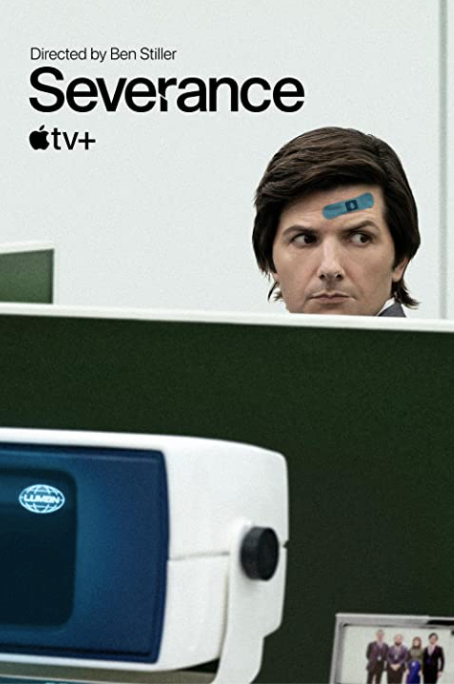
A more disturbing episode of Severance -- 1.4 -- than usual, because
[Spoilers ahead ... ]
Well, if you saw the episode, up since Friday on Apple TV+, you'll know why: Helly takes her life, or tries to take her life, at the end of the hour. I make that distinction because, you know how it is on television, if a character's head isn't literally severed (for want of a better word), than she or he might well have survived. In Helly's case, someone in that hell on Earth might have come by and rescued her.
What drove her to do this? She was betrayed by her outie, who appears in a video explaining that she doesn't want to end the severance of her and her innie. Though, it occurred to me that that video could have been a deep fake. I mean, deep fakes already abound in our own off-screen world, so, surely the dementos who built that innie world would know how to make them.
The other important aspect of 1.4 is the development of Irving as a character. We saw a lot more of him in the story than usual. But ... what did we learn about him? He may or may not be ok with a visceral relationship with Burt. At first, Irving pulls his hand away and soon after walks out of the room when Burt puts his hand over Irving's. But, later, perhaps after Irving has thought it over, he seems to seek Burt out. Not only does this behavior leave us still unclear about what Irving really wants, it's a metaphor for just about everything else in this harrowing narrative.
I'm sure it's been noted by others, and I may have already mentioned this myself, but Severance could fit comfortably into Philip K. Dick's uncomfortable corpus of work. Talk about A Scanner Darkly, in Severance, just about everything we scan with our eyes comes up blurry and unclear. The harder we focus, the more we get the feeling that we're looking into an infinite regress of possibilities. (Hey, I like working the name of this blog into my reviews.)
In any case, I'll be narrowing my gaze for some true meaning, and I'll see you back here with my review of the next episode, next week.
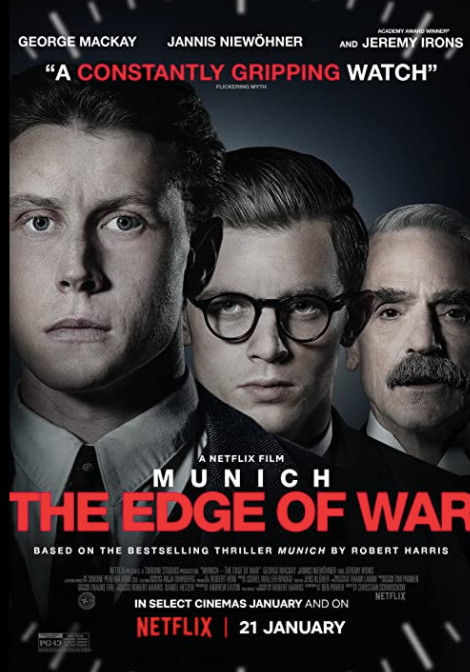
I guess this was a perfect night to watch Munich: The Edge of War on Netflix. Russia is on the verge of invading Ukraine. The Trumpists -- including Trump himself -- have still not been brought to justice for their insurrection and attack on our Capitol last January 6. And the movie is based on the novel Munich by Robert Harris, author of the alternate-history masterpiece Fatherland, in which Germany won the Second World War. Not as much of a masterpiece as Philip K. Dick's The Man in the High Castle (made into an incandescent series on Amazon), for sure, but I'd watch a movie based on a Harris novel any time.
And Munich: The Edge of War is one memorable powerhouse of a movie. As Neville Chamberlain goes to Munich to sign a deal with Hitler which gave Germany a piece of Czechoslovakia, which as we learned in school led to Chamberlain proclaiming "peace in our time" and Hitler to start gobbling up the rest of Europe less than a year later, two young diplomats, a Brit and a German, formerly classmates at Oxford, try to stop that deal from happening.
Their failure is a fact of history. Their existence, I assume, is not. What I'm not sure about is the way Chamberlain is portrayed in this brilliant film, in which he seems to really know what he's doing, deliberately delaying a hot war with Germany to give Britain and the United States crucial time to build up their forces. That's what we get for watching a movie based on a novel by an author who is so deft at writing alternate histories.
But the movie, as I just said, is brilliant, and eminently worth seeing. Historical dramas can be powerful and suspenseful even if we know the ending. As a measure of how good this movie was, I felt bad that these two central characters -- the British and German friends -- didn't really exist. That's probably because they are fiction, and where the rise of Hitler is concerned, fiction can often be better than reality -- unless we're talking about Fatherland or The Man in the High Castle.
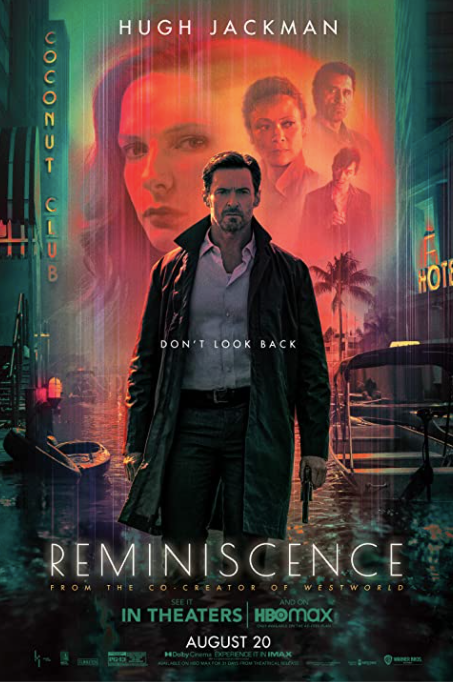
So here we are again. Critics are giving Reminiscence (on HBO Max) mixed reviews, saying it's derivative. I agree that it's derivative, but think it's excellent. In general, I think being derivative is not a bad thing, and I disagree with the myopic critics who miss how well Reminiscence does it.
Yes, Reminiscence is reminiscent of Blade Runner. Even more so in some ways of Total Recall, and for that matter, of all things Philip K. Dick. But it also recalls a lot of Christopher Nolan's work, as well as movies as far back as the 1940s like Laura, and even Body Heat in 1981 to some extent. And if it harkens to Westworld, well, Lisa Joy plays a central creative role in both.
I was a little bothered by Thandiwe Newton's character Emily motivated by the exact same thing as her character Maeve in Westworld -- finding her daughter -- but that's just one unnecessary misstep in a long list of gambits and interludes done very well in Reminiscence. Among them are the deft mix of a flooded world and the refuge in memories, and outstanding acting by Hugh Jackman in the lead role, and Rebecca Ferguson as his all-consuming love interest Mae.
This is first time I've seen Ferguson, and I'm very impressed. She's Swedish, and even before I knew that, she reminded me of Ingrid Bergman. Come to think of it, Jackman's Nick Bannister reminded me a bit of Bogart. Is that supposed to be bad? Of course not. It makes Reminiscence even more fun to watch.
I won't go into the plot, so as not to risk spoilers. I will say that I like happy endings, and I'll leave it to you to decide where the ending of Reminiscence resides on the happy/sad meter. Nick tells Mae that there are no happy endings, especially of happy stories, presumably because to end them is sad. Mae responds that therefore she'd like to hear a happy story that ends right in the middle. That's the kind of dialogue that lifts Reminiscence into a top tier, and if it reminds us of triumphs in cyberpunk ranging from Incandescence to Altered Carbon, so much the better.
Hey, I'll be teaching a brand new course at Fordham University this summer that I proposed, created, and developed over the past few months: "Science Fiction from Page to Screen". I'll be teaching the course entirely remotely, via live Zoom lectures and interviews, and group and individual email discussions, so you don't need to be in New York City to take it -- you can be anywhere in the world. And you don't need to be a student at Fordham. The course carries four undergraduate credits, and you can take the course as a visiting student from another university, or if you're a college graduate, or, if approved, if you're a high school senior (and in exceptional cases, a high school junior).
The focus of the course this summer will be Philip K. Dick's iconic award-winning 1962 novel, The Man in the High Castle, made into the Emmy-winning four-season series (2015-2019) on Amazon Prime Video, starring Rufus Sewell-- who will be be making a special Zoom appearance in our course for a live interview by me in July!
For those you who may not know me, I'm a tenured professor (former Chair of the Department of Communication and Media Studies) at Fordham University, author of seven science fiction novels (including The Plot to Save Socrates and my Locus Award winning first novel, The Silk Code) and more than forty stories, former President of the Science Fiction and Fantasy Writers of America (1998-2001), and a lifelong admirer of Philip K. Dick's work. More about me here.
I'm really looking forward to teaching this course and welcoming Rufus Sewell to Fordham!
Here is the course description:
FITV 3635 PW1 - Science Fiction From Page to Screen Session III, June 1 - August 5, 2021 Online: TTh, 3-5 p.m.
This course examines the unique, dynamic relationship between written words published as novels and short stories and their adaptation in TV series and motion pictures, in the genre of science fiction. Issues include the reader’s expectations about screen adaptations, the challenge of visualizing the impossible in science fiction, multiple movies from a single source, and books within books as a literary and cinematic device. The course will focus on a single iconic novel adapted into a multi-season TV series.
CRN: 12993 Instructor: Levinson 4 credits
Registration details for visiting students are here. Tuition details are here.
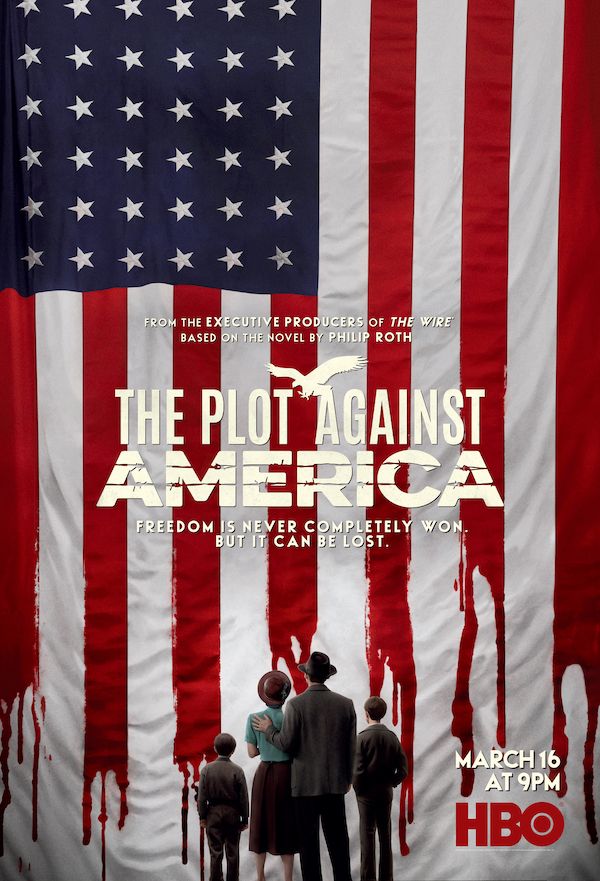
I find myself in the less than jubilant position of reviewing the third television science fiction series about Nazis - science fiction, loosely defined - in the past three days. The first would be Hunters (my review here), the second Westworld (more, precisely it's season three coda; my review here), and now The Plot to Against America on HBO. I'll leave it to you to explain why Nazis are so popular on American television these days.
The Plot hinges on Charles Lindbergh, who in real history was a non-interventionist and likely Nazi sympathizer in the 1930s, bur did fight against the Nazis and Japanese in the Second World War. In the television series, he beats FDR in the Presidential election of 1940, and (though I haven't read the 2004 novel by Philip Roth or seen more than the first episode of the series) presides over an America in which anti-semitism is rampant.
Philip Roth and Philip K. Dick are two very different kinds of brilliant writers, so don't expect any Man in the High Castle (in my view, probably the best science fiction series ever on television) in The Plot Against America alternate history. Instead, think about Roth's other notable works, like Goodbye Columbus, which focus on the pleasures and problems of Jewish life in mid-20th-century New Jersey. You'll find lots of that in the first episode of The Plot Against America, which introduces the extended Levin family, its struggle to move up in the middle class and fend off the rising Nazi tide.
The details in 1940 Newark are spot on, ranging from the Esso gas station to the clothing to the Yiddish sprinkled in the conversations. This has to be the first time I've heard the word forshpeis in an American TV drama. It brings back wonderful memories of both my grandmother's voice and her forshpeis.
The acting in The Plot Against America is top-drawer, too, with Winona Ryder, John Turturro, and David Krumholtz in important roles, eating rolls that made me hungry, and I'll be back here next week with a review of the second episode.
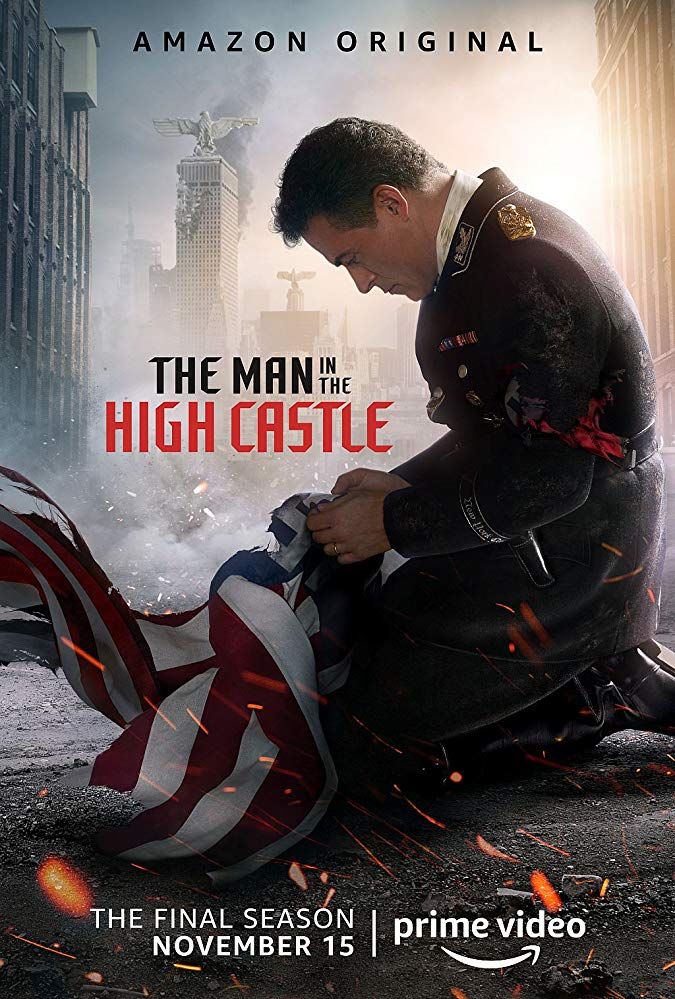
I've been saying ever since Trump began running for President with his anti-immigration policies that The Man in the High Castle and its alternate reality of literally Nazi America had special relevance to the reality in which we now all reside, in which the Allies not the Axis won the Second World War. In the final season of this extraordinary adaptation of Philip K. Dick's extraordinary 1962 novel, immigration plays a major role in the story, especially in the very last scene of the series.
[some spoilers below]
But although that story and that image are crucial to we the people on the both sides of the screen - the characters and their stories, which we are watching - there were parts of this final season that I liked even more. The details, as always in this series, were provocative pleasures to behold. Abendsen presents an alternate-history Twilight Zone on American Reich TV, intoning in Rod Serling style "The High Castle" at the beginning of every episode. Japanese and Nazis in America exchange bows and Sieg Heils, just as we saw in prior seasons, but Kido and Smith shake hands, as the Japanese and the German Nazis later recede from America - a striking evolution of symbolic gestures. Years earlier, as the American military struggles with whether to continue fighting the Nazis after they nuke Washington, DC, one officer notes that "Paton shook hands with Goering"; another counters that "Ike is gathering men" for the resistance; in this reality, the reality that is the home reality of The Man in the High Castle, the Paton quote wins.
In this season, much more attention is given to exactly how this alternate America came to be. And the vehicle is full-fledged access to our reality in which we won the war, an access much more satisfying in the narrative than the I-Ching glimpses and snippets of movies we were provided in earlier seasons. John Smith from the American Reich visits our reality. His wife Helen in our reality finds Nazi John more sexually robust than her husband who, unbeknownst to her, has been killed by another American Reich operative who crossed realities into our reality (superb performances throughout by Rufus Sewell and Chelah Horsdal). John is overjoyed that Thomas is alive and healthy in our reality, but heart-broken and furious when Thomas walks off with Marines to fight in Vietnam, echoing when Thomas walked off in the American Reich to be put to death because of his illness. These parallels, palpable echoes of one reality into the other, provide a haunting foundation for everything that happens in this final season.
In the Japanese American West, Kido (fine acting by Joel de la Fuente) has his own life-rending difficulties with his son. There's no interplay of alternate realities in the Japanese part of this season - mainly, I guess, because Tagomi and his I-Ching play almost no active role, given that Tagomi is killed in the opening Western scene in the first episode (which I regretted). Julianna picks up the I-Ching torch on the East coast, in contrast to the Nazis who travel to alternate realities via technology. The protagonist in the West is now 100% Kido, who struggles against all odds to become a better person, and succeeds. The Black Communist Rebellion along with Childan's capacity to survive also play a major role out West.
But the locus of the story and action remains in New York City and its environs. Smith always manages to outwit the German Nazis, now led by Himmler and Eichmann. In the end ... well, I won't reveal exactly what happens to you, in case you've only seen part of the final season when you're reading this. But I will say that I didn't think what Smith tried to do, the order that he gave, was entirely or even well motivated. (He was free of German Nazi control, so whose demon was he following, his own? Why?) The overall series, and this last season in particular, could be seen as Smith struggling to find his better self, the American that he was before the Germans dropped the bomb. There was ample reason to think that maybe he had.
But this disappointment, though it pertains to the central, pivotal character, did not mar the impact of this powerful, brilliant, and so very timely series for me. Too bad Philip K. Dick wasn't alive to see it. But I did, and I will always be profoundly glad for that.
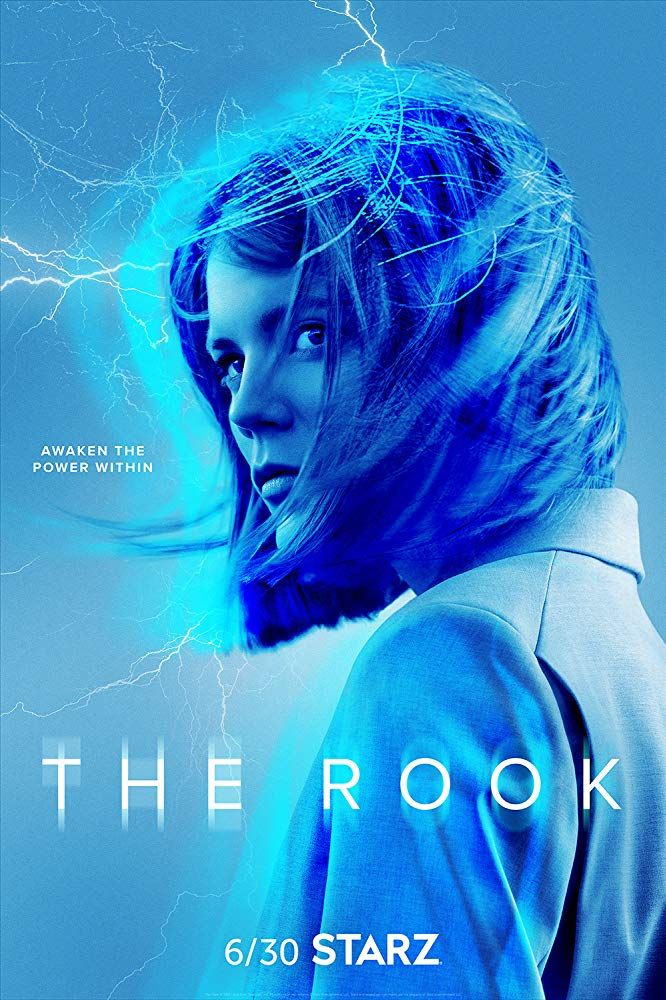
The most compelling thing(s) about The Rook 1.3 on Starz earlier this evening was the Gestalts and the short but effective explanation we got about them. They make a nice piece of science fiction, especially for the television screen, and work well in that Philip K. Dickian tradition.
They're a special kind of rook, a group of four in constant telepathic connection, emotional and visceral as well as intellectual. When Eliza passionately kisses Myfanwy, her three empathic blond brothers feel it to the extent that one of them drives off the road. Of course, that's not what Chequy recruited, bred, trained, whatever exactly intended for them. That would be to fight, which we also see a neat example of as the four get Myfanwy out of a perilous situation on a train. I'm always up for an action scene on the London underground, and this was a good one, ending in the Gestalts capturing a vulture.
That would be someone out to kill or capture a rook, and it's instructive to see the tables turned. Of course, this captured vulture can't be expected to tell Checquy and us too much, and that's exactly what happens (or doesn't happen). We still haven't much of clue, for example, as to who is the traitor in Checquy's midst.
One thing I think we can be pretty sure of, however, is that it isn't the Gestalts. Because one couldn't be a traitor without the other three knowing. And, if all four were traitors, that would likely be easier to spot than just one. I'm thinking the traitor could be Myfanwy herself - or, rather, the Myfanwy whose memory was wiped, and left messages for the current rook with that name. That would make, say, Farrier likely to know this, and her current game being to find out what made the original Myfanwy turn.
But I'm getting too far ahead here, and I'll see you again next week after we find out more.
The Rook on Starz starts off with a bunch of familiar premises - someone (in this case, a young woman) wakes up in a dangerous situation with no knowledge of who she is. She gradually learns about her past and situation from a series of helpful messages from her younger self, who knows she's in danger of having her memory wiped. We and she learn that she (Myfanwy is her name) is part of an MI6-type British secret service group. And soon another very different, but also very familiar, trope is revealed: Myfanwy has some kind of super powers - the ability to inflict physical damage on people via her mind - and the MI6 group (Checguy) is somehow all about this.
Now, I'm a sucker for all of that stuff - I stayed with Heroes until the very end, including its sequel - so I'm open to seeing another rendition of it. And I liked what I saw in the first episode, which, for a variety of reasons including the pacing and cinematography, actually reminded me more of the late, departed, superb Counterpart, also on Starz, than anything else.
The ambience and story-line is of course also very much in the Philip K. Dick mode, which is also always welcome. Dick was a master of exploring people not knowing who they are, and the voyage of discovery uncovering all kinds of wrinkles and black holes, figurative and literal, in the universe. The Rook looks to be more down-to-Earth, and that's ok, too.
There's also, apropos Heroes, an almost Japanese flavor to this narrative. Although the locale is London, lots of the scenes felt like they were somewhere in Tokyo. But this also loops back to Dick and the Bladerunner movies.
All in all, then, The Rook is intriguing, colorful, and I'll stick around at least a little while to see how it plays out.
"As a genre-bending blend of police procedural and science fiction, The Silk Code delivers on its promises." - The New York Times Book Review
Andrew Niccol's Gattaca in 1997 remains one of the surprise all-time best science fiction movies, surprise because Gattaca was Niccol's first. His follow-up, The Truman Show in 1998, was even more lionized by some, but I didn't like nearly as much as Gattaca, which was stunning in its mix Brave New World totalitarian life and the yearning for space travel. I've seen some of Niccol's subsequent movies, but I honestly can't recall them.
Anon had all the right ingredients for another great movie - Clive Owen and Amanda Seyfried in the cast, and a kind of Philip K. Dick Minority Report story, with a police force that can scan people's minds and therein nab criminals (not before but after the act), and hackers who can cut up and out those images. Add to that a serial-killer hacker suspect (Seyfried) hunted by Owen (a detective who can mind scan), and they're sexually attracted to one another, and you could've had another great Niccol movie.
There were lots of good scenes, savvy dialogue, wonderful locales (my favorite: Sal's apartment on Wadsworth Terrace in Manhattan), and a pretty good twist at the end (which I won't tell you), but Anon nonetheless lacked, I don't know, a certain depth and profundity, even though that's exactly what it was trying to convey. Anyone, especially police detectives, having access via your brain to what you see and do is a pretty traumatic and revolutionary development in human life, and for all the characters' remonstrating about that in the movie - or, in some cases, celebrating it - the ambience fell short of kicking you in the cosmic gut. Probably there was a little too much emphasis on the murders and the police work. Perhaps seeing scanning in other contexts a little more would have given Anon a more universal grounding.
As it was, Anon is a good film, worth watching, but a minor work from a great director and writer. Hey, it's good enough that I'll definitely watch Niccol's next movie.
Hey, it's December. That being the case, I thought I'd get back to something I was doing December last year - reviewing some of the plethora of short science fiction you can find and watch for free on Amazon Prime Video (that is, free if you have Amazon Prime). I'll review as many of these as I can, until the creative demands of the New Year say otherwise.
First up is Remembrance, a 13-minute short with a 2016 date on it, but listed as 2017 on Prime Video and IMDb. Mining our memories - that is, technology that allows someone to look in on someone else's memories - has become something of a staple in science fiction, and almost seems natural in this our world of Philip K. Dick, the writer whose stories have become the basis of more movies and television series than the works of most other science fiction writers combined.
Remembrance, indeed, is Dickian with a vengeance, in that it combines memory retrieval with murder, or the tapping of memory as a means of nabbing a killer. I don't want to give too much away about this short film, so I'll confine myself to mentioning that it tells the story of two woman who are twins, one boyfriend, and a memory technology that is being developed by one of the twins.
On the one hand, there's not all that much that's new in Remembrance. On the other hand, the acting is convincing (Selena Moreno as the twins, Will Lurie as the boyfriend), and the short is memorable and even powerful at times (directed by Madison Campione, written by Madison and Troy Campione). So I'd say see it if you have 13 minutes to spare. And I'll be back here soon with another short review of a short science fiction movie on Prime Video.
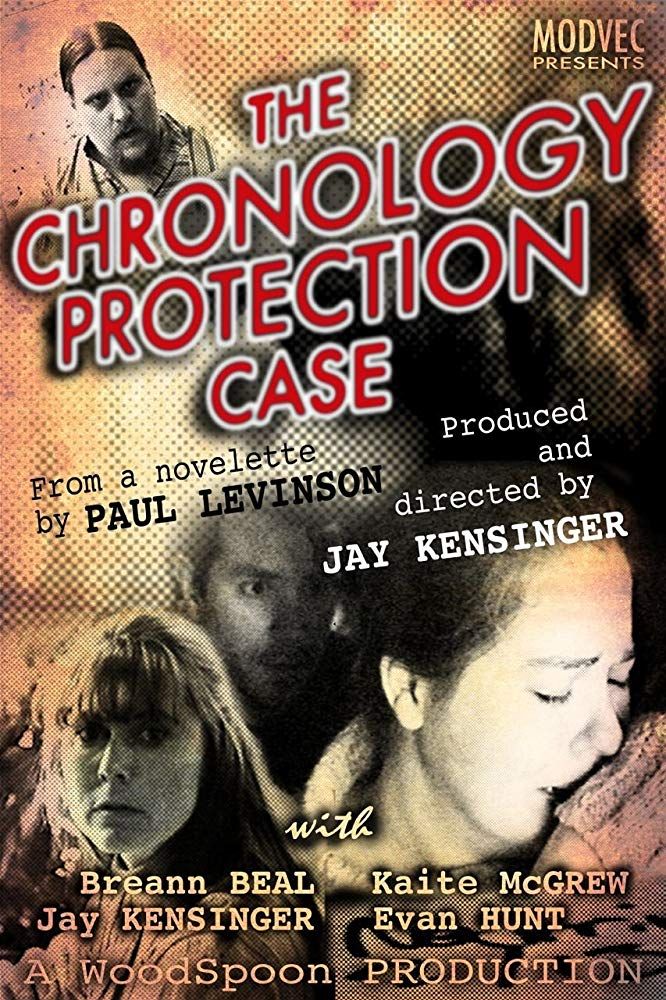
watch The Chronology Protection Case FREE on Amazon Prime
The Man in the High Castle episodes 3.2-3 go full bore into alternate realities, including -
Dr. Mengele in New York schooling a shocked Smith about them, with Smith even remarking that this sounds like something out of "Frederic Brown" - a real science fiction writer in our reality, known mostly for his humorous science fiction stories, but author of the 1949 What Mad Universe, a novel with plenty of humor but also alternate universes. (The mention of Brown continues the weaving of elements from our reality into the alternate history of the Nazis and Japanese winning the Second World War that is the central story of The Man in the High Castle, with elements of our reality seeping through.)
Smith, later watching one of the movie clips, sees his son Thomas alive and well, giving him a far deeper than professional stake in getting into or to the bottom of these alternate realities.
Out West in Japanese California, the access to alternate realities is more mystical than scientific, as they are in the Nazi East Coast of America. This mysticism, by the way, is more consistent with Philip K. Dick's approach, but I like the way it's expanded to laboratory science in this third season of the story.
Juliana's sister Trudy - the one who wasn't killed in her reality, but was in ours, now back in our reality alive and with Juliana - is discovered by Kido, the Japanese inspector who happened to kill her. This creates an unacceptable situation. Although Tagomi gets her and Juliana freed, they need to do something about the sister, given Kido's understandable desire now to find out what's going on. Fortunately, I Ching is just thing to send her back to her reality in a flash.
So we have the alternate realities on center stage now. But the backdrops are excellent, too. The Japanese Admiral realizes that the Japanese could benefit from working with Americans, rather than killing them, in the Japanese attempt to fend off the Nazis. Kido is instructed to go "lightly" in his enforcement - "persuasion" rather than "punishment" - and to use punishment only when needed. This should make for a more interesting storyline than just lining up captured Americans and shooting them.
Last - for now, before I go back to Prime to watch more episodes - I'm liking Robert's character more this season, too. He gets off a good line, talking about the Rockwells - Norman the painter and George Lincoln the Reichsmarshall of North America - underlining the ubiquitous mixing of realities in this compelling third season.











 There were lots of good scenes, savvy dialogue, wonderful locales (my favorite: Sal's apartment on Wadsworth Terrace in Manhattan), and a pretty good twist at the end (which I won't tell you), but Anon nonetheless lacked, I don't know, a certain depth and profundity, even though that's exactly what it was trying to convey. Anyone, especially police detectives, having access via your brain to what you see and do is a pretty traumatic and revolutionary development in human life, and for all the characters' remonstrating about that in the movie - or, in some cases, celebrating it - the ambience fell short of kicking you in the cosmic gut. Probably there was a little too much emphasis on the murders and the police work. Perhaps seeing scanning in other contexts a little more would have given Anon a more universal grounding.


