Chuck Todd interviews me about alternate histories
Showing posts with label Emon Hassan. Show all posts

Wednesday, September 20, 2023

AI-Generated Video Translation


Here's an AI-generated translation of my English into Hindi by Emon Hassan -- it's of me talking about my 2006 time-travel novel, The Plot to Save Socrates, in 2010 (AI by Hey Gen; from an interview Emon conducted w/me in 2010) (English follows Hindi in video). I actually think I sound a little better in Hindi than English :)

I'm also very glad Hey Gen ID's itself in lower right corner -- a good way of demonstrating that AI is not attempting to deceive.  I understand that this watermark appears only on sample or test copies of the Hey Gen AI product.  And, also, that it's easy to remove them.  But I'd nonetheless like to see these logos on all AI products -- they should be mandatory and indelible.

You can also watch the video here on Instagram.


Sunday, June 12, 2022

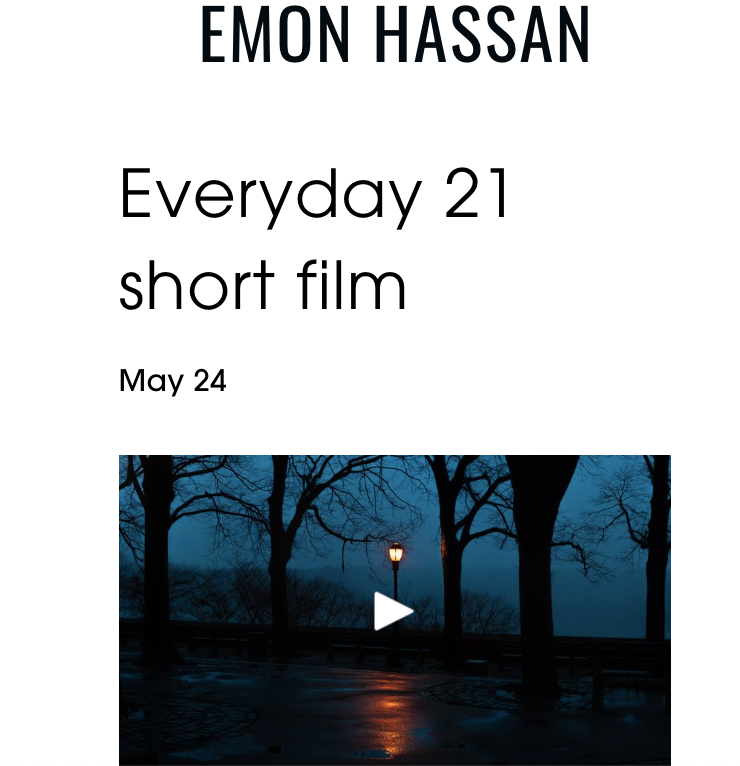
Everyday 21: The Interstellar Anthropologist


Emon Hassan is a gifted photographer and movie maker.  I didn't know that he is also a gifted composer.  He combines all three in Everyday 21, a short film of hauntingly beautiful and profound photographs -- one for every day of the year of 2021 -- backed by quietly breathtaking music that brushes against the edge of your soul.

Hassan's goal was to "find the story" in each day of 2021, and capture that story in a photograph.  The result defies literal summary, because it cuts so keenly, to a part of the brain that is moved by the music in songs, the deeper almost inchoate part that lives below and soars above the words.

But to give you a hint of what you'll find here in this 13 minute and 33 second short movie that is short on nothing: a flower growing in a hole in a wall, lots of cracks in structures, words that exist in signage that tell a story that transcends any wordsmith or poet.

Is it a coincidence that the year being so chronicled is 2021, which began with the attack on the U.S Capitol and continued the decimation and fear engendered by COVID-19?  Probably not.  Hassan is a sensitive being, and decisions as to where he pointed his camera, what to include and not include in this tableau, the order of the photographs, all were made by someone who has a golden unflinching antennae to what is going on in the world.

There are very few human faces in this documentary.  And I'd guess that's because Hassan is more interested in the results of what people do, than who they are, or look like.  I've been watching and reviewing a lot of science fiction of late -- though I guess I've been doing that for years -- and Everyday 21 has what feels to me like an interstellar quality, even though all the photographs are from Earth (and I think, but don't know for sure, that they all were taken in New York City).  It's almost as if Hassan is an interstellar anthropologist, tasked with reporting back home to what's going on here on Earth.  Not news events.  Artifacts.  Produced by our species.  Reality.  And captured by one of our most luminous members.

See the movie, anytime, here, for free.


Friday, October 27, 2017

Mindhunter: Best of its Kind

Imagine Criminal Minds - which my wife and I watched a lot of, but stopped, a year or two ago - as you might have wanted it to be: sharper intellectual focus, honest language, real serial killers, deeper character development, nudity when called for but actually no scenes of torture or murder - and you have Mindhunter, a 10-episode season (which I hope is the first) on Netflix.  In other words, a show about the BAU, but at its inception in the late 1970s, and unencumbered by the limitations and ticks of network TV.

Mindhunter is produced by House of Cards producer David Fincher, and unsurprisingly has such deft touches as subtitles when a couple are having a key conversation in a noisy bar, and the first mention I've ever heard (twice in Mindhunter) of Erving Goffman, a pathbreaking sociologist from the 1950s and 1960s who talked about the masks we all wear, and the difference between the front and back regions of our personas, or what we show to the world at large versus what we keep private to our families or closest relationships.

That high intellectual octane animates this whole series, and is brought to life by standout performances by Jonathan Groff as the young FBI agent Holden Ford trying to establish a science of understanding and even predicting psychos and sociopaths, and his older partner Bill Tench, played by Holt McCallany (Lights Out!), who pretty much supports what Holden is trying to do but is not entirely comfortable with his methods.   In this battle to establish a new, more effective, scientifically grounded method of identifying and stopping serial killers, Mindhunter also bears strong resemblances to the recently aired and excellent Manhunt: Unabomber series (and there's a lot of Jim Fitzgerald who in reality broke the Unabomber case in the fictional Holden Ford), and even a little of Masters of Sex, which I was sorry to see cancelled.

As a special treat, Mindhunter has Fringe's Anna Torv as a sociologist who joins the team.  She provides one of the Goffman references, and Holden's girlfriend, well-played by Hannah Gross, doing graduate work in sociology, offers the other.  The serial killers, ranging from Richard Speck to Edmund Kemper, are truly chilling, and we get all this with words, not scenes of their horrific actions.

An old friend, photographer Emon Hassan, strongly recommended this series.  I'm doing to same to all of you.


It all started in the hot summer of 1960, when Marilyn Monroe walked off the set of The Misfits and began to hear a haunting song in her head, "Goodbye Norma Jean" ...

Tuesday, May 17, 2016

Victoria: Buckle Up

I saw Victoria on Netflix last night, based on a recommendation by New York Times photographer Emon Hassan, conveyed by my wife.  Emon said see it "now"! He was right.  This movie, reminiscent in some ways of Scorsese's After Hours and any number of amateur-heist movies, but with a story and frenetic pace all its own, was non-stop draining and breathtaking.

Non-stop is probably the key word here.  Victoria was motion-photographed in one uninterrupted flowing and jangling point of view, in a way that keeps your feet and eyes to the fire as much as the riveting story.  That story is about Victoria, who runs into some guys in bar in Berlin, and winds up as the driver in a life-and-death big robbery.

The very language in this movie is part of its charm - most of the Germans speak German, but since Victoria is Spanish, from Madrid, she speaks mostly English, which the main German guy speaks pretty well, too.   The linguistic mix underscores one of the main messages of the movie, which is that none of the characters understand the others all that well, certainly not Victoria and her German friends.

But that doesn't get in way of real emotion, either, as Victoria indicates when she tells Sonne that she thinks she's falling in love with him.   Budding love, however, has a hard time of it in this story, as Victoria moves from beautifully playing the piano for Sonne to helping him and his buddies with the robbery.

The acting is good and the plot is well constructed.  I was guessing until the very end.  I recommend you see this movie maybe with a glass of wine in hand - the caffein in coffee or tea may be too much for you as you get caught up in the 2 hours and 18 minute ride on the screen.

Monday, January 26, 2015

Snow, Pleasure, and Paradox

Just got back from swimming 20 laps at the New York Sports Club, with the snow falling dangerously and beautifully outside the big windows.  In many ways, this strikes me as one of the heights of civilization.

My take on the snow has changed over the years.  When I was kid, it was nothing but a pleasure to get off from school, have snowball fights on the streets off Allerton Avenue in the Bronx, and even shoveling was an opportunity to earn a couple of bucks, usually less, but hey.

Now, as a professor, I still don't mind classes being cancelled, but that can sometimes come with the price of having to make them up near the end of the term, usually a sunny day in May.   As for shoveling, it's no longer a source but a drain on money, especially in a big storm in which we pay someone to do the shoveling.

And the snow itself?  It still has a magic, an expression of reality, of soft interaction with sky, that's inimitable.  A snowflake is itself a paradox to touch, because the touching wipes it out, obliterates the texture, and thus is a great example of a self-eradicating proposition.   But the snowstorm is no paradox, and about as straightforward as it gets.

Driving in the snow is certainly no pleasure, but there's an exhilaration in that too, as you best the elements in your trip back home, or wherever.   Front wheel cars have made driving in the snow a lot less dangerous, and my wife's four-wheel drive is a safe bet in everything but a blizzard.

Power outages and falling trees are real dangers, and that's where I pretty much draw the line about my enjoyment of a big snow.   If we get through this one without any loss of power, I'll count this first big snow of 2015 a blizzard worth experiencing.


Ft. Tryon Park, NYC,  in yesterday's snow, photo by Emon Hassan

Monday, December 31, 2012

Happy New Year Emon Hassan

Who's Emon Hassan - well, if you Google him, you'll find out he's a very talented photographer, videographer, filmmaker, and lots of those kind of good things.  I've benefited greatly and directly from his work.  He took the black-and-white photo of my smiling face that you'll see on my Twitter, Facebook, and like accounts.  He - along with Amanda Lyn Costa - made the Behind the Plot to Save Socrates "book doc" - see below.

And, earlier this New Year's Eve, my wife Tina and I happened, for totally coincidental reasons, to show up right in front of Emon's apartment building in Manhattan (no, we're not going to tell you where).  Just like that, totally out of the blue, right out there on the street.  We had an excellent conversation.

Emon enjoyed it, too.  He's just tweeted about it.

And I was so impressed I got an idea (always a dangerous thing in my case).  Why not make this a yearly occurrence.   From now on, every New Year's Eve, Tina and I are going to show up, unannounced, in front of some worthy person's building.  I have no idea who.  It won't be deliberate.  I'm just going to try to will the universe to make it happen.   And then I'll post about it here.

Happy New Year everyone!


Saturday, April 28, 2012

The Third Returns with Exits

Emon Hassan's The Third returns with its second episode - "Exits" - this Tuesday, May 1.  If ever there was a medium is the message movie, ala Marshall McLuhan, "The Third" would be it (even though McLuhan liked tetrads better than triads).   This is because the story, quiveringly, quietly terrifying, is told with not much content.

But I'll tell you a bit about the content, anyway.  An old woman is stretched out, eyes closed, in bed.  I thought she was dead, until she smiled.   Her son kneels by her bed, and cries.  Maybe she was dead, after all.

There's not much of the emotive actor Philip Willingham in this episode, except that haunting face, at the beginning.  But there's a guy who looks like an elderly Buddy Holly, or maybe Elvis Costello, if he'd continued with his Buddy Holly look.  And the woman and son.


The music by Kevin Mahonchak is superbly eerie and unsettling, as is the cinematography by Hassan.  The second episode of The Third premiering on the first (you knew that was coming) is just five minutes or so, with four more episodes to follow.  In case it's not apparent, there's a kind of music of the spheres, mathematical synchronicity to The Third, not only in its name but its presentation.


Reviewing last week's episode of Mad Men, I said it felt like it had been directed by some David - Cronenberg or Lynch.  The same could be said of the shot of other-worldliness to the cortex that is The Third.  You can catch the start of Exits (a rearrangement of exist) only on the Web, on Tuesday, over here - where you can also see all six episodes of last year's pilot, right now.  Click on the label "The Third" below to read my reviews of three of those.


Saturday, January 29, 2011

The Third of the Third

The third episode of The Third - Emon Hassan's darkly mysterious new web series, starring Philip Willingham and in this episode Jessalyn Maguire - was put up nine days ago, which is three times three, so I thought I'd put up the review today.

Did I mention that this micro-series has M. Night Shyamalan vibes? That's because the tone is not only mysterious and brooding, but spiritual and supernatural.   The music by Kevin Mahonchak enhances this mood.  The action, which is dreamlike and about 33.33% non-verbal, takes place at the Trinity Church, on Broadway and Wall Street, that we saw in the last episode. Trinity ... another rendition of the third.

Our hero has a conversation with a woman, who has also been drawn to the church and its graveyard.  She tells our hero about a dream she's been having, which may have something to do with why she can't keep away from this place.  The dream is about something that happened in the past, in an earlier era, with horses, lanterns, and midwives.    There's a baby involved, and he's taken by two uniformed men, who shoot the midwife while they're at it ...

The baby's not the narrator's, who has this dream every night ... but we'll have to wait until February 1* for the next episode ... which is just three days away.

*Emon just told me that the 4th episode of The Third has been pushed forward to a February 8 premiere.    That's a week, or 7 days, and 4 (the fourth episode) plus 3 (of The Third) equals 7, so that still works for me.


The Third Pilot: Episode 3 from Emon Hassan on Vimeo.


See also See also The Third - Three Minutes - on the Third ... The Second of the Third

Saturday, January 8, 2011

The Second of The Third

The second episode of  Emon Hassan's The Third appeared online January 4, four days ago.    Short, quietly mysterious, inscrutable, like the pilot, but with a glim more of a plot, and two more characters, too, which makes it a tad more scrutable, if that's a word (I don't know that glim is, either), but, even if not, you get the picture.

The hero, well played by Philip Willingham, gets an assignment by smart phone, to make contact with someone in Bryant Park.  (Ah, Bryant Park, scene of much of my third Phil D'Amato novel, The Pixel Eye - a worthy place for mystery if ever there was one.)   Sitting on a bench, waiting to talk to our hero, is someone who may be his older self.  (That's just my opinion.  The man on the bench is American and much older than our British hero.  But the two did look in some sense the same.  The closing credits, however, do list two guest performers - in addition to our hero - so chances are, at very least, that the guy on the bench is not a bloke, that is,  is not played by Willingham.)

Are you with me so far?  (If not, don't worry, you can watch the second episode right here in the comfort of this blog, below.)  Anyway, the third performer is a woman, and indeed the topic of conversation between the hero and maybe his older self on the bench.   The hero follows her to a small graveyard with crumbling tombstones near Ground Zero, in sight of the 9/11 Memorial Preview Site.   The hero is clearly affected by this, he looks at the tombstone of Moses Gale (one of the amenities in watching any movie online is how easy it is to stop the action and see what's going on - just like with a DVD or DVR, but of course not possible in the theater).  No, I don't know who Moses Gale was, but feel as if I should.

And here is where the second episode of The Third concludes.   There's clearly something serious, sinister, wrenching going on - a smidge of Nolan's Memento now, too - you can see it on the hero's face.

You can see for yourself in the complete second episode below, and you'll see me back here (a statement of my intentions, not a command to you, but you owe it to yourself to drop by) soon after the third of The Third finds its way to Internet screens.


The Third Pilot: Episode 2 from Emon Hassan on Vimeo.


See also The Third - Three Minutes - on the Third

Saturday, December 4, 2010

The Third - Three Minutes - on the Third

A shout out or Tweet-sized review of Emon Hassan's new webseries, The Third, which premiered, appropriately enough, on the 3rd of December (yesterday), with a 3-minute episode.  Lots of powerful things come in three's - Hegel's dialectic, the 3 pyramids of Giza, and Isaac Asimov's Foundation trilogy to name three (ok, I'll add in the Lord of the Rings trilogy, either Star Wars trilogy, and the Godfather trilogy, now that The Third's got me going on this). 

I'm not saying that The Third has anything in common with these other behemoth triads - certainly not in length -  but it does have something in the sparse, speechless, evocative 3-minutes of the premiere.   I can't say just what, as yet, except it conveys a sense of murky foreboding quite clearly.   Think, maybe, Primer, I don't know.

All right, this was a little longer than a Tweet.  But the premiere does follow below. 


The Third - Pilot from Emon Hassan on Vimeo.
Episode 1 of 4.

About The Third
New York City holds many mysteries and its inhabitants hide many secrets. Neil (Philip Willingham) is The Third. His job is to solve them.
InfiniteRegress.tv