Chuck Todd interviews me about alternate histories
Showing posts with label Guy Consolmagno. Show all posts

Thursday, April 12, 2018

Shout-Out to Jack Dann and Joseph F. Patrouch


This came up at Monday's conference on Touching the Face of the Cosmos: On the Intersection of Space Travel and Religion, which I organized at Fordham University.  It arose in my answer to a question I posed to the panel on "Science Fiction Looks at Space Travel and Religion" about what was each panelist's most memorable, profound, or otherwise significant example of a science fiction story, book, movie, or TV series they read or saw, in which the subject was space travel and religion.  On the panel with me were David Walton, Alex Shvartzman, and Lance Strate.  Among others in the audience were conference participants Guy Consolmagno, Molly Vozick-Levinson, Brittany Miller, Michael Waltemathe, James Heiser, Mark Shelhamer, and Tom Klinkowstein.

It was a tough question to answer - there are so many good candidate stories on page and screen - but I figured I owed my panelists and the audience my own answer.  That was actually easy for me - it was Jack Dann's Wandering Stars: An Anthology of Jewish Fantasy and Science Fiction, which is just what it sounds like.  I found it in the Science Fiction Shop - a bookstore I discovered on Hudson Street in Greenwich Village one afternoon in 1974.   I had grown up on science fiction in the 1950s and early 1960s.  (I have many times told the story of how I was banned from my Junior High School Library in 1958 by Mrs. Dayson, the librarian, because I refused to read anything other than science fiction.)  But by the early 1970s, I was more into music and protesting against the Vietnam War than I was into science fiction.  Jack Dann's anthology changed all that forever - rekindled a passion for science fiction (soon as a writer as well as reader) that would never leave me.  And it also deepened my interest in Judaism - my religion - at least a little.

Isaac Asimov wrote the Introduction to Wandering Stars - come to think of it, that's likely what gave me the idea to get Asimov to write the Preface to my own anthology, not science fiction, In Pursuit of Truth: On the Philosophy of Karl Popper, nearly ten years later.  The other book that I bought in the Science Fiction Shop that day was Joseph F. Patrouch's The Science Fiction of Isaac Asimov.  It was the first lengthy assessment of Asimov's work I'd ever read. I devoured it.  I still think it's the best.

Jack Dann and I have become friends (and he has a wonderful novella in the first Touching the Face of the Cosmos volume).  I exchanged paper mail with Joseph Patrouch some decades ago.   The Science Fiction Shop has long since closed.  But those books by Dann and Patrouch will live forever.


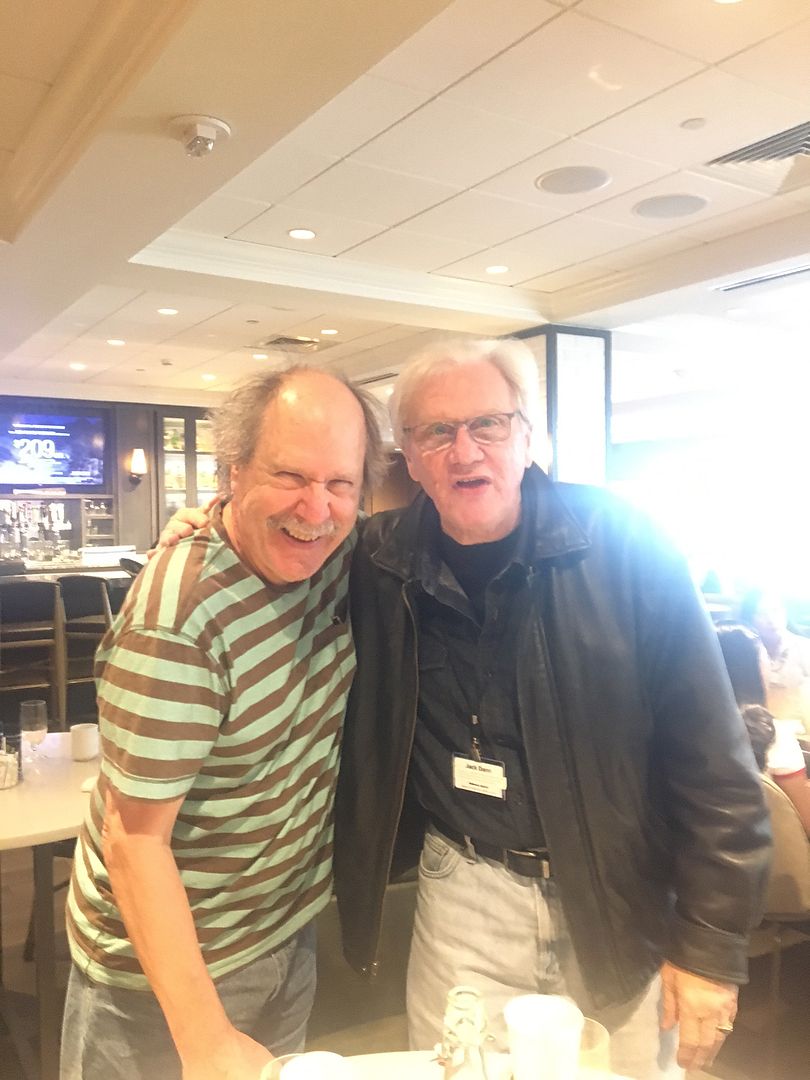
Paul Levinson & Jack Dann at Readercon 2019; photo by Tina Vozick

Wednesday, April 4, 2018

The Titan: Turning the Tables on Humans in the Cosmos

A common scenario in both science fiction and projections of what future science will do to help humans move out into the cosmos is terraforming: we use our technology to make an alien world more habitable, more comfortable, to humankind.  This could include the moderating the temperature, increasing the oxygen, adjusting the gravity, that sort of thing.

Much less frequent is modifying the human being to make us more comfortable on an alien world.  "The Enchanted Village" by A. E. Von Vogt from the early 1950s, which I read as a kid, is a great example, and has always stayed with me. An astronaut lands and come close to dying on Mars.  The environment just doesn't work for him.  As he reaches the end of his rope, he suddenly feels better.  Mars has somehow changed him into an intelligent organism that can flourish on its surface.

The Titan, which just started streaming on Netflix at the end of March, is a similar kind of a story, with the big difference that humans here on Earth are deliberately trying to genetically modify a select group so that they can live in the icy confines of Titan - Saturn's largest room - in comfort.  The result is a strong narrative, incorporating elements of horror as well as military science fiction.

One weakness is a change of character in Prof. Collingwood - well played by Tom Wilkinson, who plays everything well - which doesn't seem completely motivated. (This is a part of larger problem in movie-making, in which professors are often poorly conceived.)  The science is also a little fuzzy - or, at least, specifically what is being done to Lt. Rick Janssen (played by Sam Worthington, last seen by me in Manhunt: Unabomber, where he also did a good job), and how it all fits or doesn't fit together to make Titan habitable for him.

But the story (by Arash Amel, screenplay by Max Hurwitz - writer for Unabomber and Hell on Wheels - and directed by Lennart Ruff) still works, and Taylor Schilling does a fine job as a doctor who is also Rick's wife.  So, all in all, I'd recommend this.  At its best, the movie explores the question of how much of our humanity we're literally willing to sacrifice to go out and live in the stars.  And the timing is great, since this Monday I'll be convening a one-day conference (free admission) at Fordham University on the intersection of space travel and religion, Touching the Face of the Cosmos, with a Keynote by Brother Guy Consolmagno, Director of the Vatican Observatory.  We'll no doubt be exploring some similar issues.


Monday, January 15, 2018

Philip K. Dick's Electric Dreams 1.8 Impossible Planet: Eye of the Beholder


I've been saying throughout my episode-by-episode reviews of Philip K. Dick's Electric Dreams, the 10-part anthology of standalone episodes streaming on Amazon Prime, that this anthology has been attracting some top-draw stars.  I mean, we're talking Bryan Cranston, Steve Buscemi, Anna Paquin, Terrence Howard, Maura Tierney, Mireille Enos, and the like.  But episode 1.8, Impossible Planet, brings us Geraldine Chaplin (Charlie Chaplin's daughter, first big appearance in Dr. Zhivago) as a woman in her hundreds wanting to visit Planet Earth before she dies.

The story brings us back out into space and is pure Philip K. Dick, this time pitting us into a choice of not whether this person, memory, or thing is real or illusion, but whether the faux "Earth" the unethical captain is taking her to will fool her into thinking she's really back on humanity's home.  The ending - which as you know from my previous reviews I won't reveal - is also classic PKD.

More than most of Dick's stories and the movies and TV episodes made from them, though, Impossible Planet explores beauty (or, better, reality) in the eye of the beholder.   There's also an explicit religious element in this story, or a recognition that you can't talk about the wonder of the cosmos without some reference to God.

That part was especially music to my ears.  I long ago realized that what was missing in our efforts to get out into space was a connection to the need to know more about our place in the universe, which is inevitably not only scientific but spiritual.   Towards that end - to get that deeper element out in the open and into the mix of reasons to get out into space - Michael Waltemathe and I put together an anthology of essays and short stories in 2015, Touching the Face of the Cosmos, and we're planning a conference at Fordham University (with co-organizers Lance Strate and James Heiser) with Guy Consolmagno (the Pope's Astronomer) as keynote speaker this April. (I'll try to remember to put a link here to the formal conference announcement when it's up in the next few weeks.)

But back to Impossible Planet, the writing (from the 1953 story by Dick) for television and direction by David Farr (best known for MI-5 and The Night Manager) is excellent, as is the acting not only of Chaplin but Jack Reynor and Benedict Wong (Kublai Khan in Marco Polo).  Even the robot - a combination of Malik Ibheis and Christopher Staines, also due in part to "movement director" Ita O'Brien - was memorable, and reminded me of the great robots in Forbidden Planet and Day the Earth Stood Still.  And I'm pretty sure that's more than in just the eye of this beholder.

See also Philip K Dick's Electric Dreams 1.1 Real Life: Mutually Alternate Realities ...  1.2 Autofac: Human v Machine ... 1.3 Human Is: Compassion or Alien? ... 1.4 Crazy Diamond: DNA Batteries ... 1.5 The Hood Maker: Telepathy and Police ... 1.6 Safe and Sound: This Isn't A Drill ... 1.7 Father Thing: Dick from Space ... 1.9 The Commuter: Submitted for Your Approval ... 1.10: Kill All Others: Too Close for Comfort


with John Glenn, Guy Consolmagno, much more

Thursday, December 17, 2015

Touching the Face of the Cosmos just published


Click here, and then on Look Inside, to see Table of Contents


#SFWApro 


right after my interview John Glenn, appearing in the anthology


#7 on Amazon Kindle Top 100 Science and Religion a day after publication

Tuesday, September 29, 2015

Fordham University Press to Distribute Print Edition of Touching the Face of Cosmos; 1st Glimpse of Cover

Two very good pieces of news regarding Touching the Face of the Cosmos, the forthcoming anthology edited by Paul Levinson (me) and Michael Waltemathe:

1. Fordham University Press will be distributing the print editions of the book, which will appear in its Spring 2016 catalog, with a likely publication date in March.  Connected Editions will still be publishing all digital editions, with a likely publication date in November.   (A list of essays and stories can be found here.)   Paperback and hardcover editions now available for pre-order.

2.  Here's the cover - created by world-renown illustrator Joel Iskowitz.


And here's the catalog copy for the anthology -

Military advantage, scientific knowledge, and commerce have thus far been the main motives to human exploration of outer space. Touching the Face of the Cosmos explores what may be the best motive of all, largely untapped: the desire of every human being, essentially spiritual, to understand more about our place in the universe, how our lives on Earth are inextricably part of that bigger picture. Drawing on leading scientists, religious thinkers, and science fiction writers – including a new interview with John Glenn, and an essay by Director of the Vatican Observatory Guy Consolmagno, SJ – Paul Levinson and Michael Waltemathe have assembled a volume that puts space travel and religion on the map for anyone interested in outer space, theology, and philosophy. 
Paul Levinson, PhD, is Professor of Communication and Media Studies at Fordham University, and author of 16 scholarly books and novels, including Realspace: The Fate of Physical Presence in the Digital Age, On and Off Planet. 
Michael Waltemathe, PhD, is Senior Lecturer in Religious Education, Department of Protestant Theology, Ruhr-University Bochum, Germany, and author of Computer Worlds and Religion, and articles about science, religion, and outer space.

InfiniteRegress.tv