Chuck Todd interviews me about alternate histories
Showing posts with label Edward R. Murrow. Show all posts

Saturday, December 23, 2023

Maestro: The Memorable and the Missing


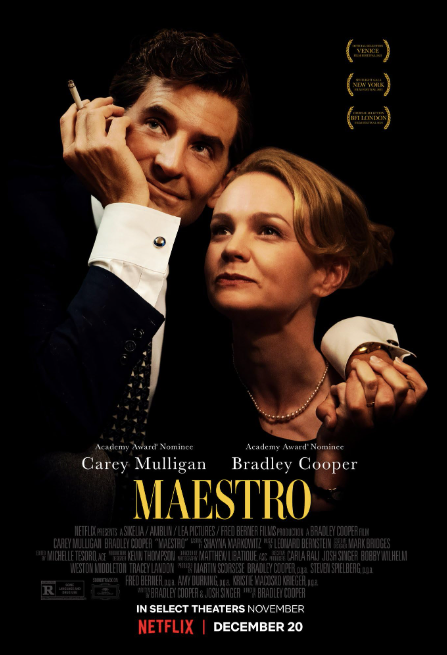
Let me start with what I really liked about Maestro, the biopic about Leonard Bernstein that went up a few days ago on Netflix, after opening in theaters in November.

Bradley Cooper's performance as Bernstein was tour-de-force, an incandescent, stunning rendition of how music inhabited, animated, catapulted the composer and even more so the conductor.  I've never seen anything quite like it on the screen.  Memorable is really too weak a word to describe it.

But here's what was missing for me:  There was no mention of Bernstein's 1967 CBS special Inside Pop: The Rock Revolution.  That TV program was a breakthrough in television and in popular cultural history.  The Beatles didn't need Bernstein to tell us how great and original they were.  Everyone with any ears worth having knew that already.  Same for Bob Dylan, The Beach Boys, The Rolling Stones. The Byrds, The Left Banke, Janis Ian, and other recording artists Bernstein featured on the program.  We already knew them, too.  And if we had any knowledge and appreciation of classical music, we already had come to the conclusion that this kind of rock and folk rock music in some ways exceeded classical music as pathways to our hearts and souls.  And would continue to do so into the future. But, Bernstein's CBS special was a welcome and crucially important signal anyway.  It broadcast a statement that still feels fresh today: music does not need to be orchestral and written in the past to be eternal.

And yet there was no mention of this at all in the movie.  All the more surprising given that David Oppenheim, prominently featured in Maestro as one of Bernstein's male lovers, co-wrote Inside Pop with Bernstein and was its producer.

And that's not all.  West Side Story is recognized as one of the greatest musicals of the 20th century.  That one musical -- because of its lyrics as well as its music -- probably has had more impact on the world than most of Rodgers and Hammerstein's wonderful musicals put together.  You hear some of the instrumental riffs from West Side Story in the background at one point in Maestro, and the famous interview with Bernstein and his wife Felicia on Edward R. Murrow's Person to Person is portrayed in the movie with a brief mention of West Side Story and Stephen Sondheim (Sondheim was not mentioned nor was the name of the musical in the actual 1955 interview).  But that's it for Sondheim in Maestro.  No short scene of him writing the lyrics or discussing the words put to music in West Side Story with Bernstein. Sondheim is thanked by the producers of Maestro in the credits but has nearly zero presence in the movie. Why was that?

The movie is somewhat controversial in its depiction of Bernstein's bisexuality.  He is depicted as genuinely loving his wife, passionately kissing her as he rushes offstage after his tempestuous conducting, and siring their children.  But he also flirts with men all the time, seductively massages David Oppenheim's foot, and is seen in bed with a male lover at the beginning of the movie.  Other than the fact that he had children, who knows if all of those interactions were an accurate portrayal of Bernstein's sexuality, if he was equally at home with either gender in bed, and if not, which one had greater carnal appeal.  So I'll confine myself to saying the whole gamut was very well acted in the movie.

And I'll hope to someday see another biopic of Bernstein that explores and presents a fuller tableau of this genius's extraordinary contribution to the world.

======

It's Real Life

an alternate history story about The Beatles

get the paperback or Kindle  here

or read the story FREE here


Sunday, November 23, 2014

The Newsroom 3.3: Journalism at the Barricades

Well, journalism is always at the barricades in The Newsroom, but it was especially and eloquently there in episode 3.3 tonight.

Neil's prosecution by the Feds, with Will stepping in to take the fire - because, as he says, the government would not have the gall to go after so an important news anchor - continues on center stage, with at least two memorable scenes.  One, at the beginning of the episode, features Charlie feigning to break into live coverage of the FBI ransacking ACN's computers, which gets the FBI to back down.   Later, Will gives the DOJ guy a good talking to, including that the DOJ bungled this operation, when the DOJ tries to threaten the wrong people - in this case, Will and company.

But, before the episode ends, Will gets served with a subpoena, making him wonder, in classic Newsroom ironic iconic style, if he maybe he's not that important after all.

Meanwhile, on a commercial rather than governmental plane, we get a great conversation between Jim and Hallie, over Jim's concern about Hallie taking a job with an online site that pays her incentives - aka "bonuses," as Hallie insists - for number of page views her stories generate.   Hallie fires back that every major news person from Edward R. Murrow to Will McAvoy got or get salaries based on the number of people who see their stories - aka viewers and ratings in television speak - so what's really the difference between her and them.?  And you know what?  Score one for Hallie and commercialism.   She's completely right that money makes the world go round, including the world of journalism (and, I might add, the academic world, too - professors are well paid).

Speaking of professors, we get a nice scene with Maggie and her Fordham law professor with a speciality in ethics.    But the EPA guy spouts insane overkill about the environment in Will's interview, and it wasn't clear to me what purpose he or this whole thread is serving.

Great episode, great series, let's hear it indeed for the First Amendment, Mr. DOJ guy.


Monday, November 15, 2010

Olbermann vs. Koppel: I Mostly Agree with Olbermann

So, we were just treated to one of Olbermann's "Special Comments".  It was advertised as about Ted Koppel, which indeed it was.  I consider Koppel one of the greats of TV news people - successor with his Nightline (which I watched raptly for more than 25 years) to Murrow and Cronkite.   I was prepared to say in this blog post, well, I came to Olbermann's defense over MSNBC's inane suspension of him last week, but now I'm back to disliking his tone and even the content of many of his "Special Comments".  Except - I think Olbermann is mostly right in what he just said about Koppel.

Ted Koppel's op-ed in the Washington Post - Olbermann, O'Reilly, and the death of real news - is what, understandably, attracted Olbermann's attention and ire.   You all know the points that Koppel makes - that Fox and MSNBC are conservative and progressive equivalents,  presenting opinions not news, and their success has destroyed "objective" i. e., "real" news.

I agree completely with Koppel on the first point - the style and partisan equivalence of Fox and MSNBC - and that's in fact the one big point Olbermann made with which I flatly disagree.  I don't know why Olbermann and Rachel Maddow and others on MSNBC insist that they are more factual and less partisan than Fox.  Maddow made this same point to John Stewart, in her superb interview with him last week. 

But otherwise - neither Fox nor MSNBC are newsless.  Indeed, the news reporting of Bret Baier and Shep Smith on Fox is every bit  the factual equivalent of actual news that is reported on MSNBC throughout the day and night.   On that point, then, Koppel is point blank wrong, and Olbermann is wrong in saying that MSNBC has more respect for facts than does Fox.

Were this where Olbermann vs. Koppel ended, I might give the match to Koppel - right where Olbermann was wrong on the first point (Fox and MSNBC are indeed equivalent), then both wrong on second (Koppel that neither Fox and MSNBC present facts, Olbermann that Fox does not but MSNNC does).

But Olbermann showed his mettle and rose to the occasion with as lucid an analysis as ever I've seen about the myth of objectivity in news.  It was never true and therefore, of course, is not today.

I often make the point to my classes that when The New York Times says "all the news that fit to print" - who are they kidding?  What we're really getting is all the news that the Times deems fit to print - i.e., selects for us to read.  And the same for Walter Cronkite, "and that's the way it was".  Not really.   A more truthful tag line might have been "and that's what the editors here at CBS thought you should think it was".  This is called gate keeping, and it's one of the things the Internet, and what I call new new media, have reduced and in some cases eliminated.

Olbermann correctly cited the finest moments of Murrow and Cronkite as not being objective, but partisan - as when Murrow called out Joe McCarthy and Cronkite spoke out against the Vietnam War.   The fact is that the public is best served not just by blind reporting of the facts, but by strong opinions and keen analyses right along with the facts.  That's what op-eds in newspapers - such as Koppel's about the death of news - are all about.  That, as Olbermann correctly noted, is what Koppel and the news media did not do during the build-up to the Iraq War, when all that was reported was the "fact" that Saddam had weapons of mass destruction.

Olbermann's  point - that the pursuit of the illusion of objectivity in journalism may hurt the democracy that journalism serves - may just be the important point Olbermann ever made.  It's certainly not made clearly or often enough.

Wednesday, August 19, 2009

And Now Don Hewitt, 1922-2009

Been a tough summer for the titans of early television. In front of the camera, Walter Cronkite was taken from us in July. And now comes the news that Don Hewitt, as great behind the camera as Walter was in front, has joined Walter.

Don Hewitt was 86. He is best known as the inventor of the tv news magazine - 60 Minutes, which debuted on CBS in 1968, and is the longest running prime time show on network television.

But Hewitt was there - meaning, here, on the screen, with us - far earlier. My parents bought their first television set in 1951, when I was four years old. I can't say that I remember the first broadcast of See It Now, with a cameo by Don Hewitt, on November 18, 1951 - but I know my parents did, because we talked about it years later.

Jonathan Sanders, formerly at CBS News, and now at Fordham University (I was pleased to bring to our faculty when I was Chair, several years ago), was good enough to send me this clip from that 1951 premier, now on YouTube. Jonathan notes Edward R. Murrow's classic line, at the beginning of the clip, "This is an old team trying to learn a new trade."

Keep watching, and you'll see and hear a little of Don Hewitt (bringing producers out front on a show was not an invention of Saturday Night Live....)

Nowadays, in the age of Twitter and YouTube and other new new media, we're all an old team learning a new trade - and it's never been more fun.

Thanks, Don, for helping blaze this trail that got us here.


See also Walter Cronkite Reaches the Cosmos

Friday, June 13, 2008

Edward R. Murrow to Tim Russert

The outpouring of grief over Tim Russert's untimely death today, at age 58, shows both the high esteem and affection that Americans hold for television journalists who protect our interests as untiring champions of the First Amendment.

When Thomas Jefferson and our Founding Fathers made the press the crucial guardians of our government - the watchdogs whose job it was to report to the American people what their government was really up to - Jefferson must have the likes of Tim Russert, and his unceasing speaking of truth to power, in mind.

He was not only the moderator of Meet the Press since 1991 - by far the most memorable - but he was NBC News' Washington Bureau Chief. He was one of the few who spanned traditional network and cable news, with his CNBC/MSNBC interview show. And he made a great guest appearance on Homicide: Life On Street, playing himself as character Lt. Megan Russert's cousin.

There are less than a handful of television reporters and anchors who in their different ways defined their genre and their age. Edward R. Murrow, Walter Cronkite (who is still with us), and Tim Russert.

InfiniteRegress.tv