Chuck Todd interviews me about alternate histories
Showing posts with label Sholem Aleichem. Show all posts

Saturday, December 7, 2019

Fiddler on the Roof - In Yiddish, Off-Broadway, Outstanding


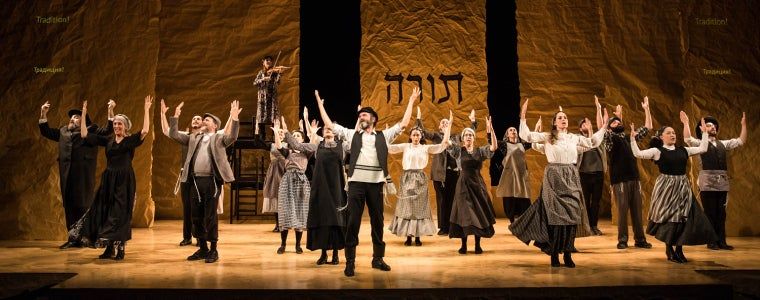
My wife and I just got back from Fiddler on the Roof - at the Stage 42 theater, appropriately enough, on 42nd Street, just a few blocks from Broadway.  In Yiddish - only appropriate, since the play (written in English by Joe Stein in the 1960s, with music by Jerry Bock and lyrics by Sheldon Harnick) is based on stories written by Sholem Aleichem in Yiddish at the end of the 19th century.

I've had a long relationship with this wonderful play and the stories it is based upon.  I read Sholem Aleichem as part of my Yiddish studies in shuleh at the end of the 1950s.  I saw the play in the mid-60s on Broadway with my entire family, including my grandmother, who had escaped Kiev with her brothers around the same time as Tevye struggles to make sense of the world that is coming into being in Fiddler someplace not too far from Kiev.  My wife played Yente in Fiddler in her summer camp, also in the mid-1960s.  And we saw the movie with Topol as Tevye in the early 1970s.

And, what can I say, this marvelous play has special relevance to our own times because, well, it's about life in Russia and Ukraine, and on one level is about the intolerance of the ruling class (Russians) to people viewed as irrevocably others (in this case, people like my maternal grandmother and her brothers, and, by descent, people like my family and me).  That's the political subtext and sometimes text of this story.

But the continuing forefront of the play is how Tevye, father of five daughters and seeming defender of tradition, finds his beliefs severely tested as his three oldest daughters each break way from tradition in the mates they choose to marry in successively more drastic ways.  These stories are conveyed in wonderfully memorable songs, brought into motion by some astonishing dancing. In one case, of four men with bottles balanced precariously on their heads as they danced,  I couldn't tell if the bottles were in some way attached to their hats (via velcro or whatever), they danced so well without disturbing the bottles [Note added 13 December 2019: But see comment below from Fiddler choreographer: Amazing! The bottles in this breathtaking performance were actually balanced on the dancers’ heads!].   If only Tevye were able to balance the vicissitudes of his life so effectively.  If only everyone else was, then and today.
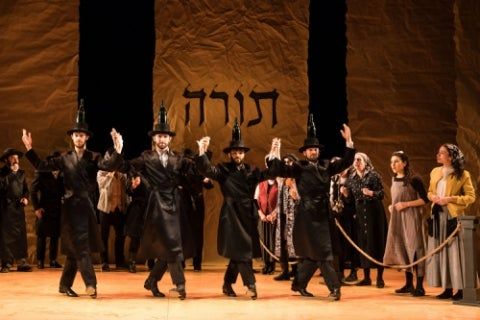


Steven Skybell as Tevye was just superb, as was every single other person in the cast.  Hearing it in Yiddish, which I can understand just a little better than a bissel, was a joy. The story and the acting brought tears of every kind to my eyes.  It's rare that I say this about any play, movie, or television show, but seeing that play was a truly life-affirming experience. Fiddler is supposed to close in early January 2020.  See it if you can!

Monday, January 7, 2013

Downton Abbey

No time travel or serial killers, so what's a review of Downton Abbey doing here?  Hey, it's a great period piece that takes place just a tad earlier than Boardwalk Empire, but that's not really the reason either.  Downton Abbey is a guilty pleasure for a science fiction and in-your-face criminal fiction fan.

Not that the period details aren't excellent and delightful.  The first season takes place right before World War I, the second during and right after the war, and last night's debut of the third season on PBS in bright new 1920.  We see the early use of the telephone and prime time for the telegram, the evolution of the automobile, and all manner of superb clothing.

But the heart of Downton Abbey is where the heart is - the story of the Earl and Countess Grantham and their three daughters.  Yep, there's a Fiddler on the Roof flavor here, as the Earl encounters problems more or less profound with the romantic interests and future husbands of each of his young ladies.  But he also has financial problems of his own - unlike Tevye, who's too poor to worry about money - and these figure not only in the first and second seasons, when the family wants a not completely obliging to Mary, oldest daughter, to marry Matthew to keep the estate in the family (long story), but in last night's season three opener, when Grantham learns all of his investments in Canada, all of his money, went south (not the U.S., but lost).

Thus, as the world moves into the Roaring Twenties and some wild prosperity, the Granthams are in danger of moving in the opposite direction, towards a Great Depression a premature decade earlier.  Mary and Matthew, who in fine Pride and Prejudice style now have at last embraced each other and their powerful love for one another, are once again in the financial soup with the family.  Matthew is in for an inheritance from the father of a woman he put aside to marry his true love Mary - but the father didn't know that - and this money would be all that was needed to keep Downton Abbey viable.  But Matthew, the epitome of morality, doesn't feel right about taking this money.  Mary disagrees, almost wrecks their impending marriage, and though her love for Matthew prevails, this issue will continue to play out this season.

The other possible source of money for Grantham comes from his wife's family, where Grantham's money came from in the first place.  Lady Grantham's an American, and her mother, Mrs. Levinson (no relation) played by Shirley MacLaine, comes to visit for the wedding.   No money from her however.   But lots of good laughs, and the two grandmothers - Levinson and Violet Grantham (played by Maggie Smith) - had some of the best lines last night (as Violet did in the first two seasons).

Now I haven't said a word yet about the downstairs, and they provide a foundation and tapestry to Downton Abbey every bit as rich and rewarding as the downstairs in Upstairs, Downstairs.  Butler, footmen, valets, cook, housekeeper, maids - they're all here and in fine, feisty form.   They also provide an oddly compelling noblese oblige for the survival of Downton Abbey - to continue their employment, There's romance, intrigue, knives in the back, and even some law and order, 1920s UK style, as Bates, one of the best characters, sits in prison for a murder he had good motive for but almost definitely did not commit.

So ... just wanted to let you know about this series in case it's your cup of tea.  I'll soon be back reviewing Fringe and Bones, Breaking Bad and the Borgias, but when you're not looking and I'm not writing I'll also be checking in to Downton Abbey.  "Professor Levinson, from America and 2013, via time machine."  I'd even put on my tuxedo, closest I have to a formal coat, but boy would I love to come by with Tina for one of those splendid dinners.


Praise for the novel...

"...challenging fun" - Entertainment Weekly

"Da Vinci-esque thriller" - New York Daily News

"...a fun book to read" - Dallas Morning News

"resonates with the current political climate . . . . heroine Sierra Waters is sexy as hell . . . . there's a bite to Levinson's wit" - Brian Charles Clark, Curled Up With A Good Book at curledup.com 

"a journey through time that'll make you think as it thrills ... so accessible, even those generally put off by sci-fi should enjoy the trip." - Rod Lott, bookgasm.com

"Levinson spins a fascinating tale ... An intriguing premise with believable characters and attention to period detail make this an outstanding choice... Highly recommended." - Library Journal,*starred review

"Light, engaging time-travel yarn . . . neatly satisfies the circularity inherent in time travel, whose paradoxes Levinson links to Greek philosophy." - Publishers Weekly

"A thinking person's time travel story... I felt like I was there." - SF Signal


Friday, December 30, 2011

Four Important Documentaries in 2011

Looking back at 2011, I would say that it was a great year for documentaries.  Here are four that I had the pleasure to see, learned a lot from, and reviewed.  They are listed in date order, because ranking them would be apples and oranges.  The dates and links are those of my reviews, which could be earlier than official release dates, in cases in which I was able to see a preview.

  • January 6, 2011:  There But for Fortune, Kenneth Bowser's vivid, incisive movie about Phil Ochs, second only to Bob Dylan in the opinion of many, certainly above Dylan in some ways ... more relevant than ever in view of Occupy Wall Street and the Arab Spring ... look for it on PBS in 2012 ... details on the movie's Facebook page
  • September 2, 2011: Connected, Tiffany Shlain's triple threat movie, one part bio-doc about her father Leonard, one part history of media ala Marshall McLuhan, one-part about the growing interconnectedness of our world now expressed in Occupy Wall Street and the Arab Spring ... details on the movie's Facebook page


Sunday, August 14, 2011

Sholem Aleichem and Marshall McLuhan

I saw Joseph Dorman's 2011 documentary, Sholem Aleichem: Laughing in the Darkness, with Tina last night.  Superb footage and sage commentary about the man born Sholem Rabinovich in Russia in 1859, who died world-renown under his pen name Sholem Aleichem in New York City in 1916 (a year after my father was born here in 1915, four years after Marshall McLuhan was born in Edmonton in 1911).  Sholem Aleichem was known as the Yiddish Mark Twain.   Given one of his specialties in ironic endings of short stories, he also could have been known as the Yiddish O'Henry or De Maupassant.

But the Twain reference speaks most to Sholem Aleichem's relevance to Marshall McLuhan.  Mark Twain's ear for American vernacular, and capacity to put it on the written page, fired up his master works Tom Sawyer and Huckleberry Finn.  Aleichem did the same for Yiddish.  McLuhan provided tools for explaining this genius of both writers - hybrid energy, their capturing of one mode, the acoustic, and rendering it convincingly in another mode, the visual.

As Dorman's movie makes clear, Sholem Aleichem might have written in Russian, his native written language, or in Hebrew, the formal, sacred language of his people.  Instead, he chose to write in the shtetel slang he heard all around him.  This made him cooler than Tolstoy and the Talmud, a written rapper of his time.

McLuhan understood and wrote about the power of slang, including its transformation into cliche and in turn into archetype (see my Digital McLuhan and its discussion of McLuhan's tetrad for more).  Sholem Aleichem, alas, died a decade before his work would achieve its full archetype status - in the Soviet Union, Palestine, and America, in different ways, as the movie shows.

Laughing in the Darkness now buttresses that enduring status.   I had one quibble with the documentary - it made no mention of Joe Stein, who wrote the play, Fiddler on the Roof,  which catapulted Aleichem's Tevye the Milkman stories into theatrical and then cinematic prominence in the 1960s and 70s.  Although I studied Sholem Aleichem in the Workmen's Circle Yiddisheh shuleh in the late 1950s, and heard about him from my parents and grandparents, for many people Fiddler was their introduction to Sholem.

From the ear to the page to the screen, a McLuhanesque story of media evolution right there.

InfiniteRegress.tv