Chuck Todd interviews me about alternate histories
Showing posts with label photography. Show all posts

Sunday, June 12, 2022

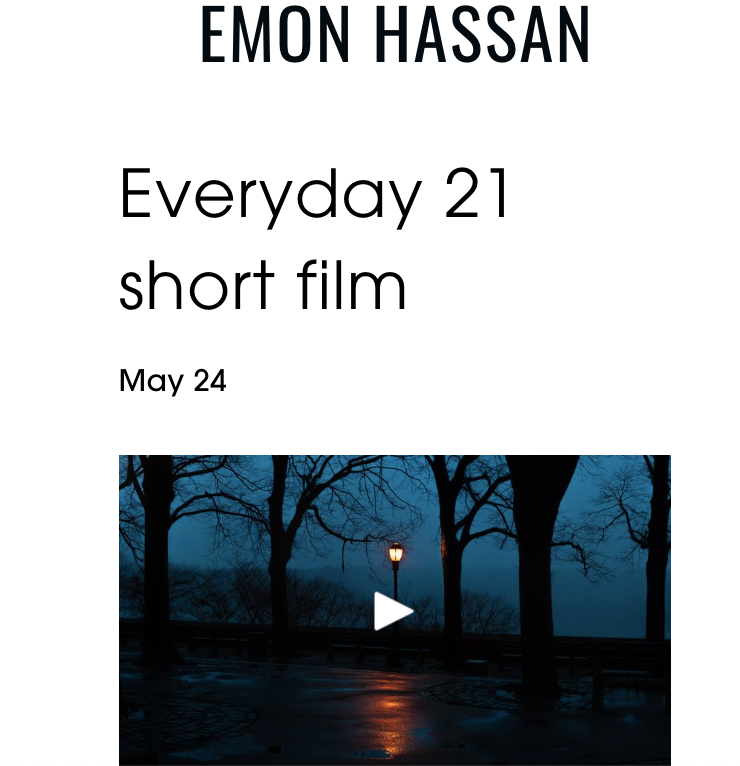
Everyday 21: The Interstellar Anthropologist


Emon Hassan is a gifted photographer and movie maker.  I didn't know that he is also a gifted composer.  He combines all three in Everyday 21, a short film of hauntingly beautiful and profound photographs -- one for every day of the year of 2021 -- backed by quietly breathtaking music that brushes against the edge of your soul.

Hassan's goal was to "find the story" in each day of 2021, and capture that story in a photograph.  The result defies literal summary, because it cuts so keenly, to a part of the brain that is moved by the music in songs, the deeper almost inchoate part that lives below and soars above the words.

But to give you a hint of what you'll find here in this 13 minute and 33 second short movie that is short on nothing: a flower growing in a hole in a wall, lots of cracks in structures, words that exist in signage that tell a story that transcends any wordsmith or poet.

Is it a coincidence that the year being so chronicled is 2021, which began with the attack on the U.S Capitol and continued the decimation and fear engendered by COVID-19?  Probably not.  Hassan is a sensitive being, and decisions as to where he pointed his camera, what to include and not include in this tableau, the order of the photographs, all were made by someone who has a golden unflinching antennae to what is going on in the world.

There are very few human faces in this documentary.  And I'd guess that's because Hassan is more interested in the results of what people do, than who they are, or look like.  I've been watching and reviewing a lot of science fiction of late -- though I guess I've been doing that for years -- and Everyday 21 has what feels to me like an interstellar quality, even though all the photographs are from Earth (and I think, but don't know for sure, that they all were taken in New York City).  It's almost as if Hassan is an interstellar anthropologist, tasked with reporting back home to what's going on here on Earth.  Not news events.  Artifacts.  Produced by our species.  Reality.  And captured by one of our most luminous members.

See the movie, anytime, here, for free.


Wednesday, July 5, 2017

What the Amelia Earhart History-Changing Photograph Says about the Power of Photography


I've been thinking all day about the newly uncovered photograph of Amelia Earhart and its upending of history, telling us she indeed survived that dive her plane apparently took into the Pacific Ocean in 1937.

We're told the photograph has not been altered - was found in a long-neglected file - and it coincides with what people who live in the Marshall Islands have long believed and having been saying. Experts have said her body proportions - from shoulder to hip - match photos we already have of Earhart.  That seems like more than enough for me to think this photograph has changed history.

But we already knew what the island inhabitants believed.  So the essence of this upending is that we believe the photograph is bonafide.  Were it not, it wouldn't matter what the experts said about the body dimensions, because all of that could have been deliberately woven into the photograph.

In this day and age of fake news, photo manipulation is a fact of life and media.   But that goes back to the very origins of photograph, as I explain in Fake News in Real Context.  Lincoln was a subject of photographic manipulation, during his life and after.

But the photo of Amelia Earhart, as far the experts tell us and therefore as far as we know, has not been manipulated.   Alteration of pre-digital photographs may not be as detectible as digital fakes, but, for the time being, I'm willing to believe the experts.

I won't be shocked if the photo turns out to be bogus.  But for now, I just love that 80 years of history has been changed by one registration on a photographic plate.  I've argued for years with critics who say a photo is no more real in the objects its captures than a painting.  But it obviously is.  Though it can be altered, its very essence is a capturing of what is in front of the camera as it actually is - unlike the painter's inextricably subjective vision - just like motion pictures and videos.  (See my 1997 book, The Soft Edge: A Natural History and Future of the Information Revolution, for more).   Today's news about Amelia Earhart, and the repercussions it has made for history, will from now on be the best example of this privileged relationship between photography and reality.


Monday, October 27, 2014

Photography Flips into Snapchat

One of the joys of understanding McLuhan is how his insights can leap forth at unexpected times to supply us with a connection or a new insight about a matter - or medium - at hand.  About six months ago, I came to realize that the photograph has flipped into the selfie in our own day and age.  Just yesterday, I did a little podcast on this subject - in which I also pointed out that radio has flipped into the podcast. And today, just a few hours ago, I realized that photograph has also flipped into Snapchat.

One of the best things about McLuhan's tetrad or four laws of media is that a given medium can enhance, obsolesce, retrieve, and flip into multiple media.  In case you'd like a quick refresher on the tetrad, it is an exploratory tool that McLuhan developed to help us make sense out of the emergence of media.   Take radio, for example:  It (1) enhances or amplifies sound (speech, music, etc) sent instantly across great distances simultaneously to lots of people; (2) obsolesces the written word as in newspapers as a mode of news delivery; (3) retrieves the spoken word that of course never really went away but was eclipsed to some extent by the products of the printing press; and radio, when it is pushed to its limits, (4) flips into television, which broadcasts like radio but re-inserts the visual into the mix.   And, radio, the professional mass medium, also flips into podcasting that anyone with a microphone and a connection to the Internet can do.    More on the tetrad in my book, Digital McLuhan, pictured below.

But back to photography: its flip into Snapchat is profound indeed, because permanency has always been one of photography's hallmarks.  As Andre Bazin so aptly noted, a photograph rescues an image from "its proper corruption in time".  In contrast, the Snapchat photo is deliberately intended to corrupt over time - and very quickly.  Because the essence of Snapchat is that you send someone a photograph that you want him or her to see only when they receive it, and not any time after.  If only former Congressman Anthony Weiner had known about Snapchat!

So we can now add Snapchat to the selfie as one of the media that photography has flipped into.   Like a reflection in a pool of water, which can also be a selfie and also can disappear as soon as the person staring into the pool walks away, Snapchat epitomizes the ever percolating evolution of media to forms that are at once both new and well established in our past.

See also Marshall McLuhan and the Kindle and Tetrad on Eyeglasses Flipping into Google Glass 


                               the spoken word
     McLuhan and the Kindle          |     McLuhan and the Selfie

Monday, December 1, 2008

Cameron Meets A. E. Housman and Andre Bazin in The Sarah Connor Chronicles

An appealingly old-fashioned, almost sweet episode 2.11 of The Sarah Connor Chronicles tonight, with talk of A. E. Housman (of "An Athlete Dying Young" fame) and the capacity of photography to, as Andre Bazin put it, rescue an image from "its proper corruption" in time - make the image, in contrast to the reality, live forever.

As I discuss in my book, The Soft Edge, years ago I was at a flea market in Stanfordville, NY. I picked up a photograph from a table - I could tell by the kind of photography (cartes de visite) that it was taken back in the 1870s. The photo was of a woman, likely in her late teens, early twenties. And, there she was, looking out at me - across more than 100 years. Could she have had any idea, when that photograph was taken, that someone a hundred years later would be looking back into her eyes?

Cameron and a guy she knows in a library contemplate and discuss such things, as they hunt through a nifty series of photographs, recordings, and early film from the 1920s and after. They discover Myron Stark, whom Cameron recognizes as a Terminator. He accidentally burns down a New Year's Eve celebration - the fire was caused by the electricity that accompanies all travel through time. But he's not a good Terminator at all. He's on a mission - to kill someone at an appointed place in ... 2010. Stark has just arrived at the wrong time.

But it's the right time for this part of The Sarah Connor Chronicles, because it gives us a chance to see even more closeness to humanity in Cameron. She and the guy in the library, who's in a wheelchair, could almost become a couple ... except, well, he's very ill, and although it's not 100% clear why he's gone at the end, he's gone, and Cameron, after all, is still a Terminator.

She figures out what Stark is up to, and finally takes him on in the flesh and circuits, as the photographs of the past merge with the reality in the present. It's poetic - Stark's progress from old photography to real life - and much as A. E. Housman said. The Terminator never had to worry about seeing his record surpassed as he grew older, but neither was he better off dying young, because he was never alive in the first place.

And the same is true of Cameron. Whatever she had slightly going with the guy in the library couldn't last, because he, disabilities of not, was frail and human, and Cameron is something else. Will she miss the guy in library? Maybe the most we can say is she learned something from him, but who knows what, and she shows up next time, with donuts again, to get into the new person in the library's good graces ... this time, a woman her own age.


See also 2.1 Cameron's Back ... 2.2 Firing on All Cylinders ... 2.3 Who, Truly, Is Agent Ellison? ... 2.4: Meet Allison ... 2.5: Unpacking the Future ... 2.6: Terminator Mom, Human Daughter ... 2.7: The Saving Robbery and Cromartie ... 2.8 Perspectives and Death ... 2.9: An Idiot's Guide to Time Travel in The Sarah Connor Chronicles ... 2.10: Riley Lashes Out at Facebook ... 2.12: Sarah Connor Chronicles in Triple Time


The Plot to Save Socrates


"challenging fun" - Entertainment Weekly

"a Da Vinci-esque thriller" - New York Daily News

"Sierra Waters is sexy as hell" - curled up with a good book


more about The Plot to Save Socrates...

Get your own at Profile Pitstop.com


Read the first chapter of The Plot to Save Socrates
.... FREE!

Monday, July 16, 2007

Digital Framez

Media evolution proceeds in spurts - some parts of new media progress faster than others. Digital photography has revolutionized the ease of taking photographs. But the display of our photographs has either remained in the pre-digital age, when we print out our photos and put them in static frames, or has relied upon the awkward procedure of everyone who wants to see a photograph or an album craning their necks around a computer.

Digital Framez has a solution - a digital photo frame, which can display either single photos or albums. You can set the time you would like the photo to display, and the transition time from photo to photo in your digital album. You can place the digital picture frames on any wall, or set them on your coffee or side table.

The great snapshots from your digital cameras and camera phones need no longer be hostage to the past. They can be displayed in a manner in tune with the digital age. You can display a digital movie in your digital photo frame, too.

I wrote about something I call "digi-prints" in my science fiction novel, Borrowed Tides. You can see a similar magic in Harry Potter's photographs.

Now you can begin to enjoy something like this for your own photographs in Digital Framez.

this is a smorty-sponsored post
InfiniteRegress.tv