Chuck Todd interviews me about alternate histories
Showing posts with label Frank Herbert. Show all posts

Sunday, December 22, 2024

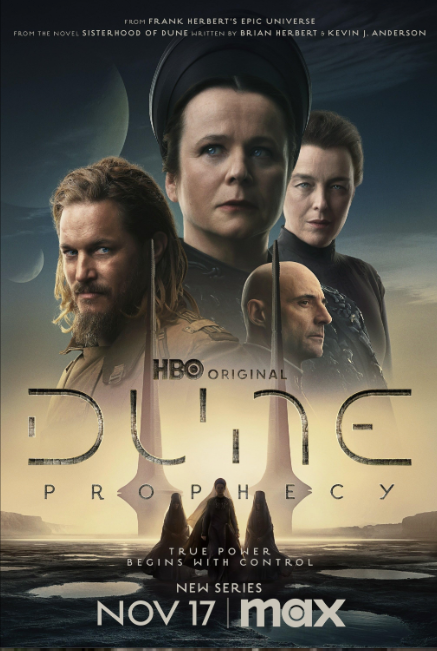
Dune: Prophecy Season One Finale: Truths Coming Out


Dune: Prophecy put up a powerfully long finale tonight on Max -- an hour and twenty-one minutes -- for its short six-episode debut season.  And it made every minute and sound of the Voice count, as it dealt out a series of blows and retributions and affirmations of what we already knew and suspected.

[I'm not going to give you a detailed recap, but I suppose I should warn about spoilers anyway ... ]

First, we learned more of the brutal truth about what Valya was willing to do, and did, to insure that the Sisterhood went her way.  That way was to keep AI as an essential weapon in the Sisterhood's arsenal. I agree with Valtya's view of AI,  But as to her methods ... well, we see that she killed not only Dorotea but a vast majority of the Sisterhood in that room, because they opposed her view, and thought AI was a blasphemous threat to humanity.

Later, we're also treated to a battle royale between Valya and Desmond Hart.  It's pretty much a draw.  As readers of my reviews here of Dune: Prophecy know, I've been a bigger fan of Hart than Valya.  They might both have well died, had not Tulya arrived and rallied her sister Valya -- and then, after convincing Valya to let her son Hart be, because she as his mother not only loved him but was sure she could control him, Tula goes and tends to her wounded son.  I said a few episodes ago that I thought Tulia would ultimately be a more potent character than Valya, and I think she proved it in that scene and in this episode.  

One thing I didn't like, though, was the Emperor's self-inflicted death.  He wasn't a bad Emperor, as far as Emperors go.  But leaving a Bene Gesserit in the palace, who now through face- and body-shifting looks just like Princess Ynez, I thought that was a pretty cool move.

All in all, I think these six episodes have offered a memorable and captivating prologue to the Dune saga. Kudos, again, to Kevin J. Anderson and Brian Herbert who wrote the novel Sisterhood of Dune, which I haven't yet read and on which Dune: Prophecy is based, Frank Herbert who got the Dune saga going with a series of masterpiece novels, and everyone who starred in this TV series.  

I'll see you back here when the second season comes along.

See also Dune: Prophecy 1.1: Compelling Prequel ... 1.2: The Hart of The Matter ... 1.3: The Power of Voice ... 1.4: The Ambience ... 1.5: Revelation and Seduction

and Dune, Part One: Half the Movie, Twice the Power of Most Other Complete Films ... Dune, Part Two: Not As Good as Part One


Wednesday, December 18, 2024

Dune: Prophecy 1.5: Revelation and Seduction


There's more than one revelation in the riveting Dune:Prophecy 1.5, but I'll focus here on only one, clearly the most important in this series:

[And of course, there will be spoilers ahead ... ]

We learn about Hart's parentage.  First, let me say again how much I enjoy the ambience of this prequel series, which feels so much like I felt in the 1960s, when I first read Dune and Dune: Messiah, the original Dune novels.  My eyes on the streaming screen give me the same feeling as my eyes on those paperback books.   They feel the same and smell the same, though of course, anything my brain perceives in watching Dune: Prophecy is entirely a product of my brain processing what I'm seeing on my laptop.  I'm not touching any paper or perceiving what subtle stimuli it delivers to my nose.

But what is Hart's heritage?  Anirul -- the aptly named AI system that the Bene Gesserit illicitly utilize (also a sensory pleasure to see in action) -- delivers its conclusion: Hart comes from both Atreides and Harkonnen lines!  Now we saw the two lines mate, as it were, just a few episodes ago.  Young Tula Harkonnen and her Atreides lover, whom she kills the morning after.  It makes sense, doesn't it, that someone with the powers of Desmond has to be the product of the two most powerful lines that stretch across the Dune saga, of course making their appearance in the very first novel by Frank Herbert.

Meanwhile, apropos love making, it was good to see Empress Natalya seduce Desmond -- God knows what that will produce if she becomes pregnant -- and Sister Francesca doing the same to the Emperor himself.  I tell ya, they got the royal couple coming and going in this episode, fortunately or unfortunately not together.

My only regret about this series is that it's a mini-series with a vengeance, the first season ending next week with only its sixth episode.  But it's shot to the top of my list, and I'll be back here not only next week with a review, but whenever its story continues on HBO: Max.

See also Dune: Prophecy 1.1: Compelling Prequel ... 1.2: The Hart of The Matter ... 1.3: The Power of Voice ... 1.4: The Ambience

and Dune, Part One: Half the Movie, Twice the Power of Most Other Complete Films ... Dune, Part Two: Not As Good as Part One


Monday, December 9, 2024

Dune: Prophecy 1.4: The Ambience


We learn a lot in every episode of Dune: Prophecy.   Before I tell what specifically I learned in episode 1.4, let me begin with an overall ambience I realized I was experiencing when I was watching this episode last night:  there's something about the pacing, the cinematography, the dialogue, the acting, I don't know, about Dune: Prophecy that makes me feel I'm in the original Frank Herbert Dune novel and its Dune Messiah sequel.  More so, much more so, than the original David Lynch movie, and the more recent efforts by Denis Villeneuve.  I haven't read the Sisterhood of Dune prequel by Kevin J. Anderson and Brian Herbert that is the basis of Dune: Prophecy and of this authenticity feeling I have about it -- whether it's in the Sisterhood of Dune, or just in Dune: Prophecy, or in both -- so I don't know who deserves credit and thanks for this.  I guess like the Dune saga itself, it's real and powerful, but its specific contours are blurry (cool, in Marshall McLuhan's sense), and it maybe, likely, adds to the charm of this narrative on HBO Max, or even is responsible for it.

Now on to some more specific things I learned last night, and here of course there will be a few spoilers in what follows:

  • It's confirmed that Desmond's fearsome ability to burn people from the inside out can indeed extend across the galaxy -- it's the case that Kasha's burning at the same time as Pruet was not somehow a reflection of Pruwet's burning.  He and Kasha were both burned by Desmond at the same time.
  • Desmond's power to burn people extends to more than two at a time.
  • A single Bene Gesserit is so far no match (for want of a better word) for a one-on-one with Desmond.  It will likely take some sort of group of Bene Gesserit to do him in.
What other powers does Desmond possess?  Is he responsible for Lila's awakening?  Also, I said last week that I'm liking Tula more than Valya.  I'm also beginning to think that Tula not Valya may be the one to bring Desmond down (if anyone can do that).  There is something about Valya that is too ... obvious. She and her wiles are easier to spot than Tula's.  We'll see.

And I'll be back here next week with my review of the next episode.

See also Dune: Prophecy 1.1: Compelling Prequel ... 1.2: The Hart of The Matter ... 1.3: The Power of Voice

and Dune, Part One: Half the Movie, Twice the Power of Most Other Complete Films ... Dune, Part Two: Not As Good as Part One


in Kindle and paperback

More books about McLuhan and the media at Connected Editions

Monday, June 3, 2024

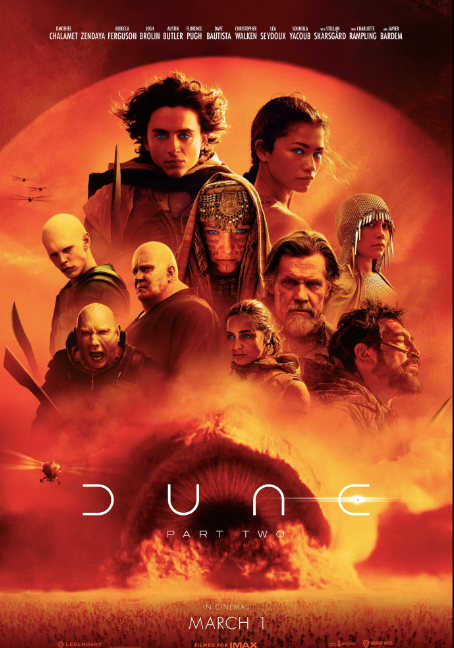
Dune Part Two: Not as Good as Part One


I'm beginning to think I'm bound to be disappointed seeing a science fiction trilogy I love brought to the screen.  Those of you who have read my reviews of Foundation, and/or listened to my discussions of the Apple TV+ series on podcasts, will know my frustration with that TV series.  In a sentence, the part that had nothing to do with the original trilogy, the Cleon clones, was the best, and the series lacked some of the strongest parts of the trilogy (or the extent of the trilogy that has so far appeared on the screen).

Ironically, I thought the first part of Denis Villeneuve's rendition of Dune was excellent on just about every level (here's my review).  But the second part, which I just saw last night, indulged in major changes in major characters, and left others completely out.

[Spoilers ahead ... ]

Let's start with Chani.  The love that she and Paul had for each other lit up the second half of Dune (Frank Herbert's original long novel).  In the movie, she's annoyed or angry with Paul in just about every other scene of the two, including storming off and away at the end.

Alia, Paul's sister, an extraordinary character in the novel, with all kinds of powers derived from the spice she received in Jessica's womb, is seen in the movie only briefly as a young adult in a vision Paul has of the future.  A child with such wisdom and power was a cardinal element of the novel.  In the movie she's reduced to a voice that Jessica hears, presumably coming from the baby she's carrying.  

And what happened to Thufir Hawat the Mentat?  And the Space Guild?  Their way of bending space with their minds actually received more attention in the Foundation TV series, though they indeed were extensively developed in the Dune novel. 

Meanwhile, Feyd-Rautha had plenty of screen time, but I thought his character was reduced to a cartoonish cliche, complementing one Atreides opponent before he kills him, and Paul himself as Feyd-Rautha is about to die from Paul's superior knife-play.  The actual fight, I'll admit, though, was excellent.

And while I'm on the subject of what was excellent in Dune Part 2, I thought Javier Bardem delivered in every scene as Stilgar, whose part was well-drawn in the movie, as did Florence Pugh as Princess Irulan, surprisingly relevant in the movie as in the novel.  Indeed, all the acting was fine or better in Dune Part 2, as was the cinematography.

But I'll end with one more complaint: I don't know, but the scenes of Paul riding the sandworm just weren't as impressive as the scenes required.  All too often, they looked to me as if Paul was riding some kind of undulating carpet made of sand (I was half expecting to hear Steppenwolf in the background).

In sum: see Dune Part 2 -- if only to prepare yourself for the third installment, which will bring Dune Messiah to the screen, which I hope will remedy some of the many problems in Dune Part 2.

See also: Dune, Part 1: Half the Movie, Twice the Power of Most Other Complete Films


Sunday, March 31, 2024

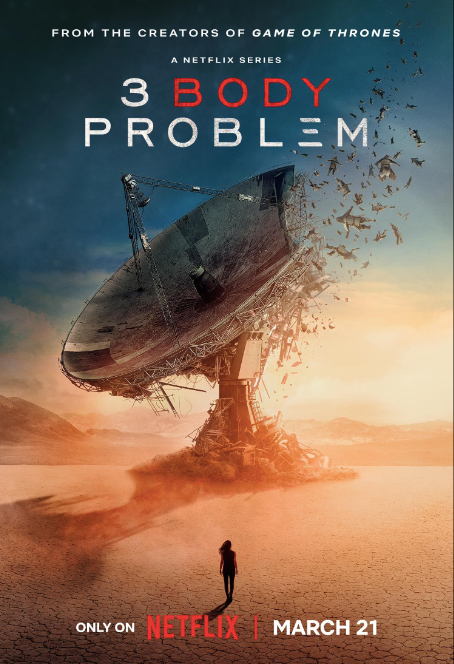
3 Body Problem: The Joke Was Great, and the Last Few Episodes Were Even Better


I haven't read the novel by Liu Cixin and its sequels, and I didn't read much about the series because I wanted to be surprised.  I'd say the first season of 3 Body Problem was superb -- a powerful mix of thought-provoking, stunning action, and heartbreaking human stories, all in support of a story of a life-threatening interstellar intelligent species, the San-Ti, who have been in contact with our planet for more than 50 years and now are approaching us, some 400 years away from arriving, which may mean the end of our species.  And there was a wise and funny joke about Einstein and God which I hadn't heard before.

But almost all of that happened in the last few episodes, and the beginning and middle of the eight-episode first season was bogged down with a computer game the interstellar beings are doling out to various people on Earth for various reasons.   I've always enjoyed science fiction about computer games interacting with reality, beginning with Orson Scott Card's path-breaking and brainy Ender's Game, but its situation in 3 Body Problem was needlessly repetitive.  The heart of 3 Body was closer to Arthur C. Clarke's Childhood's End and Damon Knight's "To Serve Man" (see this collection of Knight's stories), and the first season of the 3 Body television series, whatever may have been done in the novel, should have spent more time on that.  (This slow start is reminiscent of another iconic novel in science fiction, Frank Herbert's Dune, that also took a long time to get going, but once it did was fabulous, and led to not just a trilogy but a whole series, exceeded in excellence only by Isaac Asimov's Foundation novels, in my opinion.)

But speaking of hearts and brains, biology was actually far more the star of the first season than was space travel.  This puts 3 Body Problem in a league with Andrew Niccol's debut motion picture Gattaca.  If I'm making 3 Body sound derivative, that's because it is, but that's ok, because the first season puts all of these perennial elements of science fiction together in an original, compelling way.  It's not every day you see a science fiction series starting in Mao's China and its emphasis on ideology over truth (a problem unfortunately arising now in the United States and other parts of the world, off the fiction screen and for real), moving into a life-and-death James Bondian present fighting for the survival in the future of our very species.  

Ironically, the unflattering depiction of intellectual life in Mao's China at the beginning of the 3 Body Problem television series contradicts the warning that five Republican US Senators sent to Netflix in 2020 that the TV series would just be spreading Chinese propaganda. Of course, those Senators and no one other than the creators of the TV series had any idea what would actually be depicted in the TV series, and thus those Senators based their concerns on the novel. The original Chinese publication of the novel indeed did not begin with the jolting scene of a physicist brutally killed in the throes of the cultural revolution -- because he believes in truth over ideology -- but that scene did appear in the middle of the original Chinese novel, and at the beginning of the English translation (Liu Cixin confirms that he wrote the novel with that scene at the beginning). Apparently those US Senators didn't take the time to read the novel before offering their ill-founded concerns about the TV series.

In any case, I don't recall seeing anything quite like this TV series at all, and I'm eagerly awaiting the second season and more.  The dialog, by the way, was excellent, as was the acting.  Nearly everyone was new to me, other than Game of Thrones' Liam Cunningham, and it was good to see him on the screen again. Kudos to David Benioff, D.B. Weiss, and Alexander Woo for creating the series, and kudos to me for not having to warn you about spoilers in this review, because they really aren't any, are there?


Wednesday, January 25, 2023

In-Depth Discussion of Golden Age Science Fiction


If classic science fiction is your cuppa tea, you might enjoy this in-depth interview about  A. E. Van Vogt, Isaac Asimov, Robert Heinlein, Frank Herbert, capped off with a reading of my alternate history story about John Lennon, "It's Real Life", which can read in its entirety, for FREE, right here.

Friday, October 22, 2021

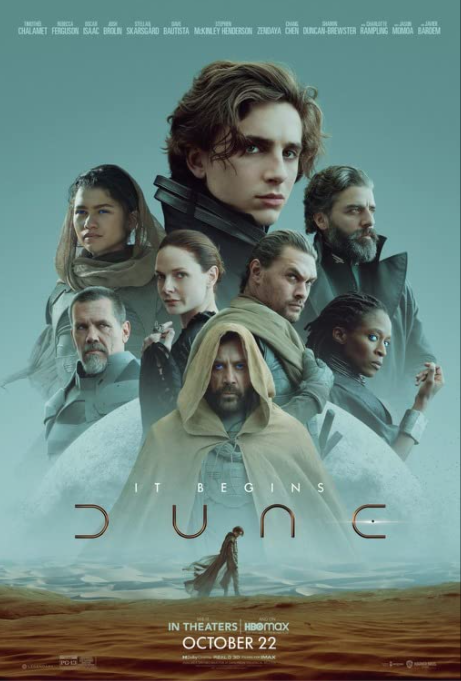
Dune, Part One: Half the Movie, Twice the Power of Most Other Complete Films


The first half of Dune -- over two-and-a-half hours of almost a six hour movie -- came up on HBO Max late yesterday.  It's also in theaters, and an expert critic or two proclaimed that it can't be fully or really appreciated unless you see it on the big screen.  Maybe my mind is prone to see in cinematic vistas, but I liked the movie just fine on my Mac Airbook.

In fact, I thought this first half of a movie was superb, far better than most other complete films, including David Lynch's 1984 brave attempt to do Dune (the only thing I remember about that movie was Sting).  The new 2021 first half of the movie was true in all important respects to the original Frank Herbert novel, very well acted and staged, with desert scenes that made me thirsty.  The sandworm and the Fremen were especially effective, and all the major characters shined (well, I guess you can't say that about the Harkonnen, who were nauseating, but that's exactly what they're supposed to be).

I've told people over the years who are thinking of starting the Dune book series -- I first read the novel in the mid-1970s, about ten years after Frank Herbert's masterpiece was finally published -- that they just need to suspend their judgement for the first third or more of the book, which is dense and often boring, and hold out for the tour-de-force it becomes as the story progresses.  That origin of Dune, that template that director Denis Villeneuve had to work with, makes his accomplishment even more impressive.  And in addition to the movie narrative, the battle scenes and the music are powerful, too.

Jason Momoa was outstanding -- he should talk in his roles in plain English more often.  His character Duncan Idaho has a great future ahead, and Momoa got him off to a good start.  I also liked Jason Bardem as Stilgar, and Zendaya was stirring as Chani the short time she was on the screen.  Oscar Isaac, who was powerful in Scenes of a Marriage, delivered the same as Duke Leto in Dune.

I first saw Rebecca Ferguson in Reminiscence earlier this year, and was struck by her performance.  She was fine in the crucial role of Lady Jessica in Dune.  I thought I saw some cheap shot at Timothée Chalamet in some review I glanced at and didn't read.  He was fine in the even more important, pivotal role of Paul.  I'm looking forward to seeing him with blue eyes.

That will happen in Part Two, when with any luck we'll also meet Alia, (maybe) see what happened to Duncan Idaho, see more of the Bene Gesserit, meet the Emperor, and who knows what else.  And I'll be back here when that movie is released with another review.


See also Dune, Part Two: Not As Good as Part One


Friday, April 3, 2020

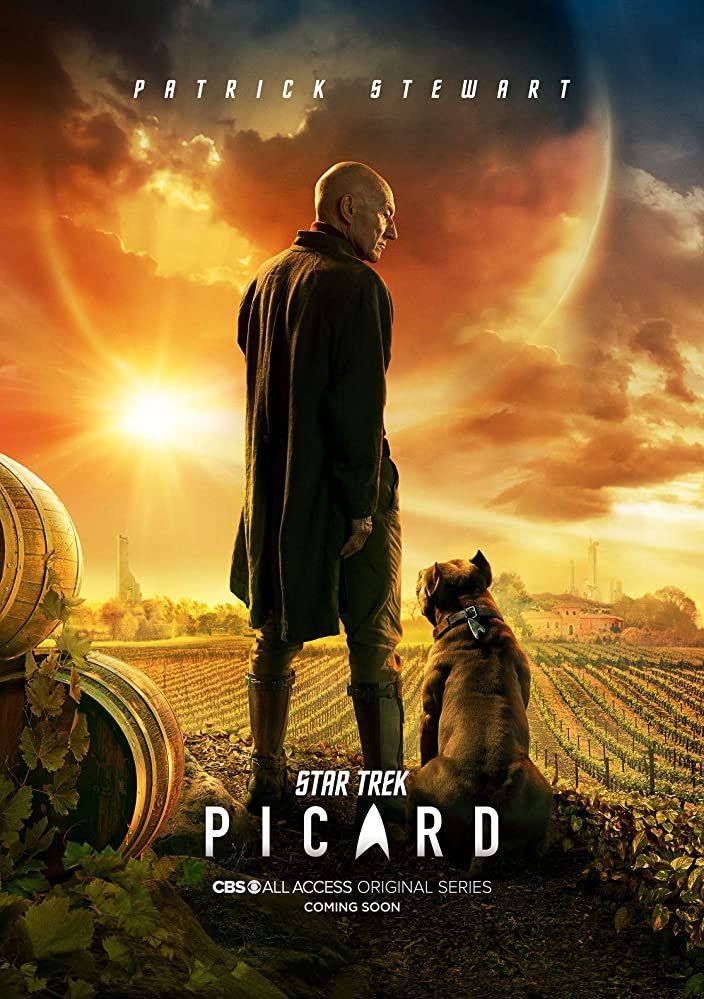
Star Trek: Picard: Non-Pareil


Just finished binging Star Trek: Picard on CBS All Access.  It's the best Star Trek since Star Trek: The Next Generation, which is where Jean-Luc Picard was introduced.  And unlike TNG which was episodic, this first season of Picard was serial, which is a big plus in my book.

But let me get this relatively minor point, in retrospect, out of the way: I thought the weakest part of Picard was the beginning, or the first episodes, which show a 90+ year-old retired Star Fleet admiral down on Earth.  This part of the story was good enough, and enjoyable.  But it's not until Picard literally takes off in a faster-than-light ship that the story really takes off.

The series meshes with TNG and with the entire Star Trek corpus just beautifully.  In addition to Picard, three of the major characters from TNG play important and very satisfying roles.  More minor characters also reprise roles and are equally effective.  And at least one iconic major character from another Star Trek series makes some game changing appearances in Picard.

And Picard borrows well from two titans of off-screen science fiction.  Isaac Asimov is read in this future in paper books, and Dr. Agnes Juradi (nicely played by Alison Pill, billed right after the non-pareil Patrick Stewart) reminds me of Susan Calvin, who figured prominently in Asimov's early robot stories.  And there are a group of warrior nuns in the mix, who echo the Bene Gesserit in Frank Herbert's Dune series.

The cinematography is splendid, reminiscent of Second Life (that's a compliment).  The battle scenes and the warp speeds are palpably portrayed.   The Borg and the Romulans figure crucially in the narrative, and we're introduced to some new planets and people, as well.

If you've noticed that I haven't said anything specific or much at all about the plot, you'd be right.  I don't want to spoil some of the many surprises for you.  But what I can tell you is that, if you're a sentient being, you'll be moved to tears, more than once, as well as laugh and be caught up in the combination of intellectual puzzle and sheer adventure that you'll find in this superb new series.

See also  Discovering Star Trek: Discovery ...   Star Trek: Discovery 2: Tour de Force Story and Characters


Wednesday, March 26, 2014

Book Review: Redshift Rendezvous by John Stith is Perfect Science Fiction Mystery Hybrid

I've published dozens of reviews of science fiction novels by well-known and little-known authors in the past few decades, in the New York Review of Science Fiction, Tangent, the Journal of Social and Evolutionary Systems, and other places.  I thought it was time to begin putting these reviews up on this blog, one or two a month, right alongside the more numerous reviews of television series.

To start, here's my 1992 review, published in the Journal of Social and Evolutionary Systems, of John Stith's  Redshift Rendezvous (Ace, 1990, 256 pp.), now available on Kindle.   People often ask me to name a science fiction/ mystery hybrid that really works.  Isaac Asimov's robot stories (in contrast to his faster-than-light ships in space) are a good example.   And then there's Redshift Rendezvous, in some ways even truer to the hybrid ideal ...


Faster than light travel has been one of the most intriguing and frustrating challenges of science fiction, which generally distinguishes itself from fantasy by writing about technologies and events that are at least scientifically plausible. But according to Einstein's theory of special relativity, movement at faster than light speeds is flatly impossible, and the slightly more lenient theory of general relativity insists that objects attain infinite mass at light speeds. So how, then, is science fiction to write about human relations across star systems and galaxies in human time frames?

One approach might be to contest Einstein's proscriptions on super-luminary travel on scientific or philosophic of science terms. If we agree with the philosopher Karl Popper that even the best corroborated scientific theories are nonetheless highly fallible and destined for falsification -- as Einstein himself did -- then fiction writers should have little trouble amending Einstein much the same as Einstein amended Newton. But not many science fiction writers seem aware of Popper, or indeed sophisticated discussions of philosophy of science, at least insofar as these might pertain to speed of light.

The result has been a science fiction that by and large has repealed Einstein without much of a hearing. Whether the hyperspace drive of Asimov in the 40s or the warp drive of Star Trek and most else in between, travel at faster than light speeds has been more of an assumption than a challenge in a genre which is supposed to engage rather than subsume technological puzzles. (Cryogenic solutions that posit transport of frozen humans to be wakened upon reaching their destination at least have the merit of not ignoring Einstein. Frank Herbert's approach of beings "folding" space in the Dune series has an Einsteinian plausibility, but relies a bit too much on the quantum mechanical idea of mind pushing matter to be satisfyingly scientific.)

Even more disappointing than the repeal by fiat of Einstein has been science fiction's treatment of human relations in the faster than light environments. That treatment has usually been a simple transplantation of human dynamics from Earth to far vaster realms, with the assumption that travel from here to Tau Ceti and beyond should in principle be no different in terms of human effects than our capacity to easily travel now from New York to Los Angeles. But history and philosophy of technology have shown over and over again that new modes of transportation profoundly transform their passengers -- the medium is the message, as McLuhan pointed out, whether communication or transportation -- and science fiction that treats a trip across the galaxy as no different in human principle than a trip across the country thus shortchanges its readers.

Which is why John Stith's Redshift Rendezvous is so refreshing. The book is in many respects a standard adventure of murder and hijacking in space. But in one crucial regard this book is extraordinary in science fiction: it deals with the human detail of faster than light travel. Indeed, speed of light and its consequences is the real hero of this book.

The "Redshift" is a ship that travels faster than light, and Stith posits that speed of light inside the ship is therefore reduced to some ten meters per second, or 30 million times slower than its usual speed. This is far from always pleasant, and passengers are advised to keep their lifebelts on at all times (in order for their neural chemistry to operate at normal speeds), and trust their kinesthetic rather than optical perceptions.

Simple dining can be very interesting in this environment -- a morsel of fish turns indigo as it enters its eater's mouth and life field -- but committing and solving murders are even more so (the latter can be done by removing the victim's lifebelt). The chief security officer single-handedly manages to nearly disable an entire terrorist crew by virtue of his superior understanding of human movement and vision aboard his ship, and in the end he calls upon the physics of the ship's corridors to quite literally hoist the villain on her own petard.

If you like your science fiction to treat faster than light travel with a bit more respect than Dorothy clicking her heels together three times to go from Oz to Kansas, you'll enjoy this book. I look forward to return voyages on the Redshift and other Stith vessels that speculate on the stretching of natural laws and its effect on humans.


"As a genre-bending blend of police procedural and science fiction,
The Silk Code delivers on its promises." - The New York Times Book Review

#SFWApro

Saturday, November 24, 2012

Foundation, Dune, and Laplace's Demon


The Invigoration of a Philosophic Issue in Science Fiction:  How Laplace’s Demon Finds a Stage in the Foundation and Dune Trilogies

by Paul Levinson

Note: An earlier version of this brief essay, then entitled “Fantasy and Science Fiction Rooted in Fundamental Concerns,” was first published in Media & Methods in 1979. I expanded and re- published it in 2009 on Google's Knol system, which was shut down a few months ago.  

Most educated people acknowledge - grudgingly, or happily, or somewhere in between - that science fiction is a very useful source of information about science.    So the proposition that a work of science fiction can be valuable in helping to teach children or adults about science is, I think, a rather easy proposition to prove. 

What I am going to be discussing in this essay is something a little different, and it stems from my experience over decades of reading and thinking about science fiction - which has convinced me that science fiction is also a great source of material to teach people about philosophy.  And actually this is a point of view I have had for decades.  I began thinking about it when I first read Isaac Asimov’s Foundation trilogy - that would have been in the late 1950s - and then in the late 1960s when I began reading Frank Herbert’s Dune series.   And so, what I’ll be discussing in this essay is  how those two great classic science fiction series in particular can help us better understand a very profound philosophic problem. 

I would say that there are probably hundreds - even thousands – of philosophic problems that science fiction can help us understand.    But for the purposes of this essay, I am going to confine my discussion to just one philosophic problem. It is a very rich and deep philosophic problem and it concerns the role and nature of knowledge in our lives.  This is something Plato wrote about in his discussion of the “Meno” paradox, in which Plato said that in order to know something we have to already know it - how could we know that what we have is knowledge if we did not already possess some basis to make that judgment, that is, if we did not already have some knowledge of that area?  Philosophers have been thinking about such questions about the role of past and present and future knowledge for millennia, but here I want to focus on an issue that a mathematician by the name of Pierre-Simon Laplace considered a few centuries ago. He asked a hypothetical question:  if  a super intellect, call it Laplace’s Demon,  had sufficient knowledge of everything that was going on in the Universe at a particular time, could it then predict everything that would happen afterwards?  In other words, if we had sufficient knowledge of initial conditions, could we then predict everything that would happen thereafter?  Laplace’s answer was yes.

Now I think most people would acknowledge that it is impossible even in science fiction to have a situation in which we have complete knowledge of everything presently in the Universe, or even in our world.  But in the two great series of novels that I mentioned – Isaac Asimov’s Foundation series and Frank Herbert’s Dune series – the proposition of what we can know and do in the future, given some valid knowledge of that future in our present, is given brilliant, riveting, and instructive exposition.  

Let us start with the Foundation trilogy. First of all, the Foundation trilogy comes from a series of shorter works of fiction that were published in Astounding Magazine in the 1940s, with the final piece published in 1950.  Asimov credited Astounding editor John Campbell with encouraging him to develop the stories, including suggesting important elements of the plot. The stories were collected into the Foundation trilogy, published by Gnome Press in the early 1950s. The trilogy has been reprinted many times, and Asimov later went beyond the original trilogy with some additional novels in the 1980s.  I am going to confine myself in this essay to the original trilogy: Foundation, Foundation and Empire, and Second Foundation.   

In those stories, Asimov sets out a proposition: a mathematician by the name of Hari Seldon is able to devise mathematical equations which summarize the important events in human life and society that are occurring at the time.  And having posited these “psychohistorical” equations, Asimov wants to investigate the extent to which Seldon and his successors can predict the future on the basis of these equations.  What makes the story wonderful fiction is it seems at first that the future can be predicted.  There are a series of developments in which the evidence at the time, a hundred or more years after the creation of the equations, seems to be going against what the equations are predicting - but at the end of each of those stories it turns out that the equations put people in just the right place at the right time, so Seldon’s original equations did indeed predict the future, and predict it successfully.  The equations are so good that they allow the heroes of these stories, the First Foundation,  to survive against overwhelming military odds.  As long as they are in the right place, at the right time, as projected by Seldon’s original equations, nothing can harm them.

But then things begin to go wrong.  A mutation arises – “The Mule” – who, as a result of being a mutation, has not been accounted for in Seldon’s equations.  (In his 1980s, novels, Asimov suggested that The Mule might have been an android – I prefer the original biological mutation genesis.)   The Mule is Asimov’s first indication that the future cannot be infallibly predicted.   And the episodes involving The Mule make for some of most exciting parts of the Foundation saga.

Fortunately for the good guys, it turns out that, at the very beginning, Hari Seldon/Isaac Asimov set up a special group of people who not only understood the import of the equations but were able to revise them as time progressed.  In fact, prior to the appearance of The Mule,  the First Foundation leaders really understand very little of the equations.  They just know that they have to get out of the way of events in history to let them happen as the equations predict.  But the second, more sophisticated group – the Second Foundation – has a “meta”-position in the saga. They are, in effect, Hari Seldon’s insurance policy, in case blindly following the equations does not work out the way the equations predict – which is exactly what happened with the unexpected appearance of The Mule.

And this, I think, brings home an extremely important point in the philosophy of knowledge, and its value in predicting the future.  The fact that human intervention is required, even in a situation in which equations seem to predict what is going to happen – human intervention to insure that those things happen – shows that there is no such thing as perfectly predicting the future.  Even accepting the premise that we could have a mathematics so sophisticated that it could encompass all human activities and therefore permit us to perfectly  predict the future – even with such a Laplace’s Demon realized - Asimov is saying in his Foundation trilogy that there is still an irreducibly open-ended quality to the future.  Which means that Laplace’s Demon is crucially less than a perfect prognosticator.

We might think of this as an open versus a closed system – an open Universe versus a closed Universe. This kind of territory is addressed not only in philosophy but in systems theory. 

But in a philosophy classroom, if you want to teach students to at least begin thinking about this particular kind of problem – if we have sufficient knowledge can we predict the future? – there is no better way than having them read the Foundation trilogy.  Like all great fiction, it puts abstract ideas into a setting that commands your emotional allegiance.

Now, Frank Herbert’s Dune trilogy – also started under John Campbell’s tutelage, and published as a series of novels beginning in the 1960s – is really a very different kind of story.  There are no equations in that universe – that is, no equations that enable people to predict the future.  What moves events in Dune are people who have the power to see the future - in particular, the hero of the original Dune trilogy, Paul Atreides, who becomes Muad’dib, whose combination of genetic make-up and exposure to a powerful spice, a certain kind of drug, gives him the capacity to see the future.  And so we once again have the question: if someone has the ability to see the future – this time not through devising and understanding of mathematical equations, but as the result of some kind of metaphysical, drug-related, genetically-based conditions – can that person be successful? Can he triumph over his enemies, right the wrongs in his world, and find personal happiness and satisfaction?

And once again, the answer in the Dune trilogy is similar to the answer in the Foundation trilogy, because at first Muad’dib does well with his ability to predict the future. He is able to foresee what his enemies may do and take appropriate actions to make sure those things do not happen.   But what then begins to happen, inevitably, is he not only sees certain things in the future not to his liking, but begins to see that if he tries to prevent those things from happening he will cause other bad things to occur.  And in the end, he is actually destroyed by his ability to foresee the future. He loves a woman by the name of Chani, and she is captured by one of the bad-guy groups, and they offer to give her back to him, and he loves her very much but he can foresee in the future that if he takes her back she in effect will be someone that he cannot rely on – she will not be the person that he previously loved, even though she seems, for all intents and purposes, to be that person.  And so Paul Muad’dib decides not to take Chani back – to let her die - and as a result, he winds up tearing himself apart. He is caught between the rock of his love for her and the hard place of his capacity to see the future. He wants with all of his soul to take her back but he can foresee that she is not going to be what she was.  Neither solution – taking her back or not taking her back – is acceptable.  So he walks off into the desert, a broken man.  Another victim of the capacity to have knowledge of the future.  A capacity which, in Dune, is almost a curse.

So what the Foundation saga does on a mass-societal level, the Dune stories do in a personal dimension.  But as for the philosophic question of what value does knowledge of the future have? – once again, in the Dune series, the answer provided is: it does not give you the ability to necessarily succeed.  Because whatever you might see in the future can put you in an untenable situation in the present where there is no way that you can succeed.

For people, then, who are interested in philosophic questions – students, teachers, everyone -  I  would  recommend the Foundation and Dune novels as vivid introductions to one of our most profound philosophic problems.   And they are more than introductions.  They are stages upon which this problem is acted out, upon which the ironies and paradoxes of predicting of the future are invested in dramatic characterizations which give them a compelling, almost flesh-and-blood appeal.

We can read, with great profit, Plato and Laplace and other philosophers on these and related subjects – which come under the headings of epistemology and cosmology, the nature of the Universe, and to what extent can it be determined.  But the science fictional setting gives us something unique.  As we come to identify with the characters and enjoy the stories, we internalize the philosophic issues in a way that makes them a permanent part of our thinking.  I became a philosopher, without realizing it, and wrestled with Laplace’s Demon the day that I first started reading the Foundation trilogy – when I was twelve years old. And the trilogy has never left me.

See also postcard from Isaac Asimov to me, 1979

podcast of this essay


InfiniteRegress.tv