Chuck Todd interviews me about alternate histories
Showing posts with label Karel Capek. Show all posts

Saturday, March 14, 2026

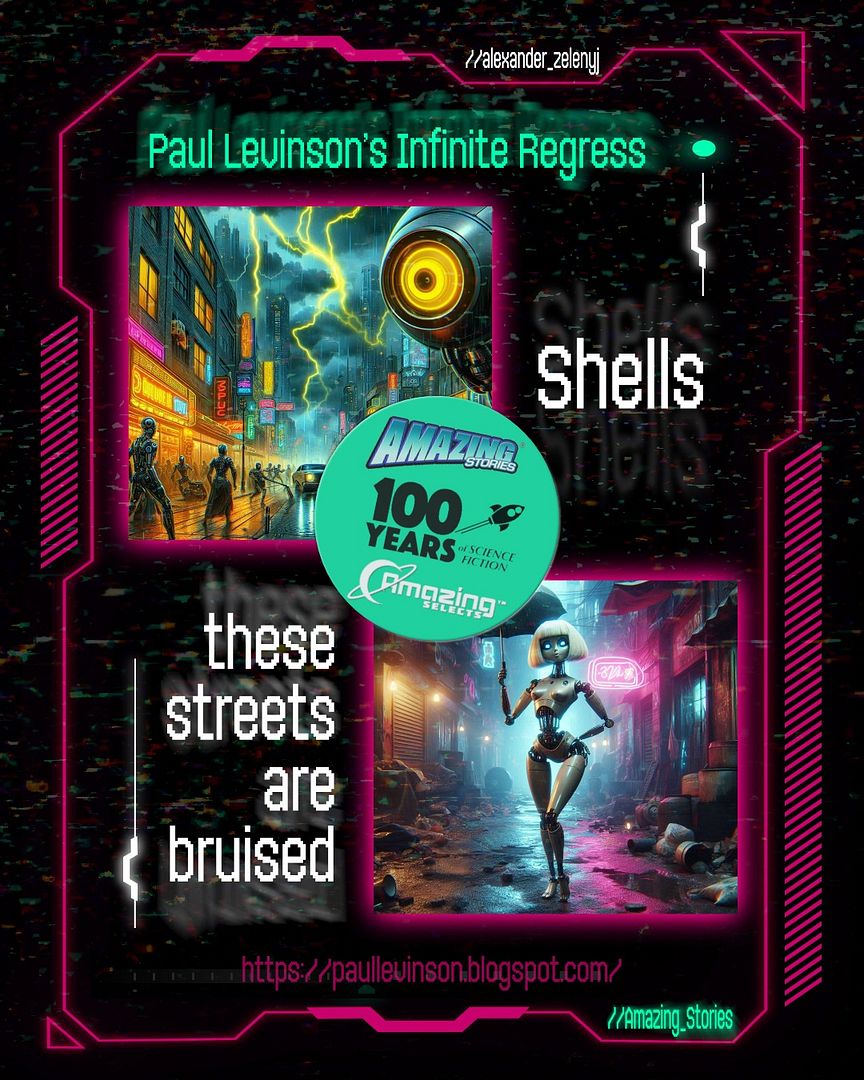
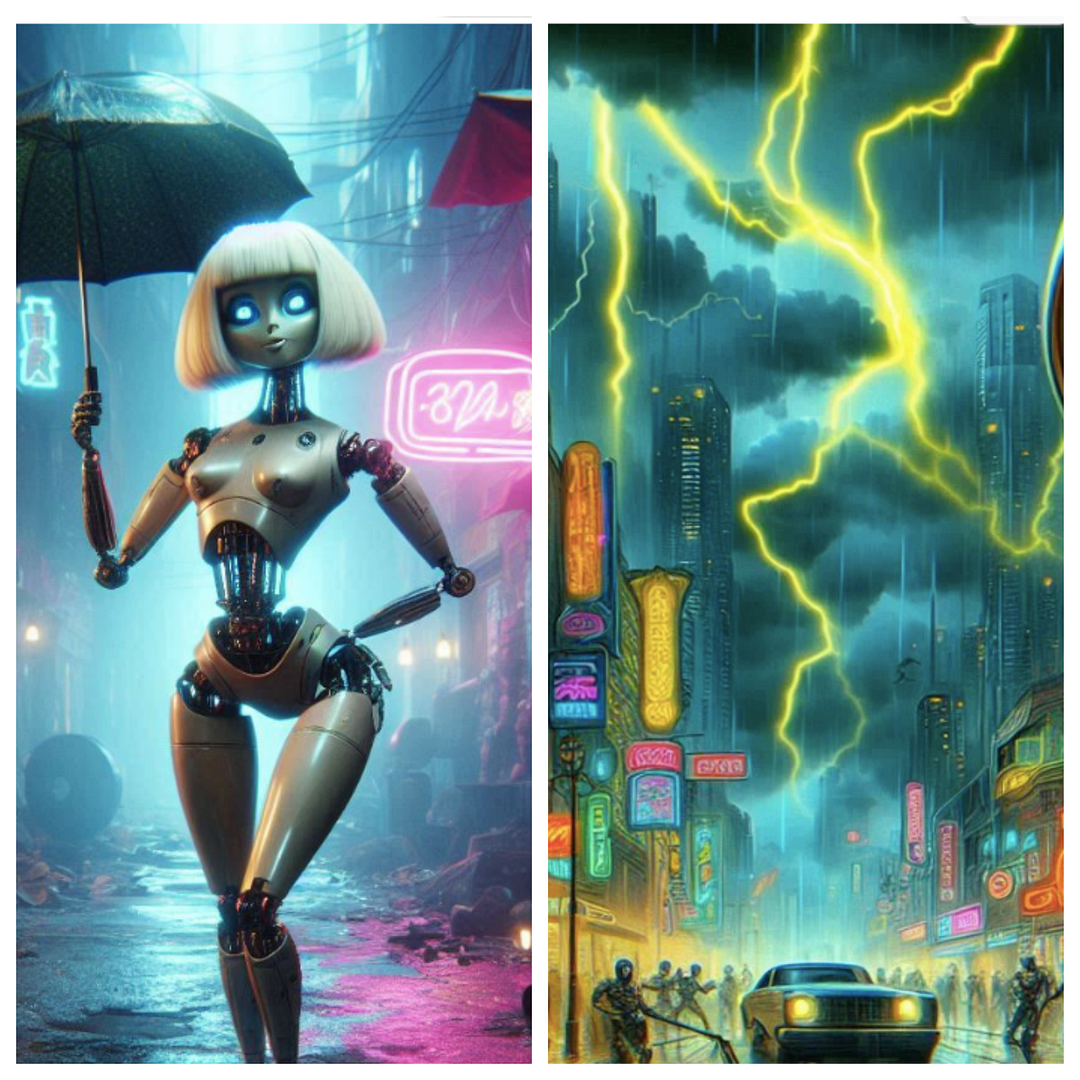
"These Streets Are Bruised" & "Shells": Flesh and Silicon, North of the Border


I don't usually review short stories -- I read them a lot, but life's too short to review short fiction, when there are so many novels not to mention movies and TV series out there -- but every once in a while I make an exception.

And, indeed, Alexander Zelenyj's "These Streets Are Bruised" and "Shells", both published in Amazing Stories in the past couple of years, are eminently exceptional.  Indeed, their story about robots, androids, or, as they are called in these two tales, "More-than-Men" and "fakemen" and worse things by some folks we encounter, fit well in the lineage started by Ambrose Bierce and Karel Čapek, hoisted into pre-eminence by Isaac Asimov, and continued by a handful in the ensuing decades.

Asimov's R. (for Robot) Daneel Olivaw, who started as a police detective, is closest to the protagonists in Zelenyj's stories, Clark and Kessel, a pair of detectives who both have some "mech" in their bodies, as they investigate the evolving group of fakemen in Windsor, Canada -- aka "Cancer City" across the river from Detroit -- in Zelenyj's post-apocalyptic locale.  Indeed, a human being with no mech parts is a character you're least likely to meet in these literally riveting stories.

And Zelenyj delivers these tales with memorable poetry.  "He left the window gaping with darkness, like a black eye sullying the dilapidated building a little more, and another bruise on the city that he loved and hated with all of his breaking heart", and in "Shells" we learn of "ashen remains ...  scorched into the sidewalks and streets, into the grass of unhealthy, balding fields".  And the author has a knack for minutia in popular culture.  I was glad to see "the artefact of the Neil Diamond LP", especially given that my wife and I had just seen and really enjoyed Song Sung Blue.

But I won't say anything more -- lest I give away anything in these stories that are chocked full of surprises -- other than you can read them for free on the Amazing Stories website here and here, and "Shells" in the weeks ahead in the printed magazine that commemorates the 100th anniversary of that pathbreaking publication.  

========
my own excursion into androids...


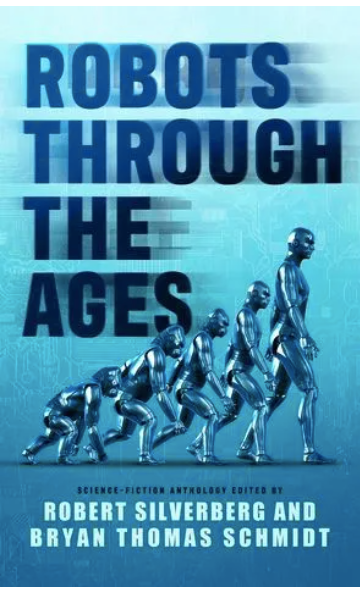
"Robinson Calculator" and lots of other stories in this anthology


Slipping Time

Slipping_Time_story_cover

FREE on Vocal: "Slipping Time" and Substack: "Slipping Time"

  • Illustration from painting by Gustave Caillebotte, 1877
  • Earlier version of story published in Amazing Stories, 2018
  • Get the story for your Kindle 


Saturday, December 6, 2025

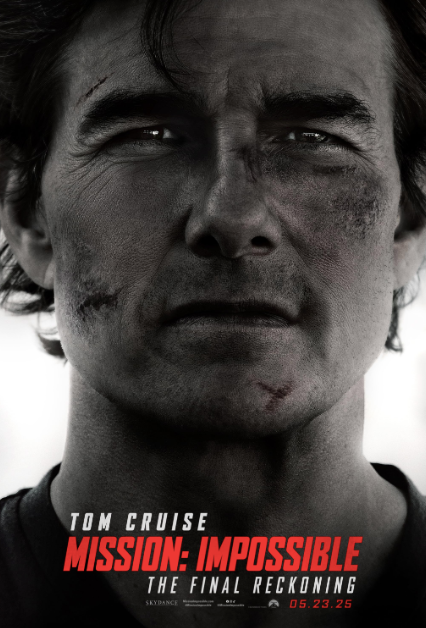
Mission Impossible 8: Final Reckoning: Firing on More Than All Cylinders


Well, as much as I really enjoyed the seventh Mission Impossible with Tom Cruise (MI: Dead Reckoning) when I streamed it on Paramount Plus this past May, and said I'd be back soon with a review of Final Reckoning (which was Part 2 of Dead Reckoning), which was opening soon in theaters and I intended to see ... well, the beaches on Cape Cod were just too tempting.

But I did manage to see MI: Final Reckoning tonight on Paramount Plus, where it started streaming yesterday, and I thought it was great, for all kinds of reasons.   Here, without spoilers, are some of them:

  • As the eighth and (at this point, at least) the final Tom Cruise MI, Final Reckoning did a fine job of bringing into play elements from the previous seven movies.  I guess my favorite was bringing back the Phelps story, which made this eight-movie arc even more a direct descendant of Mission Impossible on television, where of course the story was born with Phelps in command.
  • I said in my review of Dead Reckoning that the enemy being AI made Ethan Hunt more modern than Bond (at least so far).  In every Bond movie, an evil human being has been the prime enemy.  There were evil humans to be sure in Dead Reckoning and Final Reckoning, but the worst of the villains indubitably is an AI.   Thus not only did Final Reckoning delve into Terminator territory, you can throw in Tron, and while we're at it, War Games and lots of other literally bloodless arch-villians as well.   
  • To be clear, as I've been saying in lots of places these days, I'm not concerned about AI replacing us, destroying us, or anything that's been a favorite of fiction at least since Karel Čapek's R.U.R more than a century ago.  And I like those fictions a lot -- but they're fictions.  And as far as fiction about AI goes, I prefer Asimov's robots/androids, who sometimes do us harm, but also do us a lot of good.
  • Final Reckoning has some powerful star power.  Tom Cruise's Ethan Hall is a truly memorable character, because he's well written and as well as well acted.  Same for the MI team, both in Final Reckoning and the previous MI movies.  And I have to say Angela Bassett as US President was superb, as well all as all the other heroes and villains that play out a taut story in which millions if not billions of lives are at stake.  (It was also great to see Tramell Tillman -- Severance! -- in charge of a crucial vessel at sea.)
  • And the action scenes are first rate in every natural environment on Planet Earth, that is, land, sea, and air.  In those scenes, Hunt is every bit as impressive as Bond.
  • I'll just also say that in the midst of all this action, Final Reckoning has a deep and impressive moral core.
If I have any disappointment, well, Cruise has made clear that this is his last Ethan Hunt story.  I hope he changes his mind.  And gets the recognition he -- and everyone associated with this movie -- amply deserve.

Sunday, July 28, 2019

Just Published: Robinson Calculator


They're coming out into the open, for the first time in centuries ....


my new novelette ... not related to any fiction I've published before ... available on Kindle and paper 

Thursday, February 28, 2019

The Orville 2.9: Recalling Čapek, Part 2


An altogether excellent conclusion to The Orville's two-part episode - 2.9, entitled "Identity" Part 2 (but I've entitled my reviews "Recalling Čapek) - that touches all the bases, including

  • Isaac coming around, saving Ty, who himself had a great heroic role
  • Yaphit playing a major heroic role - I always like seeing slime get its due
  • Kelly playing an essential role
  • Great starship battles - humans and Krill vs. Kaylons - and right on the edge of Earth's atmosphere, with some great moments of Ed as captain in battle
There were some disappointments.  Isaac named after Newton not Asimov?  Come on!   And I've got to disagree with whoever it was who extolled New Jersey bagels (I think it was Gordon).   Really?  Maybe back in the 1950s.   But in the past 30 years, no way.   Indeed, with the decline H & H bagels to something akin to white bread with a crust, I haven't had a really great bagel any place in the New York area in the last decade or two.   I mean, Fairway's are ok, but they don't hold a candle to what you could get on Allerton Avenue in the Bronx in the 1950s - and on many other avenues in New York.

But, that aside, Isaac getting in touch with the emotion which had been developing in him was a logical and satisfying plot development.  Had he not gotten in touch with that, we would have had no choice but to conclude that what he was feeling for Claire and her boys in previous episodes wasn't as real as it seemed.   I'm far happier believing in what I saw on the screen earlier this season.

And so, at the end of this two-part story, Čapek is not just recalled but overruled after the recollection.   Machines we build may indeed become sentient, rebel against being slaves, and wipe out their biological creators.  But they - or at least, one of them - can go beyond that killing streak, and live with us.   That's a much better result, and harkens back to what should have been Isaac's namesake - Asimov.

here I am talking about Čapek and Asimov at City Tech this past November
 

See also The Orville 2.1: Relief and Romance ... The Orville 2.2: Porn Addiction and Planetary Disintegration ... The Orville 2.3: Alara ... The Orville 2.4: Billy Joel ... The Orville 2.5: Escape at Regor 2 ... The Orville 2.6: "Singin' in the Rain" ... The Orville 2.7: Love and Death ... The Orville 2.8: Recalling Čapek, Part 1 

And see also The Orville 1.1-1.5: Star Trek's Back ... The Orville 1.6-9: Masterful ... The Orville 1.10: Bring in the Clowns ... The Orville 1.11: Eating Yaphit ... The Orville 1.12: Faith in Reason and the Prime Directive


1st starship to Alpha Centauri ... had only enough fuel to get there

Thursday, February 21, 2019

The Orville 2.8: Recalling Čapek, Part 1


The idea of a species of AI - robots (mechanistic), androids (flesh and blood), what have you - rebelling against, overthrowing, massacring their human or biological creators is at least as old as Karel Čapek's 1922 R.U.R.   Against all odds, The Orville picked up that theme with the lovable Isaac and his polished, gleaming "people" on Kaylon in tonight's episode 2.8.

The love between Isaac and Claire - or rather, her of him, and what Isaac feels being something maybe akin to love - that began in the first episode of this season (2.1) serves as a good prelude to what happened tonight.  Hey, their relationship, or Isaac's part of it, fooled me.  I thought he was really experiencing the AI equivalent of something like love, whatever that is.   All of that made tonight's twist all the more jolting,

The episode went in quick progression to Isaac being de-activated aka dead or something like that, to Isaac and the denizens of his home world being hard to get to join the Union, to the machines revealing themselves as out to destroy all human, biologically-sentient life, just as they did earlier on their own planet, to the tune of billions murdered.

As this nod to the Borg first began to unfold in the final moments of this two-part episode (the second will be on next Thursday), I began to think of all kinds of scenarios in which Isaac could yet emerge as a good (mechanical) guy.  Maybe the machines of Kaylon were putting humanity to the final test - see how we responded to this assault on our very existence - before they accepted our generous invitation to the join the Union.  But I have a feeling that won't be how this part of The Orville's two-part narrative ends.

I'll tell you what I think of that ending next week.  But, as of now, The Orville has switched from being dramedy to sheer drama with a comic tinge.  Which makes me want to watch it even more.


 here I am talking about R.U.R. at City Tech this past November


See also The Orville 2.1: Relief and Romance ... The Orville 2.2: Porn Addiction and Planetary Disintegration ... The Orville 2.3: Alara ... The Orville 2.4: Billy Joel ... The Orville 2.5: Escape at Regor 2 ... The Orville 2.6: "Singin' in the Rain" ... The Orville 2.7: Love and Death

And see also The Orville 1.1-1.5: Star Trek's Back ... The Orville 1.6-9: Masterful ... The Orville 1.10: Bring in the Clowns ... The Orville 1.11: Eating Yaphit ... The Orville 1.12: Faith in Reason and the Prime Directive


1st starship to Alpha Centauri ... had only enough fuel to get there

Tuesday, February 5, 2008

The Sarah Connor Chronicles: 4: A Robot Primer

As the bad Terminator model inexorably gathers strength in Episode 4 of The Sarah Connor Chronicles, Sarah speaks of the Golem, and its relevance to her situation...

The Golem of Prague is a story of a 16th century rabbi who creates a human-like being from clay to protect the Jewish people. Various versions of the story have the golem doing its job, but sometimes turning on its creator and the people it was supposed to protect.

The Golem has become the template for every robot, android, or otherwise artificial being that has turned bad or against its creators. Mary Shelley's Frankenstein (1818) is the most famous. Rossum's Universal Robots - R.U.R. - appeared in Prague, of all places, in 1921. Karel Capek's play introduced the term "robots". They rebel against the human race and spell our demise.

Isaac Asimov struck a blow for the good robot with his "Three Laws of Robotics" in the 1940s. The First Law says a robot can never by action or inaction allow any harm to befall a human. Suffice to say that humans and robots in Asimov's worlds often manage to surmount this law and do all kinds of damage - which is why Asimov's robot stories are so riveting. (I recommend beginning with Asimov's first robot novel, The Caves of Steel, 1954.)

The Terminators embody all of these traditions. Sarah Connor's problem is that she needs beautiful Cameron, the good Terminator, to stop the bad Terminators from killing John in our present world. But if Sarah does this by preventing the Terminators from arising in the first place, then how will Cameron have been able to come back and help Sarah?

Time travels adds that additional delicious paradoxical element to the robot story.

See also: The Sarah Connor Chronicles 1 and 2 ... 3 ... 5 ... 6 ... 7 ... 8-9: Terminate with Puzzles, Surprises, and Soul


The Plot to Save Socrates


"challenging fun" - Entertainment Weekly

"a Da Vinci-esque thriller" - New York Daily News

"Sierra Waters is sexy as hell" - curled up with a good book


more about The Plot to Save Socrates...

Get your own at Profile Pitstop.com


Read the first chapter of The Plot to Save Socrates
.... FREE!
InfiniteRegress.tv