Chuck Todd interviews me about alternate histories
Showing posts with label Elon Musk. Show all posts

Monday, January 5, 2026

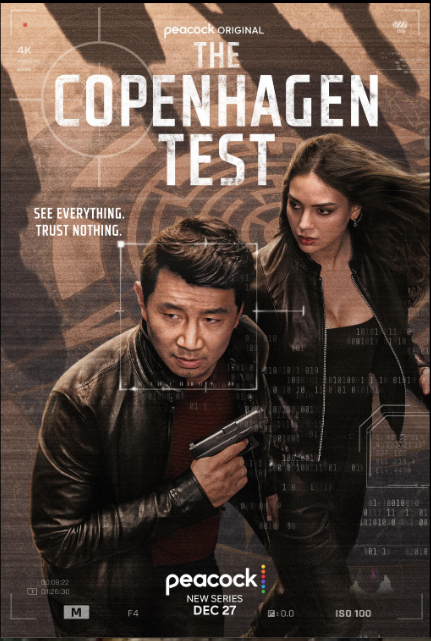
The Copenhagen Test: Don't Try to Pass It, Watch It


Binged The Copenhagen Test -- eight episodes -- on Peacock the past the two nights.  It's billed as a spy thriller, which it certainly is.  But in as much as Alexander Hale (powerfully played by Simu Liu, pretty much first time I've seen him, ok I saw him in Barbie) is a spy who discovers he's been hacked -- everything he sees and hears is streamed by his brain to whomever has the receiver -- I'd say The Copenhagen Test easily qualifies as cyberpunk, a well-known branch of science fiction.  I mean, I guess this kind of neural hack is related to Elon Musk's Neuralink, but that's a very first step, and the hack in The Copenhagen Test is already serious big business for the Orphanage, the US spy agency that monitors the CIA, the FBI, etc.

Now, I'm not going to tell you anything about the plot, because one of the many strengths of The Copenhagen Test are the twists and turns which multiply faster than Frank the Bunny in Donnie Darko.  Indeed, just when you think you've been told the whole story, you're dealt another curve ball, and the only way to really know the story is over is when the eighth episode is completed, and even then, well ,,,

Along the same lines, the morphing of heroes into villains and vice versa is the most I've seen or read in any story.   But it all makes pretty much sense in the end, and my only regret is that The Copenhagen Test didn't have the Beach Boys' "Heroes and Villains" as its theme song.

About the acting:  As I said, Simu Liu was superb.  So was Brian d'Arcy James as Peter Moira, someone pretty high up in the Orphanage, whom my wife immediately recognized from The Family McMullen, which we saw last week.  Sinclair Daniel and Melissa Barrera were both indelible in their parts, and you can't go wrong with Saul Rubinek, especially when there's so much action in his character's restaurant.

And trust me, if you're a fan of spy narratives and cyberpunk, even if you're not, you can't go wrong with The Copenhagen Test.


Tuesday, July 22, 2025

Superman: Foe of Musk and Putin


I've been following and enjoying Superman's exploits since I started watching him played by George Reeves on television when I was a kid in the 1950s, and started reading the comic book a few years later, created by Jerry Siegel and Joe Shuster way back in 1938.  And as an adult I even contributed an article about The Man of Steel -- “Superman, Patriotism, and Doing the Ultimate Good” (which explored why Superman didn't just wipe out Hitler and the Nazis in World War Two) in The Man from Krypton -- an anthology published in 2006.

I think I've also seen most of the movies.  Like the TV series and the comics, they were all immensely entertaining.  But none packaged that with the political acumen and clout that James Gunn invested in the new Superman movie that my wife and I just saw in the LOOK Dine-In Cinemas in Dobbs Ferry.  Andrew Slack and Jose Antonio Vargas nailed in their guest column in The Hollywood Reporter, "Yes, Superman Has Always Been an Immigration Story," what Gunn did in his movie.  Superman has always been the ultimate alien -- literally, he came from outer space.  And just as people from other countries helped build and protect America from day one, so Superman has done the same since he started growing into adulthood in Kansas.

The movie also gets all the related political travesties and depredations that currently afflict our country and thereby the world right on target, too.  Lying buffoons on a Fox-like "news" channel, a fickle populace gobbling down fake news like it was cotton candy, a Putin-like character invading a neighboring country just as Hitler did in the 1930s, and most important, making Lex Luthor, Superman's brilliant, demented arch-enemy who first appeared in the comics in 1940 into someone we've all come to know all too well the past few years.

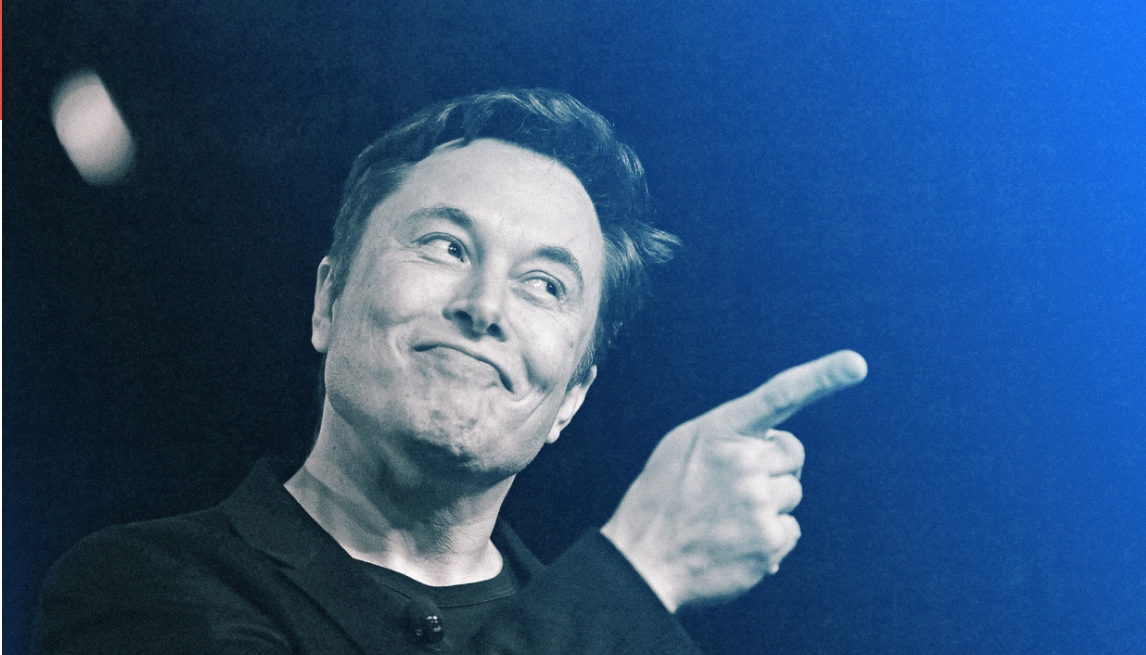
My nine-year-old grandson called it when he saw Superman with my son a couple of days ago and told him: "Lex Luthor is Elon Musk".  I don't know if Musk is as smart or as evil as Luthor, but he's certainly done plenty of damage.  Among the many reasons to cheer what Gunn has done in this movie is the way he put up Musk in Luthor.

And there are indeed many other reasons.  Superman is not only powerful but vulnerable and amazingly admirably sweet and good -- he takes the time to save a squirrel.  David Corenswet (who was in one episode of House of Cards) was excellent in the title role.  So were Rachel Brosnahan (Mad Men, Mrs. Maisel ) as Lois Lane, Edi Gathegi (For All Mankind, StartUp) as Mr. Terrific, and Nathan Fillion (The Rookie, Castle) as Green Lantern.  In fact, everyone was in fine form, including the super heroes I didn't know, the robots, and especially the dog.

So, if you're a fan of Superman, you can't go wrong with this movie.  And if you're a fan of democracy and a foe of fascism, you can go wrong with this movie, either.

***


Note added: James Gunn claims in this interview that one of the biggest pieces of fake news in his movie -- a recording of Superman's parents, released by Lex Luthor, urging their son to use his super powers to dominate the world -- actually wasn't fake news at all, that is, Superman's parents really said that.


My response: as I. A. Richards advised way back in the 1920s, it's a mistake to ask the author or creator what they intended in a given passage (or scene). They may be trying to manipulate the public, for whatever reason. It's far better, Richards says, to let the work speak for itself.

(Thanks Cynthia Walker and Nick Leshi for getting a conversation about this going on Facebook.)

Tuesday, December 27, 2022

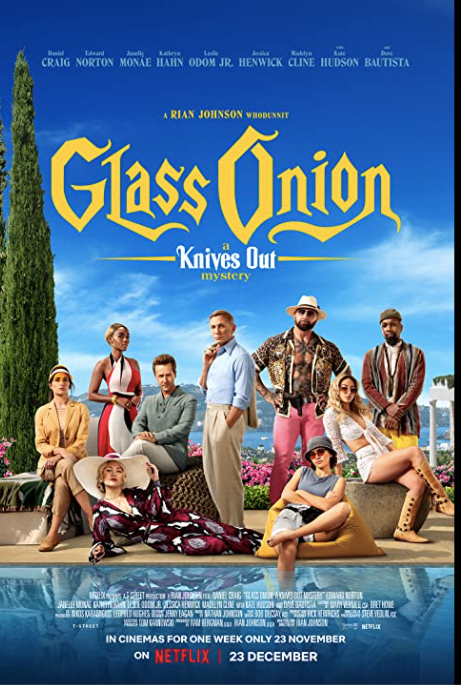
Glass Onion: A Knives Out Mystery: Hercule Poirot and Elon Musk


Glass Onion: A Knives Out Mystery was even funnier and more fun than Knives Out, which was plenty funny and fun.  Plus, Glass Onion was just brimming with social relevance, extending its satire of Agatha Christie to our real world at large.  All to the good -- given what our real world is like, we could use all the satire we can get our eyes and ears on.

[Spoilers ahead ...]

COVID is the first real calamity to receive this treatment.  I certainly wouldn't want to see an entire movie lampooning anything about the pandemic -- it's no laughing matter -- but the start-up of Glass Onion with the masks and the protective blast to the throat was just right.

Elon Musk, on the other hand, deserves all the satire anyone can lob at him.  And Miles Bron, who turns out to be the villain of the story, surely has elements of Musk, hawking a scientific miracle energy breakthrough, flaunting his billionaire wealth, and all the rest.  Social media in general get a good ribbing in this movie, too,

The acting was great.  Daniel Craig (as sleuth Benoit Black) and Ed Norton (as Miles Bron) have never given anything less than a top performance, at least as far as I know.  And the supporting cast were in fine form, too.  For some reason, my favorite was Madelyn Cline as Whiskey (hey, she was excellent in Outer Banks, too).

Of course, in a satire whodunnit, the mystery plot has to be tight and well resolved.  I won't give everything away, on the slim chance that you're reading this and haven't already seen Glass Onion.  But I will say Hercule Poirot would've approved.

Oh, and the music was good, too!  "Glass Onion" is always a pleasure to hear.  And it sounded fantastic at the end of this movie.  I'm thinking the producers of the movie did to the sound what Peter Jackson did for the Beatles in Get Back -- the Beatles never sounded better!

And while we're on the subject of music in this movie, Nat King Cole's "Mona Lisa" gets that same -- let's call it Peter Jackson -- treatment. Cole's uniquely warm voice, like "chestnuts roasting on an open fire," sounds like it's in the same room with us. Mona Lisa -- the Leonardo da Vinci painting -- makes a major appearance in the movie, a symbol of Bron's boastful greed -- as does an acoustic guitar alleged to be Paul McCartney's, which Bron strums for "Blackbird" to impress his guests. 

Okay, this review is about a movie, not its music, but as long as I'm into it, the Bee Gees' "To Love Somebody" sounded crystal clear beautiful, too, as did David Bowie's "Starman" (his "Star" is in Glass Onion, too, but I always liked "Starman" much more). And one last point, promise, about this music: it was fun to hear Toots and the Maytals sing "Take Me Home, Country Roads," but yeah, it made me wish I was hearing John Denver singing his song with co-writers Taffy Nivert and Bill Danoffin this supersonic mix. 

 All credit goes to Rian Johnson, who not only selected the songs, but wrote and directed this gem of a movie.

not the least bit funny ... well, maybe a little

It's Real Life

alternate reality about The Beatles on Amazon, and  FREE on Vocal

Saturday, June 18, 2022

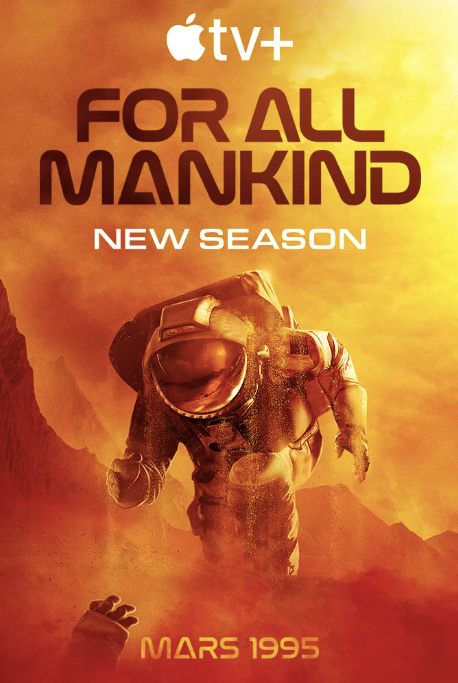
For All Mankind 3.2: Dmail


My favorite alternate history detail in For All Mankind 3.2 on Apple TV+ yesterday is "dmail" -- that's the name in 1992 for what we call email in our world.  I guess "d" comes from digital -- digital mail, just as the "e" in ours comes from electronic mail.  I like details like that.

[Now for some bigger spoilers... ]

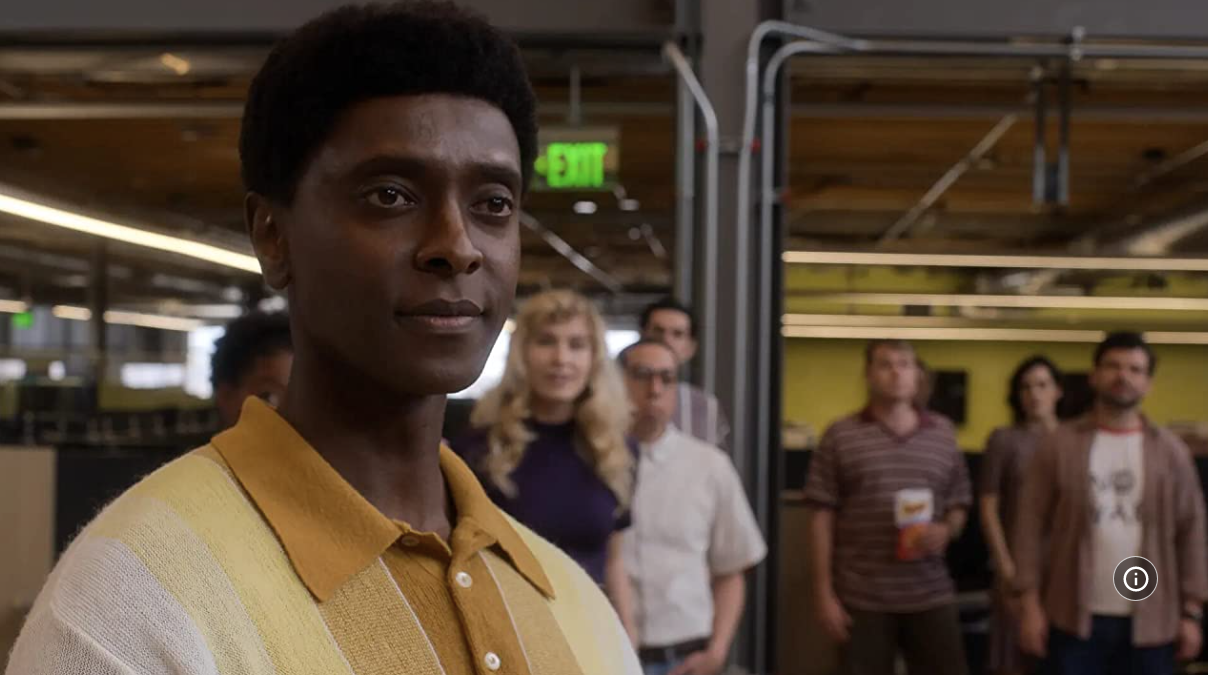
I had a feeling as soon Marge fired Molly and removed Ed from the Mars mission that he would wind up on what Dev was doing.  He's a great character.  An Elon Musk, Jeff Bezos, or Richard Branson mega-rich titan with the cosmic visionary quality of Steve Jobs.  And he's played by Edi Gathegi, who was just iconic in StartUp.

And I like the way Ed got there.  I said in my review of last week's 3.1 that I thought Sam's death was good for the narrative, freeing up Karen to maybe get back with Ed and who knows else.  In 3.2, we learn that Ed has split with his wife (good), and Karen and Ed are indeed much closer.  But, most importantly, she pitches Ed as the leader of Dev's mission (pitch is his apt word), he takes a vote of his people in the room (his company is at least this far a democracy), and Ed is commanding the mission.

This sets up a heated rivalry between Ed (Helios) and Danielle (whom Marge has chosen to lead the first Mars mission for NASA) and who knows who the Soviets might send up there.  And to up the ante, and increase the pressure, Dev is moving up the date of the mission.

It's an easy prediction that Ed and Danielle will be on Mars at the same time, and one will likely save the other.  But that's getting ahead of the story, and I'll see you back here next week with my review of 3.3.


See also For All Mankind 3.1: The Alternate Reality Progresses

And see also For All Mankind, Season 1 and Episode 2.1: Alternate Space Race Reality ... For All Mankind 2.2: The Peanut Butter Sandwich ... For All Mankind 2.3: "Guns to the Moon" ... For All Mankind 2.4: Close to Reality ... For All Mankind 2.5: Johnny and the Wrath of Kahn ... For All Mankind 2.6: Couplings ... For All Mankind 2.7: Alternate History Surges ... For All Mankind 2.8: Really Lost in Translation ... For All Mankind 2.9: Relationships ... For All Mankind 2.10: Definitely Not the End

It's Real Life

get the paperback or Kindle here

or read the story FREE here


*** Note added 27 October 2023:  Check out my review of Jack Dann's new book, The Fiction Writer's Guide to Alternate History

Wednesday, October 20, 2021

Call for Essays and Science Fiction Stories for Volume 2 of Touching the Face of the Cosmos


It’s been almost six years since we brought out Touching the Face of the Cosmos: On the Intersection of Space Travel and Religion, an anthology of essays and science fiction stories, assembled with the purpose of jumpstarting the human movement into space by connecting it to the sense of wonder, the need to know what we are doing here in the universe, that is the basis of religions and spiritual thinking.


Since 2015 and especially recently space exploration has gained momentum:, Richard Branson, Jeff Bezos, and William Shatner have gone very briefly into space. Elon Musk has sent a ship with people into orbit for three days. The United States has sent robots to Mars, and the Chinese have put a crew in Earth orbit for months.

But we as species have not lifted off this planet in the way that many foresaw when people first walked on the Moon in 1969. We are still in need of a more robust connection to that spiritual sense of wonder to lift us beyond our home planet.

We therefore think the time is right for a second volume of Touching the Face of the Cosmos. As with the first volume, we are looking for both essays and science fiction stories, 500 (five hundred) to 7000 (seven thousand) words in length (but query us if you have something that you think would be perfect for the anthology, but is shorter or longer). We would like original essays and stories, but will consider a very limited number of already-published science fiction stories.

-- Paul Levinson and Michael Waltemathe

Deadline for receipt of submissions is 1 February 2022.

Please send to:

Levinson@Fordham.edu 
and michael.waltemathe@rub.de

Sunday, October 17, 2021

Looking Back at “The Missing Orientation”: One Year Later


Abstract: Space tourism has received four literal liftoffs in the past year, and science fiction about space travel is flourishing, with new Star Trek seasons and Isaac Asimov’s Foundation series streaming this Fall. All of these both kindle and express our sense of wonder, but the pathways to space are still expensive and dangerous, and they need to be connected to the taproots of our sense of wonder In religion and science fiction, so those pathways stay open and strong.

Key words: space tourism, science fiction, religion, sense of wonder, Star Trek, Foundation, Richard Branson, Jeff Bezos, Elon Musk, Joe Biden, William Shatner

======

It’s been nearly a year since I wrote “The Missing Orientation” (Levinson, 2021), and its call for enlisting our religious or spiritual sense of wonder about our place in the universe in our continuing efforts to expand our existence off this planet and out into space.

Billionaires Richard Branson (Chang, 2021) and Jeff Bezos (Rincon, 2021) touched space in July, albeit briefly, kissing the cosmos in their spaceships and laying the equivalent of groundwork for tourism off this planet. William Shatner aka Star Trek’s Captain Kirk him went up to space in Jeff Bezos’s Blue Origin in October (Pereira, 2021; Roulette, 2021). And Elon Musk’s Space X literally brought four civilian tourists into space for three days in September (Duffy, 2021). But Branson’s Virgin Galactic apparently had a problematic re-entry (Wattles, 2021), showing how dangerous space flight still is, and seats on the Space X’s Inspiration 4 are estimated as costing some $50 million per seat, putting that flight beyond the reach of most tourists (Kelvey, 2021).

Meanwhile, the sense of wonder intrinsic in science fiction has been firing on all cylinders. Paramount+ will be streaming new seasons of Star Trek: Discovery and Picard in the months ahead, and Isaac Asimov’s Foundation series at long last found expression on the screen when Apple TV+ began streaming Foundation in September. As I mentioned in “The Missing Orientation,” it was the original Star Trek series in the 1960s that ignited my interest in space travel, and the Foundation trilogy got me thinking about humanity in galactic terms when I was a boy in the 1950s.

Star Trek always emphasized the inherently international nature of space travel and exploration. In 2021 and the years ahead, China is promising a robust space program (SCMP Editorial, 2021). And U. S. President Joe Biden’s 2022 budget request for NASA is the “2nd-best budget proposal for the space agency in 25 years,” supporting projects on the Moon, Mars, and Jupiter’s moon Europa (Dreier, 2021).

But, as the vacuum in the American space program for decades after humans walked on the Moon in 1969 and a few years after so vividly shows, budgeting for space exploration, especially in democracies, is unreliable. And space tourism needs to drastically lower its price before it becomes a part of our lives. Tourism is rooted in our sense of wonder, and as long as that sense remains strong, and connected to space via the ancient and more modern channels of religion and science fiction, our path to space will remain open and expand.

References

Chang, Kenneth (2021) “A Ride to Space on Virgin Galactic? That’ll Be $450,000, Please,” The New York Times, 5 August https://www.nytimes.com/2021/08/05/science/virgin-galactic-ticket-price.html

Dreier, Casey (2021) “Biden's 2022 NASA Budget Says Yes to Pretty Much Everything,” The Planetary Society, 4 June https://www.planetary.org/articles/nasas-fy2022-pbr-analysis

Duffy, Kate (2021) “SpaceX's all-civilian crew chatted with Elon Musk and shared photos of Earth from the spaceship's glass-dome bathroom on their first full day in space,” Insider, 17 September. https://www.businessinsider.com/spacex-civilian-inspiration4-elon-musk-spaceship-shared-photos-earth-2021-9

Kelvey, Jon (2021) “Inspiration4: How Much Does a Ticket to Space Cost?” 16 September. Inverse. https://www.inverse.com/science/inspiration-4-how-much-is-a-ticket-to-space

Levinson, Paul (2021) “The Missing Orientation,” Religions. 2021;12(1):16. https://www.mdpi.com/2077-1444/12/1/16/htm

Pereira, Ivan (2021) “How William Shatner's Blue Origin space trip can reignite passion for science,” ABC News, 12 October. https://abcnews.go.com/Entertainment/william-shatners-blue-origin-space-trip-reignite-passion/story?id=80404356

Rincon, Paul (2021) “Jeff Bezos launches to space aboard New Shepard rocket ship,” BBC News, 20 July https://www.bbc.com/news/science-environment-57849364

Roulette, Joey (2021) “In a Blue Origin Rocket, William Shatner Finally Goes to Space,” The New York Times, 13 October. https://www.nytimes.com/2021/10/13/science/william-shatner-space-blue-origin.html

SCMP Editorial (2021) “The sky is the limit for the emerging Chinese space industry,” South China Morning Post, 24 July https://www.scmp.com/comment/opinion/article/3142412/sky-limit-emerging-chinese-space-industry

Wattles, Jackie (2021) “FAA grounds Virgin Galactic, says it's investigating problems with Richard Branson's flight to edge of space,” CNN Business, 2 September. https://www.cnn.com/2021/09/02/tech/richard-branson-virgin-galactic-space-danger-scn


Tuesday, September 8, 2020

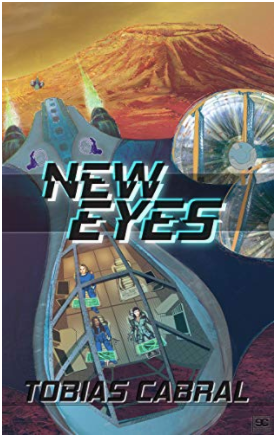
Review of Tobias Cabral's New Eyes: Newer Worlds

Tobias Cabral picked a good time to send me his 2018 novel New Eyes for review.   Mars is in the air.  Actually, it's always been in the air, or at least, at the top of the air, in the sky.  But NASA's Perseverance is on its way to Mars, with a landing date in February of next year.  Elon Musk wants to colonize the Red Planet (I'm 100% on board, here's a talk I gave at the 19th Annual International Mars Society Convention at The Catholic University in Washington, DC on 23 September 2016):

And I just saw, loved, and reviewed the first season of Away on Netflix.

Cabral's novel starts in February 2047.  Trips to Mars take just four days.  There's a space station named "Jeff Bezos," a ship named the "Elon Musk," and androids are "equipped with ‘minds’ that could not just pass but proctor the Turing Test" (italic and quotes around 'minds' in the novel).  And, at least one is capable of murder.  With the result that New Eyes is just as much in the tradition of Westworld and the new Raised by Wolves (see my reviews) as it is a descendant of The Martian Chronicles and The Martian.

But as the title suggests, the fulcrum of this narrative are eyes, in particular Gaspar's "Martian eyes".  The character's a "bio-cyberneticist," women desire his body, and his new eyes in effect make him a human on the way to becoming an android, in the time-honored Six Million Dollar Man way.

The novel also has resonance to the work of Orson Scott Card (sims play an important role, as in, you often can't tell what's really really real) and, to my eyes, at least, the novel reads a lot like Isaac Asimov (a big compliment in my book).   But as to the plot, well, Mars is "a mostly-unpopulated planet" at this point,  and this "young Martian society" is populated by humans and increasingly by androids.  Could this actually happen by 2047?  Probably not (more because of the androids than living on Mars).  But my late editor at Tor, David Hartwell, always told me that readers are willing to grant you at least one big part of a story they find unbelievable, and I'm happy to grant Cabral that.   I should also mention that Cabral throws in a bit more repartee humor than does Asimov -- someone comments that someone has a "nice assonance... that sounded naughty" -- and there's even some rapping in this story.

But that still doesn't tell you much about the nuts and bolts of the plot, does it?   You'll need to set your eyes on the novel to find that out.  Ok, I'm in a good mood.  Here's a quote from the novel: - think "alternate branches in a Many Worlds Hypothesis time travel story".  And enjoy.


first starship to Alpha Centauri leaves from Mars Vestibule ...


Thursday, December 27, 2018

Astounding by Alec Nevala-Lee: Transformative Treasure Trove


One of the joys of reading on a Kindle (or, in my case, a Kindle app) is the ease of bookmarking.  As one indication of how important I found Alec Nevala-Lee's Astounding: John W. Campbell, Isaac Asimov, Robert A. Heinlein, L. Ron Hubbard, and the Golden Age of Science Fiction, I bookmarked it ten times more than any other book I've read in the past few years.  (The runners-up are The Perversity of Things: Hugo Gernsback on Media, Tinkering, and Scientifiction by Grant Wythoff and Dreaming the Beatles by Rob Sheffield, though I read those two on paper.)

It's no surprise (at least to me) that Astounding had much more of an impact on me - a transformative impact - than The Perversity of Things.  I knew neither Gernsback or Campbell in person, or by any means other than their published writing.  In contrast, I knew and worked with Isaac Asimov, the high point of which was getting him to write a Preface for my first published book, In Pursuit of Truth: Essays on the Philosophy of Karl Popper in 1982.  It was a collection of essays (I contributed one) of which I was the Editor, and I didn't have to work very hard to get Asimov to write the Preface: we already knew each other (I'd sent him my analysis of the Foundation trilogy published a few years earlier in Media and Methods - here's his postcard response - and he quickly accepted Humanity Press's not overly generous offer of $100 to write the Preface for the Popper volume).  And, as President of the Science Fiction Writers of America from 1998-2001, and as a science fiction writer myself, I also knew or still know many of the secondary players in Astounding, including Harlan Ellison, Arthur C. Clarke, Hal Clement, Robert Silverberg, Sam Delany (I first heard about him from his mother Ruth, in the mid-1960s, in the George Bruce Branch Library in Harlem where she worked as a librarian and I as a clerk),  Ray Bradbury, David Kyle, Barry Malzberg, Greg Benford, Joe Haldeman, Janet (Jeppson) Asimov, and many others.  So seeing them in these pages was a tour through many significant conversations and interactions I've had in my own life.

And on being a science fiction writer myself, Nevala-Lee's book also tapped into another profound wellspring of my career:  I've been published in Analog 17 times (15 stories and 2 nonfiction articles - one story acquired by Trevor Quachri, all the rest by Stan Schmidt), and am a card-carrying member (well, pin-affixed) of the Analog Mafia.  Stan's editing philosophy continued the best of Campbell's.  In my case, for example, Stan urged me to not kill off Phil D'Amato (which I had in the first draft of "The Chronology Protection Case"), just as Campbell had urged Frank Herbert not to kill Alia in Dune, one of a plethora of winning details that Nevala-Lee puts in this book.  "The Chronology Protection Case" was made into a short movie, now on Amazon Prime, and Phil D'Amato's appearance in my first novel, The Silk Code, won a Locus Award for Best First Novel of 1999.

Ok, so I love Nevala-Lee's book.  But what about people without my professional history?  I can't say for sure, but I would bet that any science fiction writer, as well as any science fiction fan, would find this book riveting, and a treasure trove of context-setting scenes.   What follows, in rough order of their appearance in the book, are some of the highlights for me:

1. I knew that Paul Krugman was influenced by the Foundation stories, but not Elon Musk.  Given the latter's age, I wonder if he was reading Analog in the mid-late 1990s, when my stories first started appearing in its pages.

2. Campbell, as a kid, kept a garter snake in his pocket.  I wonder if Stan Schmidt, who had pet snakes, knew about this.

3. I was fascinated to learn that Campbell's favorite professor at MIT was Norbert Wiener.  I studied Wiener's Cybernetics when earning my PhD in Media Ecology under Neil Postman at NYU in the late 1970s.  Cybernetics also appears later in the book in its extensive discussion of dianetics - the least favorite part, for me, because I never related to Hubbard, dianetics, or Scientology, but it's an important part of the Campbell story.

4. It turns out that Campbell, like Gernsback, was in effect a media ecologist, presaging the kind of thinking that Marshall McLuhan made famous, by observing that unlike radio, television was very possessive, "you have to look at it," and "Man molded the machine, but the machine is going to mold Man". This difference between radio and television played a crucial role in my doctoral dissertation, Human Replay: A Theory of the Evolution of Media, and I often say that radio amply survived the advent of television if for no other reason than you can listen to radio, but can't (safely) watch television, when driving.  I'm grateful to Nevala-Lee for alerting me that Campbell made this point back in the 1930s.

5.  One thing I do have in common with L. Ron Hubbard: he was elected President of the NY chapter of the American Fiction Guild in 1935.  As I already mentioned, I was President of SFWA at the end of the 20th century.   That, and later being Chair of the Department of Communication and Media Studies at Fordham University in NYC, convinced me that elected office was no pleasure, and indeed took too much time away from writing.

6. A lot of the material about Asimov comes from his two-part autobiography, In Memory Yet Green and In Joy Still Felt, which I devoured as soon as they were published (1979, 1980).  But it was fun to read it all again - ranging from Asimov getting $64 for his first sale, "Marooned Off Vesta," to Amazing Stories not Astounding (my first sale of a science fiction story to a professional publication was also to Amazing Stories - "Albert's Cradle" in 1993 - and the first payment I ever received for any writing was $65 from The Village Voice for "A Vote for McCartney" in 1971) - to Campbell continually coming up with essential ideas for both the Foundation and the robot stories.   (I should also mention that, like Asimov, I have no intention of ever writing under any name other than my own.  Except Asimov eventually did, and I won't.  I want the girl who didn't laugh at my jokes in 5th grade to see the error of her ways when she walks into a bookstore - or, in today's world, when she's browsing on Amazon.)  And it was enlightening to read material about Asimov from other sources that I didn't know.

7.  I also studied General Semantics in the NYU Media Ecology PhD program.  I still give talks at some of their meetings, and therefore enjoyed Nevala-Lee's recounting of Heinlein's interest in the subject and movement.

8.  I do have something else in common with Hubbard:  when a potential recommender invited Hubbard to write the recommendation himself, Hubbard obliged with "This will introduce one of the most brilliant men I have ever known."  A reviewer once asked me to write a review of one of my stories, because he was pressed for time.  I did, and said it was the best example of this kind of story ever written.  I sent it to the reviewer for his approval and he decided to write his own review, after all.

9. It was great reading about Campbell's launching of the Probability Zero section.  That was where I had my first publication in Analog, in February 1995.

10.  Campbell and Nevala-Lee repeatedly refer to Heinlein as Astounding's (and science fiction's) best writer (until Asimov's The God Themselves in 1972, when Nevala-Lee says Asimov "finally pulled ahead" of Heinlein).  I disagree: Asimov was almost always the best science fiction writer, by virtue of his Foundation stories (at least, beginning with "The Mule" in 1945), his robot stories, and The End of Eternity for good measure.  But Heinlein was second, with no one even close behind him, until Philip K. Dick (who I learned in Nevala-Lee's book was published in Astounding/Analog only once).

11. I love this quote from S. I. Hayakawa: "The art [of science fiction] consists in concealing from the reader, for novelistic purposes, the distinctions between established scientific facts, almost-established scientific hypotheses, scientific conjectures, and imaginative extrapolations," from ETC, 1951. I was book editor of that journal in the late 1970s.

12. Nevala-Lee provides many examples of Campbell's astute - and not-so-astute - scientific thinking.  I'd say that his most accurate was his anticipation of the hydrogen bomb.

13. I hadn't known that Claude Shannon - co-creator of the Shannon-Weaver model of communications, fundamental to any study of the subject - was a neighbor of Campbell in New Jersey!

14. Nevala-Lee should have said more about The Puppet Masters (1951) - one of Heinlein's best novels, one of the best science fiction novels, period, and of which a good movie has yet to be made (unlike Starship Troopers).

15. I don't blame Asimov for long resisting acquiring an agent.  I've had mixed results with agents over the years myself.

16. I also loved learning that Campbell sent Heinlein a Tom Lehrer record as a "peace offering" after an argument (they would "never fully reconcile").

17.  I'm with Heinlein not Asimov in Heinlein's bristling at editors' instructions and revisions.

18. Heinlein's The Door Into Summer (1956) indeed ranks among his best work - and I'd say among the all-time best time-travel novels - but it comes in second, again, in my opinion, to Asimov's The End of Eternity, published a year earlier.  (Nevala does say that it's Asimov's "best single novel".  He doesn't say if Heinlein was moved to write his novel after reading Asimov's.)

19.  Campbell's rejection of Asimov's "Ugly Little Boy" was one of his worst mistakes - the story is one of Asimov's very best (and, as Nevala-Lee tells us, one of Asimov's favorites).

20. The material about Charles Manson being inspired by Heinlein's Stranger in a Strange Land strikes me as the same as Manson being inspired by the Beatles' Helter Skelter:  you can't blame a creator for what a lunatic gets out of the creator's work.

21. Apropos the mention of Marvin Minsky:  I should add that he's also on record as saying his work in AI was triggered by Asimov's robot stories.

22. Campbell's racism in the 1960s was indeed repugnant, as Nevala-Lee says, not to mention his critique of the demonstrators at Kent State in 1970.  Silverberg was right not to want to work him after the racism became apparent.

23.  I was (sadly) reminded that Mitt Romney said Hubbard's Battleship Earth was his "favorite novel".  Back in June 2007, that was one of ten reasons which led me to wonder if Mitt Romney was a cylon.

So there you have it - a sampling of the gems Nevala-Lee's book offers.  If you have any interest in science fiction, let alone knowledge of its history and authors, you'll find this book indispensable.  And, if you've ever written any science fiction, maybe transformative, too.  It had that exhilarating effect on me, because it made clear that what little I've done as a science fiction writer is tied to a genre, a tradition, that propelled us, and lit up our lives, in the 20th century, and still does.


Friday, December 2, 2016

Mars 1 and 2 on National Geographic: New Kind of Helping Hand Into Space

Just caught the first two episodes of Mars on National Geographic, and wanted to post this review before I see and review more.

First, this series is a great amalgam of documentary - up to and including events in 2016 - and a drama about the first expedition to Mars with humans in 2033.   That's a great idea for a story, and it works very well on screen.

The main of the part of the documentary, so far, is Scott Kelly's year in space mission, which ended successfully in March 2016.  This is counterpoint to the 2033 mission to Mars, in which team leader Ben Sawyer is badly injured right before landing and ... well, I won't tell you how that works out, because that's the main personal drama in the first two episodes.

But the point of this new kind of docudrama is that the personal stories are part of the bigger story, the yearning and necessity of human beings getting off this planet, and successfully settling on another planet - in this case, Mars.  Not a complete migration by any means, but establishing enough of  a continuing existence to insure our survival if and when something catastrophic happens to Earth. As Elon Musk of Space X and other worthy fame says in the first episode, this is the only way to insure our survival - since catastrophes happening to both Earth and Mars at the same time are extraordinarily unlikely.

The cinematography in both 2016 and 2033 is stunning.   We've seen all kinds of fictional accounts of space travel - ranging from The Martian to Star Trek - and all kinds of docudramas, such as Apollo 13. I've loved all of them, both as riveting stories in their own right, and as vehicles to getting our imaginations in better gear to actually get further off this planet and out into space.

We'll need all the help we can get, and its good to see Mars now lending a big, bold, imaginative helping hand.


InfiniteRegress.tv