
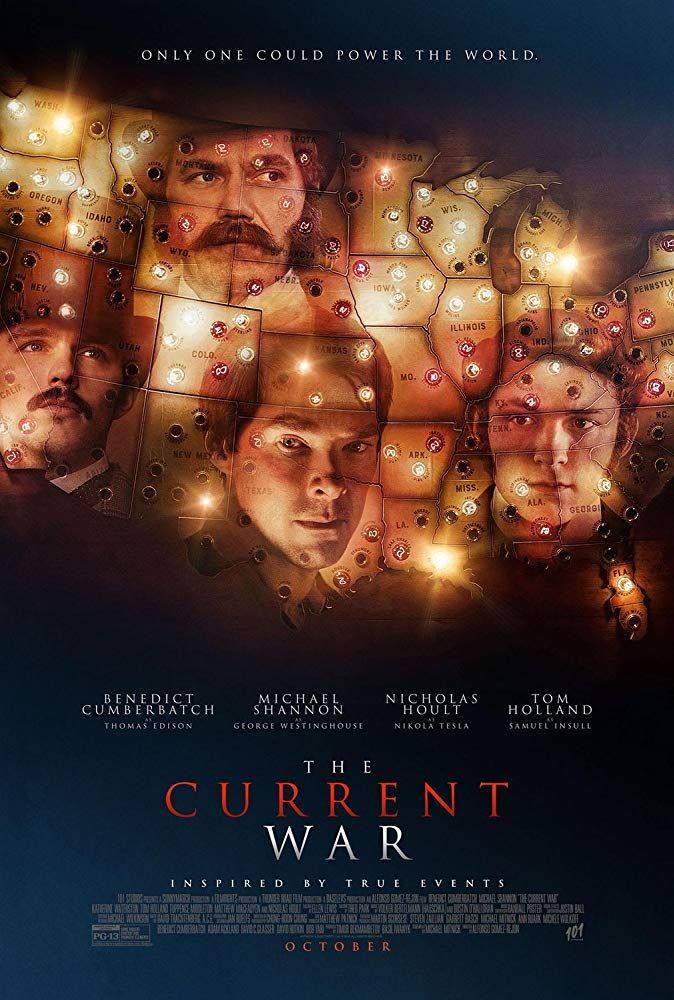
My wife and I just saw The Current War. She said, as we were leaving the theater, that it was "a lovely little movie". I agree completely.
The subject was about as big and momentous as you can get: whose brand/kind of electricity, Edison's or Westinghouse's, would become the national standard? This "war" was fought in the 1880s and 90s. The winner was George Westinghouse, and his AC (alternate current) indeed became the standard for delivery of electricity that we still use.
The loser, Thomas Edison, was a far more important person in history, having harnessed not only electricity in his electric light, but invented the phonograph and motion pictures (the latter also invented at pretty much the same time by the Lumière brothers in France and William Friese-Greene in England). But Edison and his team rightly get the credit in the United States.
So what made this movie "lovely". Edison is usually portrayed in straight-up history books as ruthless and obsessed with success. Benedict Cumberbatch's Edison has these traits, but they're tempered by a real humanity. Edison doesn't want to use electricity to take human lives, including in the electric chair, thought to be more humane than hanging. Yet he gives one of the electric chair champions explicit instructions, in a brazen attempt to stain Westinghouse (also perfectly by portrayed by Michael Shannon, who, like Cumberbatch, is outstanding in everything he does). And when the electrocution is applied, it turns out to be a very inefficient, cruel method of meting out death. Question: Did Edison deliberately give poor instructions, because he was steadfast in his desire not to see electricity employed to kill human beings, including those convicted of murder?
The history, as far as I know it, was right on the major details, but perhaps not in every conversation portrayed. At one point, Edison characterizes his motion pictures as doing for the eye what his invention the phonograph does for the ear. As I always heard it, it was the phonograph does for the ear what the camera (not Edison's invention, having been invented nearly half a century earlier) does for the ear. But who really knows.
My wife and I also really enjoyed the movie because we've long been fans of late Victorian culture. There was something truly heady about the first use of telephones, phonographs, and electric lights, and this was sensitively and satisfying portrayed in The Current War. It was also instructive to see the beginning of almost no holds-barred corporate rivalry, and the manipulation of the media to win these battles.
One thing you won't find in this movie, however, is a satisfying portrait of Nikola Tesla, who is suggested as a major character but actually isn't in this narrative. No matter, there were and will be other movies which focus more primarily on Tesla.
See the movie and enjoy the lights, the tenderness, and the struggling to set up the future, all so well shown on the screen.

Edison has a major role in this novel


