Chuck Todd interviews me about alternate histories
Showing posts with label Carrie-Anne Moss. Show all posts

Wednesday, December 22, 2021

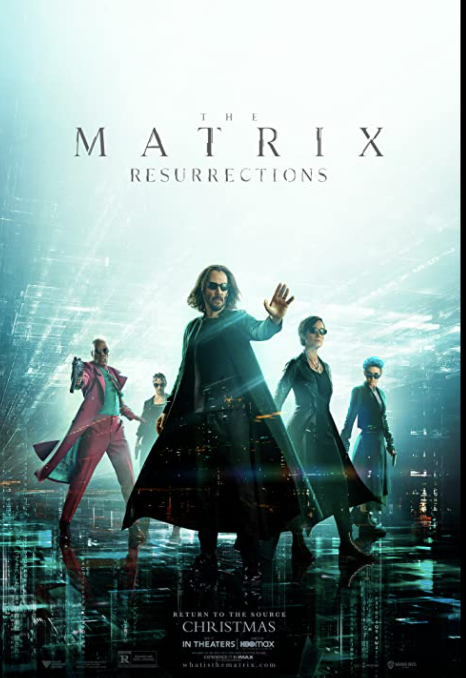
The Matrix Resurrections: Great Mix of Deep Philosophy and Fast-Moving Action


I just saw The Matrix Resurrections on HBO Max.  It may be the best Matrix since The Matrix -- that is, the first movie, so I'm saying Resurrections may be better than the two earlier sequels, certainly better than the third in the original trilogy, Revolutions.

One of the reasons I'm thinking this is how well the meta angle is handled in Resurrections.  We find Neo working as a programmer, whose great accomplishment was writing a computer game called "The Matrix".  He's sucked into a journey in which reality vs. fiction as an explanation for what is happening vie for our attention at every incandescent turn, and there are many of them.  

[Note: For once, or as a rarity, there WON'T be any big spoilers ahead ... ]

Let's talk about the acting.  Keanu Reeves as Neo and Carrie-Anne Moss as Trinity were excellent.  I was prepared to be annoyed at Yahya Abdul-Mateen II as Morpheus and Jonathan Groff as Smith, because their original incarnations by Laurence Fishburne and Hugo Weaving were so brilliantly, searingly memorable.   But the new actors for these crucial characters were quite good.  In the first three movies, Smith was for most part the more keenly acted and therefore more unforgettable character -- delivering such now immortal lines as, to Neo, "How can you speak if you have no mouth?" with perfect laser, razor precision --  and even though Groff is not quite as knife's edge as Weaving, his Smith will be somewhat memorable, too.

Among the new characters, by far my favorite was Neil Patrick Harris as The Analyst -- a big step up from Doogie Howser, MD but in a related medical profession -- and I very much liked the unpredictable villainous kindred relationship between him and Smith.  Both had a fair share of bon mots, and if I had to choose the most profound it would be The Analyst's observation that feelings make fictions real.  In addition to these lines that could have come from Plato -- who notoriously distrusted both feelings and art (see his Republic) -- we also get some good ultra-contemporary commentary from some of the characters.  I guess my favorite would be the Merovingian's, a returning character, who lashes out at both Facebook and Wikipedia in a tense, verge of bursting into action scene.  It's probably worth noting that Facebook didn't exist when we last saw Merv in Revolutions in 2003, and Wikipedia was just a tiny three years old, so his denunciation of these two social media giants is understandable, if not fair to Wikipedia, which has done far more good and much less damage than Facebook.

Without telling you anything more about the plot, I'll say it's plausible, exciting, and works well with its three predecessors.   The action and special effects were outstanding, as always, and the characters' awareness of the deep philosophic issues that underlie their exploits endows this movie with a refreshing intellectual heft.  I'd say The Matrix Resurrections is a triumph of a reboot, and one of the best now around in the burgeoning genre.





Tuesday, September 15, 2020

Wisting: Nordic Noir at its Best


When they came up with the name Nordic Noir -- whoever that they was -- they surely had something like Wisting in mind.   Not only does it take place in Norway and feature a seasoned detective and his team hunting not just one but at least two serial killers of beautiful blonde women, but in its single-ten-episode season it manages to weave together two quite separate though connected murder stories, and tell us compelling backstories for at least half a dozen diverse characters.

Many of the characters are of course police.  William Wisting, whose name the series takes, is head of a unit with Nils (a detective Wisting's age who has almost nothing but contempt for the FBI pair who come to assist Wisting in the first half of the season, because the serial killer is likely a transplanted American), a younger male detective earnest but unseasoned, a woman who has to juggle in-vitro fertilization with her work on a breaking murder case, and like that.  Carrie Anne-Moss (The Matrix) plays one half of the FBI team, and I didn't know the rest of the actors, but they are were superb.

The biggest personal story that runs through the season is the relationship between Wisting (a recent widower) and his daughter Line, an investigative reporter with penchant for crime stories, blonde, and you just know she's in danger from at least one of the serial killers, which in fact she is.  She's played by Thea Green Lundberg whom, come to think of it, I did see in another fine Norwegian series, Occupied (with a memorable Dylanesque opening song), and she was excellent in both.  And as long as I'm giving kudos to the actors, let me mention Mads Ousdal as Nils, who almost could be a Norwegian Jean-Paul Belmondo, and Sven Nordin, who does a perfect job as Wistng.

In addition to all that, the scenery is a sight for pandemic-sore eyes.  Characters have homes on, over, or near the water, and the roads and the forestry are lush.  Hey, I'm not a detective, but the environment was so inviting I was tempted to jump through the screen and see if I could be of any help.

I'll have to settle having seen a captivating season, and looking forward to a season two.


Thursday, February 16, 2017

Humans 2.1: Westworld Meets Nashville

Humans was back with its second season this week, with an episode that was every bit as good as the first season, which is to say, good indeed!

Comparisons inevitably arise with Westworld, since both series are about androids or human-like robots who want to be human, but otherwise the two are very different.  In Humans the androids are out in the world, all over the world, and although there's some significant philosophic musing about the nature of human cognitive intelligence, there's much more focus in Humans on relationships, and what psychologists call emotional intelligence.

The set-up in the second season is a bold departure from the first.  Niska has released a code world-wide which jump-starts some of the androids into human sentience.   The "some" is, at this point, apparently very few, and the other sentient androids - our main characters - don't know why the code worked, and, for that matter, how the code worked.   (Possibly/presumably Niska does.)  This is a big leap from last year, in which the emergence of sentience was much more organic (in the figurative sense).

But as was the case last year, the best part of Humans are the specific androids and their personalities. Max, always ready to smile and see the best in people - and androids - is still among my favorites.   His optimism is a tonic.   Mia, wanting more than any other sentient android to be not only humanly sentient but fully human, and the aforementioned Niska, the most dangerous of the androids in all kinds of ways, and now exploring her sexuality, are back in good form as well.

Some newcomers are in the mix, too, such as Sam Palladio as the human Ed (Gunnar from Nashville!) - would be great to hear him sing "Borrow My Heart" to Mia - and Carrie-Anne Moss has the makings of an intriguing AI scientist.   Not much yet with the Hawkins family, who were the centerpiece of the first season, but they seem suitably simmering for significant interaction with the androids, and Niska's showing up unannounced at their door in the last scene should set that in motion.

And I'll be back here next week with another field report.

See also Humans: In Ascending Order ... Humans 1.7: "I Think You're Dead, George"


a different kind of humans
InfiniteRegress.tv