Chuck Todd interviews me about alternate histories
Showing posts with label alternate reality. Show all posts

Friday, September 11, 2026

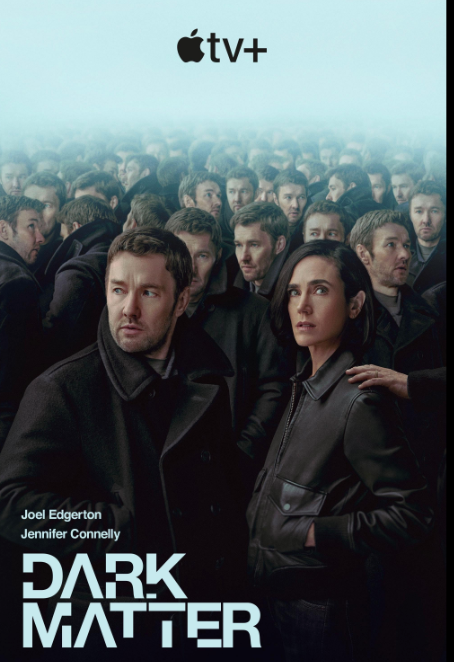
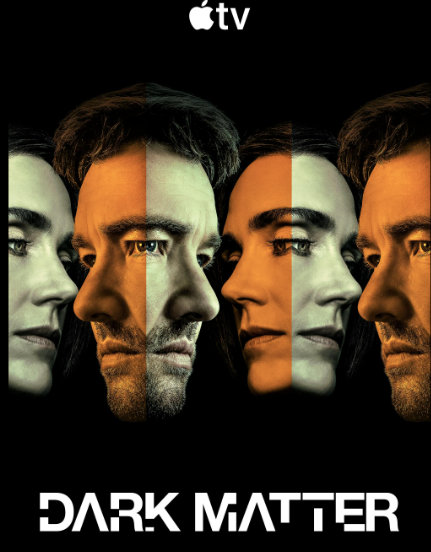
Dark Matter 2.3: Can Two Couples Be in Two Different Places at the Same Time?

That question -- can two couples be in two places at the same time -- is posted fairly early in the latest episode of Dark Matter, 2.3.  Let's look at that question more carefully.

The obvious answer is of course not, unless you're a world in which alternate realities exist.  But, actually ...

We've been in such a world ever since mass media were invented.  I mean, a photograph printed in a newspaper can be in as many realities or worlds simultaneously as the number of newspapers printed. If people are careful with their newspapers, or were talking about books, photos of people can also travel forward in time without aging too much.

But wait, a photograph of a person isn't really a person, right?  People can move and talk.  Ok, well, what about a person talking on the radio, or talking on television, or talking on a streaming service like Apple TV?   Edmund Carpenter, someone who worked with Marshall McLuhan, said when people are on television, they're like angels, which in some interpretations can be omnipresent, much like a deity.

So we can add angels to alternate realities as places where people or humanlike entities can be in more than one place, indeed an infinite number of places, at the same time.  But there's an important difference between angels and the characters we see in Dark Matter.  Those folks are certainly not angels, and some of them do some very bad things.  After all, Dark Matter is a life-and-death got-you-by-the-throat science fiction drama in just about every scene.

But angels and Dark Matter and alternate realities do have one thing common:  they're all modes of fiction, as far as we know.  See you back here next week, after we find out what happens next to the devils and angels on our screen.

See also Dark Matter 2.1: Who's Who in the Infinite Bucket ... 2.2: Sam Spade Back in Action

And see also Dark Matter 1.1-1.2: Break-Neck Action and Philosophic Contemplation ... 1.3 Missing Fingers ... 1.4 The Multiverse Unveiled ... 1.5: The Lesson ... 1.6 "A Bunch of Chicagos" ... 1.7: Obama Tower ... 1.8: A Bevy Of Jasons ... 1.9: Science Fiction and Horror


Friday, September 4, 2026

Dark Matter 2.2: Sam Spade Back in Action


Dark Matter 2.2 starts off with a nice piece of alternate history, as Jason, Daniela, and Charlie seek "A Perfect World" (title of the episode), actually a world in which they can find some relief from the chaos.  And they find a world with no Internet, smart phones, home computers, or social media -- all because Nixon beat Kennedy, and defunded NASA, and we never got to the Moon -- the race to get there in our reality having sharpened science and invention.

[More slight spoilers ahead .... ]

And the ending had a nice piece of a different kind, as we see Jason and Daniela unknowingly just across the hall of the hotel from Ryan and Amanda, one of the other couples and people making their way through the maze of alternate realities in this so-far not only exciting but conceptually rich second season.

But my favorite part of this episode is private detective (listed in the IMDb credits as "agent", though I thought I saw "Private Investigation" on his door) Mitchel MacNamara, whom Jason goes to for help, but we see at the end investigating the box that is the conduit to alternate realities.  MacNamara (played by Chris Diamantopoulos, an actor with a dossier of many roles) has a Sam Spade played by Humphrey Bogart kind of vibe, which is always welcome, but an especially good addition to this story of alternate realities with omnipresent life-and-death implications and consequences. 

And come to think of it, Sam Spade is a logical inhabitant of the technologically stifled world that Jason finds himself in -- The Maltese Falcon movie adaptation of Dashiell Hammett's 1929-1930 novel in which Bogart's Spade appeared hit theaters in 1941, a world just slightly less advanced than the place that Jason and family are hoping is a refuge.  

I really like that world in movies made at the time, and in streaming series and movies that harken back to that early media world (by our current standards).  But you know what?  I streamed Dark Matter 2.2 on my Mac Airbook last night, and I'm writing this review on that same laptop computer, and posting it on my blogs, and I like that world just fine, thank you. :)

See also Dark Matter 2.1: Who's Who in the Infinite Bucket

And see also Dark Matter 1.1-1.2: Break-Neck Action and Philosophic Contemplation ... 1.3 Missing Fingers ... 1.4 The Multiverse Unveiled ... 1.5: The Lesson ... 1.6 "A Bunch of Chicagos" ... 1.7: Obama Tower ... 1.8: A Bevy Of Jasons ... 1.9: Science Fiction and Horror


Friday, August 28, 2026

Dark Matter 2.1: Who's Who in the Infinite Bucket?


Dark Matter -- the TV series on Apple TV -- based on Blake Crouch's novel -- which Blake Crouch created -- is back for its second season.  I thought the first season was thought-provoking and excellent, all that an alternate history science fiction TV series should be.  I thought episode 2.1 was even more so.

[And there will be a few spoilers ahead ... ]

The episode starts with a great punchline, as Jason tells the police detective (Keller from the first season) before she's replaced (along with Mason, also from the first season) by some other kind of cop (who says he's not a cop), "What, is it illegal to look like a bunch of dead people?" in response to being questioned about the bevy of dead Jasons who have turned up on the tables.  No, it's probably not, but we'll soon see another dead Jason, killed by Daniela because she's sure he's not her Jason, let's call him, Jason 1. The slain Jason does seem a little more ragged than our hero, and that ring on his finger, some of what he said, but ...

All of which raises an interesting question, at least to me.  Can we be 100% sure that the Daniela who pulled the trigger is Daniela 1, and the Jason she killed is indeed not Jason 1?  I mean, I get that we're supposed to think that the Jason who shows up after Daniela pulls the trigger is her (and our primary) Jason, but how can we know for sure in a series in which doppelgangers show up everywhere, including in the song "The Quiet Life," heard early in the episode (and indeed the name of this episode), which sure sounds like it was written and performed by Leonard Cohen, when in fact it's by Teho Teardo and Blixa Bargeld?

But that's all part of the mental stretching aka deep fun that characterizes alternate realities -- that's why I read them, watch them, and write them -- and season 2 of Dark Matter looks like it will have plenty of doppelgangers in the story, additions to the seemingly infinite number of Jasons, of which the Jasons on the tables at the beginning of 2.1 are just a drop in the infinite bucket.

And I'll be back here every week with a review of every season 2 episode, which looks to be well on its way to becoming classic.

See also Dark Matter 1.1-1.2: Break-Neck Action and Philosophic Contemplation ... 1.3 Missing Fingers ... 1.4 The Multiverse Unveiled ... 1.5: The Lesson ... 1.6 "A Bunch of Chicagos" ... 1.7: Obama Tower ... 1.8: A Bevy Of Jasons ... 1.9: Science Fiction and Horror



Saturday, December 27, 2025

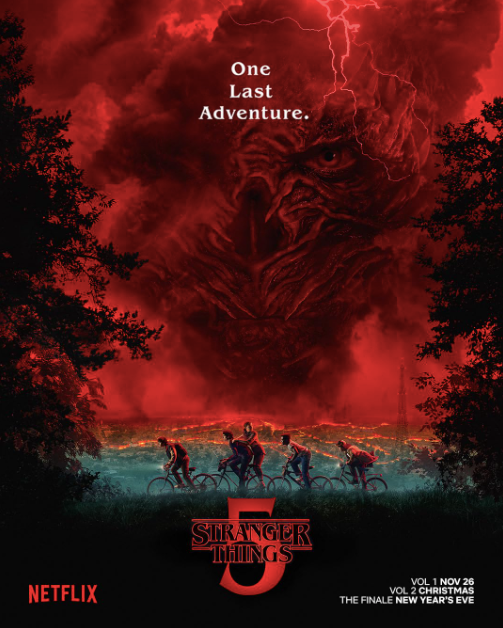
Stranger Things 5.5-5.7: Not Science Fiction But Supernatural


Well, I said in my review of Stranger Things 5.1-5.4 last month that I thought those first four episodes of the final season were the best in the series so far.  I continue to think that, and include the next three episodes in that assessment, having just seen episodes 5.5-5.7.on Netflix.

Here is what I especially like about these penultimate episodes (the final, ultimate episode coming next week) (no spoilers ahead): 

Someone says that Vecna and everything our brave crew is fighting is not science fiction but supernatural.  Now, on the one hand, labels don't really matter.  I said years ago, when my first novel, The Silk Code, was published, that it was science fiction/detective.  After all, it features an NYPD forensic detective who discovers Neanderthals may still be among us.  But some devotees of mysteries said it could not be a detective or mystery story, because it contained science fictional elements.   I eventually got tired of trying to convince those readers the novel was a hybrid or co-genre, and said, it doesn't matter what genre it is, just read it.

But, actually labels are necessary.  If I walk into a restaurant that says it offers Japanese cuisine, but it serves only lasagna, I might well be disappointed, even though I love Italian cuisine as much as Japanese. In other words, labels in cuisine and culture have value, because they help us make selections that reflect our tastes and moods.  So I think it's helpful that Stranger Things -- or at least, this rendition of Stranger Things in what might well be a larger universe -- identifies itself as a story of the supernatural, even though it has some significant science fictional trimmings.

And, in fact, we get a glimpse of more of those trimmings in these concluding episodes.  Talk of outer space, alternate universes and realities -- hey, that's right up my alley, I'm down with that.

And I'll be back here next week after this series, and its part in a larger universe, concludes.


more about The Silk Code here


Wednesday, February 26, 2025

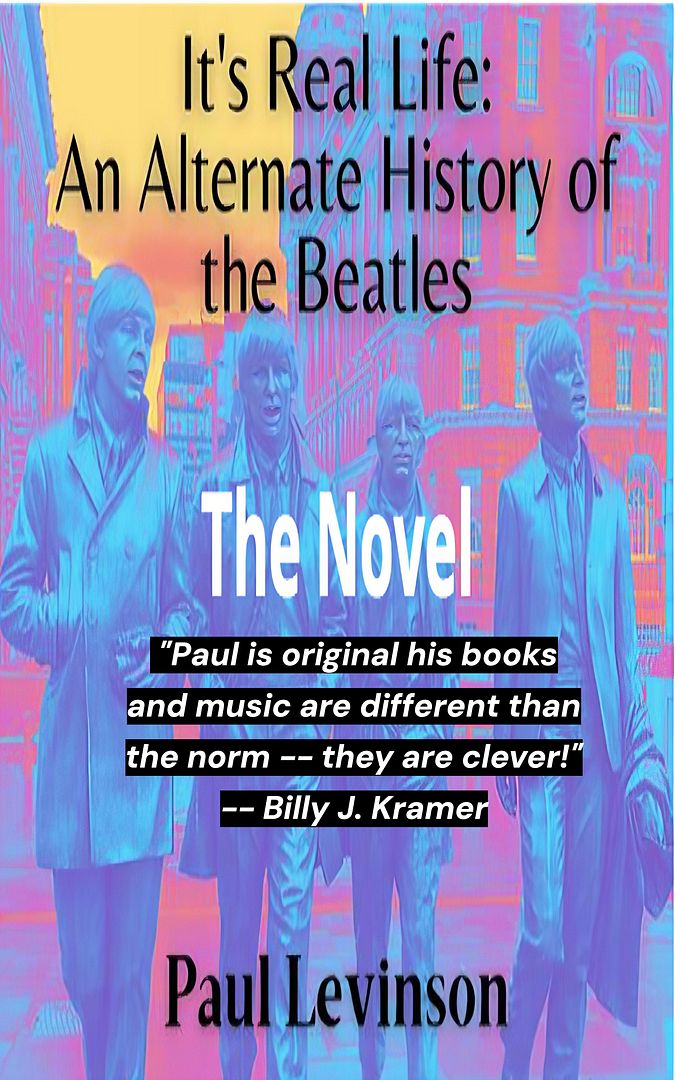
Video of Unique Dramatic Reading from It's Real Life: An Alternate History of The Beatles at Big Red Books


This reading took place on 23 February 2025 at Big Red Books in Nyack, NY, and features Anthony Marinelli and Amanda Greer -- real life characters from the novel who voiced what they say in the novel -- as well Denise Reed, Frank LoBuono, and me.

More about the novel here


Anthony Marinelli, Amanda Greer, Paul Levinson, Denise Reed,
Frank LoBuono, and Richie Fulco (owner of Big Red Books)


Sunday, December 1, 2024

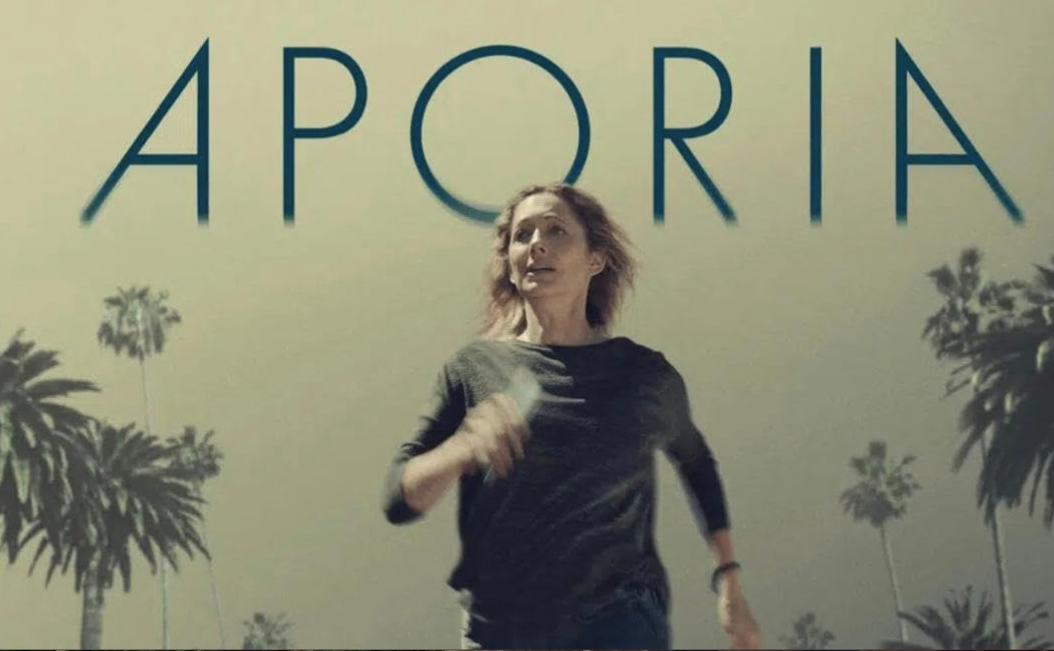
Aporia: Firing Back in Time


Readers of this blog will know that my favorite genre -- as a viewer, reader, and author -- is time travel, and its close relative alternate history.  You'll know this because I say it in just about every other post.  But you would also know this because, at least by my lights, excellent and even good examples are not easy to find (and, I'll immodestly or modestly say, as an author, to write).

But Aporia, a 2023 movie I saw last night on Hulu, is an excellent example.  The heart of its narrative is that a would-be inventor (later, inventors), of a time machine discovers that the clanky machine he's struggling to build in his home can't quite do it -- it's not powerful enough to hurtle a human back in time -- but it can send a subatomic particle back to a specific time and place (the time just a handful of years or a little bit in longer into the past), where it will cause a very minor explosion.  And the inventor realizes that if the place in the past where the subatomic particle lands is inside someone's head, well, what he the inventor has created is a gun that can reach back and kill someone in the past, by putting one of these time-travelling particles into the target's head.

[And I'll here I'll tell you that there will be spoilers ahead ... ]

So, there are three main characters in Jared Moshe's movie (which he wrote and directed): Jabir and Mal were working on the time machine in Jabir's home, when Mal was killed by a drunk driver.  This of course left his wife Sophie desolate.  Jabir is desperate to ease her pain, and restore her life, and comes up with a plan: send one of those lethal subatomic particles back in time, to land in the drunk driver's head, before he gets into the car and accidentally kills Mal.  And the plan works!

But that's when Aporia really gets riveting and ethically wrenching, as Sophie struggles with the fact that although she got her husband back, she had to take another human life to do it.  She reaches out to the drunk driver's widow.  They become friends, and so do their daughters. And here the movie excels in depicting how the people who know the original reality, and know that it has been altered, deal with the new reality they now inhabit.  (I tend to like this metaphysics of time travel -- that people who cause the changes in time are aware of the changes, even if the changes affect them -- maybe because I always employ such a narrative structure in my own works.)  As Sophie gets to know the drunk driver's family, she finds she can't bear the fact that she was responsible for killing the drunk husband and father, however much he may have deserved it ... but any attempt to change the past again by killing someone else with a time-traveling particle could have unforeseen consequences ...

Aporia resonantes in all kinds of ways.  The build-your-machine-at-home continues the tradition started by H. G. Wells' The Time Machine, and furthered more recently by Primer and just a few months ago Quantum Suicide.  The idea of sending something rather than people or living things back in time was put to good use by Gregory Benford in his 1980 award-winning novel, Timescape, in which information could be sent back in time.  And the idea of apprehending criminals, not because they committed a crime, but because you know they will commit a crime, was of course memorably developed by Philip K. Dick in his novel The Minority Report

But Aporia has a story and an ambience all its own, brought to life by really excellent acting by Judy Greer as Sophie, Edi Gathegi (who has been great in For All Mankind, and before that, StartUp) as Mal, and Payman Maadi as Jabir.  And all of this builds up to a top-notch ending, in which a smile tells us almost everything.


my interview with Jared Moshe


watch the movie on Amazon Prime Video -- read the novelette here


in Kindlepaperback, and hardcover


Wednesday, May 29, 2024

Dark Matter 1.5: The Lesson


Well, Jason 1 appears to have learned a crucial lesson in the fifth episode Dark Matter, up on Apple TV+ just a few hours ago.

And that lesson is--

[Spoilers ahead ... ]

What he needs to do in his original world -- World 1 -- is block the box off, so no one can use it.

He found this out the hard way, in which he and Amanda were treated to a succession of differing horrendous realities, as they tried to wish/will the world they were going into, into being -- which was the lesson that they and we thought we learned last week in episode 1.4.

But as the two applied that logic -- the world-creating power of a feeling (B. J. Thomas's "Hooked on a Feeling" would have worked well here, though his "Rock 'n' Roll Lullaby" is such an outstanding record) -- Jason 1 and Amanda found the worlds they entered were flooded, wracked by a deadly plague, and last but not least a world in which the analog of Jason 1 was in prison, presumably convicted for some kind of terrible crime.  So Jason 1, now -- presumably -- back in World 1, says he needs to wall it off.

This of course will prevent far more than Jason 1 and Amanda not being able to use the box in the alternate realities any more.  It will mean that everyone currently in World 1 will be stuck there.  Including Jason 2. Which means that Jason 1 will have to share his bed with Daniela 1 and Jason 2?

That would be a pretty rough world for both Jasons, right?  Which means, what?  That once Jason 2 got through the box/room into World 1, everyone's life in the infinity of worlds was in one way or another worse than it was before?

I'm not sure.  But I certainly don't hold out much prospect for a happy ending in this fascinating, complex story.

See also Dark Matter 1.1-1.2: Break-Neck Action and Philosophic Contemplation ... 1.3 Missing Fingers ... 1.4 The Multiverse Unveiled


Wednesday, May 22, 2024

Dark Matter 1.4: The Multiverse Unveiled


A highly informative episode 1.4 of Dark Matter up on Apple TV+ today, as Jason 1 and Amanda make their way through "The Corridor" (the title of this episode) and therein partake of the doors to the multiverse.

And I have to say that my favorite spoken line in this episode is when Jason tells Amanda that the entire corridor with its doors don't really exist, they are rather the result of their human minds struggling to make a little sense of a reality that the human mind cannot comprehend.  The only thing missing in this astute observation was that the true conduit(s) to the universes Jason and Amanda were accessing were the thing-in-itself, which Immanuel Kant realized the human intellect could never comprehend.

Kant made that observation in the 1700s (in our universe).  Jason 1 also draws upon a fundamental principle of quantum mechanics, which of course brings us to the 1900s, and underlies all of Dark Matter. That principle is that the mere observation of a subatomic particle can change it.  Jason explains that he and Amanda can get to the alternate reality they seek by merely clearly thinking about that reality.  This QM on the macro-level has been a staple of lots of science fiction, and Dark Matter is parlaying it very effectively.

Indeed, Jason goes on to explain that his kidnapping that launched this narrative was the result of Jason 2 figuring out in which alternate universe Jason 1 was residing, because Jason 2 wanted to give Jason 1 some of the pleasure of having Jacob 2's accomplishments as a world-famous scientist -- actually, not figuring it out, but envisioning it in some intense way, and thereby finding and identifying the door into that reality.  Since the multiverse consists of all possible realities, which in practice is an infinite number of places, this QM way of locating the place that you want to visit is a good thing to have on hand.

And Dark Matter, as of its fourth episode, is a very good thing.  It's rare to find philosophy woven so well into a thriller, inside a corridor with so many tempting and dangerous doors.

See also Dark Matter 1.1-1.2: Break-Neck Action and Philosophic Contemplation ... 1.3 Missing Fingers


the corridors under Fordham University figure in this novel ...


Thursday, May 16, 2024

Dark Matter 1.3: Missing Fingers


Just saw Dark Matter 1.3, the third episode of what I'd call the interchanging alternate reality series on Apple TV+.  I thought it was excellent.

[Spoilers ahead ... ]

Dark Matter 1.2 ended with the shocking murder of Daniela 2 in Jason 1's reality -- that is, not the Jason who actually built the full-size superimposition box/room that makes shifts into alternate realities possible -- and this in effect is an announcement that this story, or at least some of the characters in it, really mean business.  Their motives are still not clear by the end of the third episode, but Dawn losing a few of her fingers as she tries to stop Jason 1 and Amanda after firing a gun at them confirms that this narrative means business indeed.

The loss of the fingers also serves another important purpose.  We're told that four characters in World 2 entered the box/room, and, who knows, there could be more.   We'll at least now know immediately that if Dawn suddenly shows up in World 1 with missing fingers, she's actually Dawn 2.

But lest you think that Dark Matter is all quantum mechanics and gore, there's also some nicer clever touches in 1.3  My favorite is the guess who's coming to dinner party in World 1, in which Jason 2 struggles to know who everyone is and what they do -- using an iPhone to help (of course it's an iPhone, the series is on Apple TV+) -- and Ryan 1 tells Jason 2 that he's looking good (which he should -- award-winning scientists probably do live and look at least a little better than their harried professor counterparts).

Dark Matter continues to be philosophically provocative, hard hitting, and we can now add, suitably wry. More than enough for me to eagerly continue to watch.

See also Dark Matter 1.1-1.2: Break-Neck Action and Philosophic Contemplation


Wednesday, May 8, 2024

Dark Matter 1.1-1.2: Break-Neck Action and Philosophic Contemplation


Dark Matter, the first two episodes of which debuted on Apple TV+ today, is the third alternate reality narrative I've seen on the screen in the past month (see my reviews of Quantum Suicide, a film created by Gerrit Van Woudenberg which should be streaming on some major app by the Fall, and Constellation, another series on Apple TV+).  All three bounce off the at-once famous and infamous Schrödinger's cat.  Quantum Suicide has the feel of Primer and the work-at-home scientist.  Dark Matter, as of the first two episodes, has a similar feel.  And I'm beginning to think I don't want to think about these matters too hard, because the more I think about them, the more I think it's possible that I could be in an alternate reality myself, right now.  But, hey, I'm so dedicated to doing this review, that I'll risk it, anyway.

[Some spoilers ahead ... ]

One thing that makes Dark Matter, adapted by Blake Crouch from his novel of the same name published in 2015 (which I haven't read), different from the many other alternate realities that I've encountered on pages and screens is that the two versions of the lead character Jason, once the story gets going, share the same knowledge of themselves and the alternate worlds they inhabit, up to a point.  Or, to be more precise, the two versions of Jason have switched realities -- for some reason we do not yet know -- and each quickly learns about their new reality, while retaining knowledge of their original reality before the time that their original reality split in two.  

We also are beginning to understand that the fork in this particular double reality happened 15 years earlier, when Jason had to make a decision about how he felt about his girlfriend Daniela's pregnancy.  Our story begins in the present, with Jason and Daniela happily married, with Charlie their 15-year-old son.  Before too long, Jason is kidnapped and ends up in an alternate reality in which Jason didn't want to be a father, Daniela had an abortion, and they're living separate lives.  As the two episodes unfold, with an appealing mix of break-neck action and philosophical contemplation, we find the Jasons beginning to struggle with the question: In one reality, he's a happily married father, but he and Daniela have lackluster careers.  In the other reality, Jason is a pathbreaking, enormously successful physicist and Daniela a famous artist, but neither has much of a personal life.  Which life will/would Jason choose?  That is, assuming Jason has the power to now make such a choice.

I'll definitely be watching every episode of this new series, and posting reviews here as appropriate.

See also 1.3 Missing Fingers ... 1.4 The Multiverse Unveiled ... 1.5: The Lesson ... 1.6 "A Bunch of Chicagos" ... 1.7: Obama Tower ... 1.8: A Bevy Of Jasons ... 1.9: Science Fiction and Horror


Monday, April 15, 2024

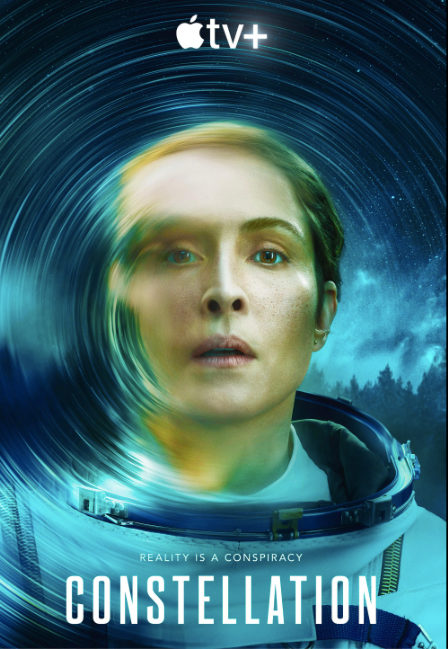
Constellation: Alternate Realities and Family


I've read and seen many alternate reality stories.  Some are caused by quantum entanglement -- the mega version of two subatomic particles colliding and then moving in opposite directions but still intimately and instantly connected -- and some just happen or are already there.  I just reviewed a movie with that schema, and have written a few double realities stories and a novel with that premise myself.  But none explore the existence and impact of that on families the way that Constellation does.  Indeed, none do much of that at all in the at once deep and startling way that this new series on Apple TV+ does.

[Some spoilers ahead ... ]

The title and the start of the series makes you think it's a story about space travel.  But space is just the catalyst for a powerful, heart-tugging story that takes place right here on Earth.  Jo is an astronaut on the International Space Station, which suffers a devastating accident.  Most of the astronauts, cosmonauts, and space travelers from Europe manage to return to Earth.  Jo and Paul are left on station. Paul dies of his injuries.  Jo manages to get back to Earth, and that's when the fun begins.  That is, fun for us, quite the opposite for Jo and her family.

Jo soon discovers that things aren't quite the same with her family as when she left for the voyage to the ISS.  Her husband Magnus is surprised with how much Jo seems to like him.  Her daughter Alice doesn't seem quite the same person. We soon learn that this voyage to space has split Jo's reality into two -- literally.  There are, or were, two Jo's, two Magnus's,  two Alice's.  We hear about macro quantum entanglements.  In this case, two families, which in fact are two versions of the same family. And things get really crazy when they try to communicate with one another. 

There's a history to this -- the strange effect of going out into near space has been happening at least since the 1970s.  There's a touch of alternate history, too.  There's an Apollo 18 mission (in our reality, the Apollo Program ended with Apollo 17's trip to the moon).  But the heart of this carefully crafted narrative is the agony that Jo's two families -- the same family, in two slightly but significantly different versions --  go through as they struggle to make sense of Jo's return from space and what's happening to them.

The narrative is immensely savvy, with winks to all kinds of things.  There's a cat that lives and a cat that dies -- the same cat, actually, in alternate realities -- apropos Erwin Schrödinger.  Alice lives up to her literary tradition, in wonderland on both sides of the looking glass.  And the story is lifted by powerful performances, especially Rosie and Davina Coleman (twins) as the Alices, and Noomi Rapace as Jo.  Jonathan Banks as Henry/"Bud" Caldera, an astronaut on that Apollo 18 mission and still very much around in twofold form in the 2020s, puts in an even more memorable than usual crusty performance. And it was good to see Barbara Sukowa as Irena, a cosmonaut whose double plays a crucial role in this story.  Hats off twice to Peter Arness (Wallander) who created and wrote the series.

All in all, a thought-provoking, tightly woven, emotionally valent eight episodes of what could well be the first season of more to come, and I won't soon forget in any case.


Saturday, December 24, 2022

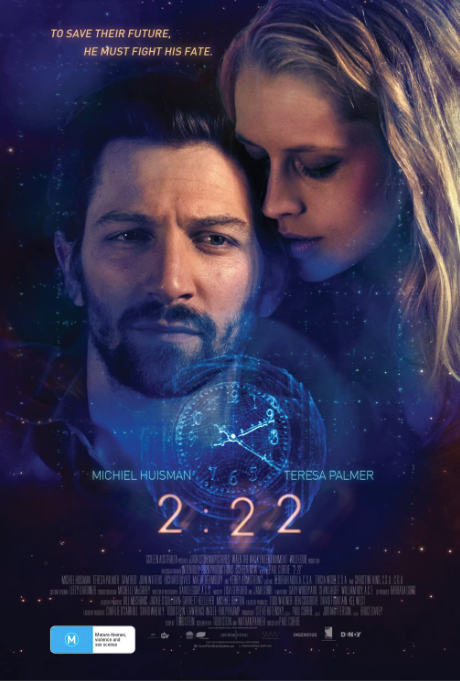
2:22: Grand Central Terminal of Science Fantasy


I don't know how I could've missed it, but I just came across 2:22, a 2017 movie, on Hulu.  And seeing as how it had a least a whiff of time travel, and its locus was none other than Grand Central Terminal in New York City, I had to watch it.  (Grand Central Terminal is also a centerpiece of my story, "It's Real Life," now being made into a radioplay -- which in itself is something we associate with the 1940s.)

I'm glad I watched 2:22, and I'll try to tell you why without too many if any spoilers.

Dylan is an air traffic controller who gets slightly pulled into some other reality at a crucial time, with the result that two planes nearly crash.  On one of the those planes is Sarah, who wanted to be a dancer but instead plays a big role in an art gallery.  Art and motion and the night sky and holograms all play a big role in the ensuing story.

Dylan and Sarah fall in love, and it's a lot more and deeper than love at first sight.  Dylan and therefore we keep seeing a murder scene in Grand Central Terminal which happened almost thirty years ago.  We gradually learn that the two are somehow connected to it, as is Jonas, an artist whose exhibition will soon open at Sarah's gallery.  Also, the two used to be a couple.

And I'm not going to tell you any more about the plot, because of what I said about limiting spoilers.  What I will say is that 2:22 captures the pace and flavor of pre-COVID New York City very well, even though at least part of the production company credits are Australian.  And though the developing story and its resolution put it in more in the realm of science fantasy than science fiction, there's enough science deftly mixed in there that the movie works for me.

Fine directing by Paul Currie, and I liked both  Michiel Huisman (who is currently playing Prince in Echo 3, which I've been enjoying and reviewing) and Teresa Palmer in the lead roles of Dylan and Sarah.

It's Real Life

alternate reality about Grand Central & The Beatles on Amazon, and  FREE on Vocal

Monday, April 26, 2021

Debris 1.9: Resets 1

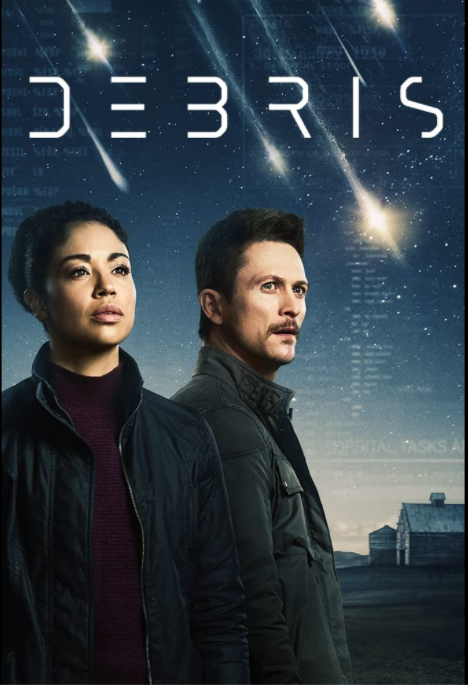
Whoah -- a brilliant game-shaking episode 1.9 of Debris on NBC tonight, in which the piece of said Debris shifts those who come into its presence into alternate realities.  That is, what clearly is not one but what seems to be an unlimited series of alternate realities.  That would be a cool centerpiece of this narrative.  But the story that plays out for our characters is an ingenious piece of work in itself for just an episode of a television series.

The hour starts off conventionally enough (that is, conventionally enough for Debris).  A diver comes into contact with a piece of Debris off the coast, and finds he's in an alternate reality minus his sister.  And the narrative stays conventional enough (that is, for Debris) throughout most of the rest of the hour.  Bryan and Finola investigate what's going on, now with the help of Finola's sage father.  But the diver, desperate to find his sister, keeps jumping in the ocean and swimming towards the Debris to enter yet another new reality.  We see everything from the diver's perspective, including Bryan having different partners in some of the realities.  Finola's father says colors are important in understanding what's going on, especially the color orange.  In an especially nice touch, it even looks like one of the Bryans has orange reddish hair.  (Did they dye Jonathan Tucker's hair, or just changed the lightning, or maybe my mind was playing tricks on me.)

But all of that is just prelude to what happens near the end.  Bryan tries to stop the diver from swimming towards the Debris -- the repeated resets of reality could "damage the universe" -- and Bryan gets sucked into an alternate reality himself, where, among other things, Finola is not his partner.

And this turns out to be just Part 1 of a two-part story about alternate-reality resets.  I've seen some good alternate-reality episodes on various science fiction series over the years -- those on Star Trek: TOS and Star Trek: TNG are especially memorable -- but this episode of Debris is something new, very different, and right up there with the best.

See you back here next week in what I hope is our same reality with my review of the conclusion of this story (or these stories).

See also Debris 1.1 Some Probability of Gems Among the Pieces ... Debris 1.2: Clones ... Debris 1.3: Trapped Out of Time ... Debris 1.4: Suspentia Belief ... Debris 1.5: Fine Tuning ... Debris 1.6: Fountain of Youth and Its Complications ... Debris 1.7: Ferry Cross the Moebius Strip ... Debris 1.8: Resurrection and Its Hazards


InfiniteRegress.tv