Chuck Todd interviews me about alternate histories
Showing posts with label Frank Sinatra. Show all posts

Wednesday, June 14, 2023

Why the Final Beatles Record via AI Will Be Great, But Not So Revolutionary


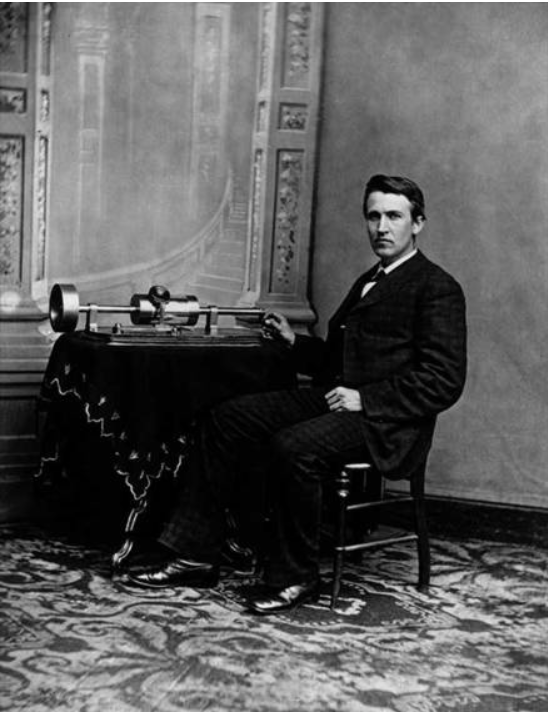
Edison and his first phonograph

Everybody's talking about Paul McCartney's comment in a BBC interview that AI was used in the creation of the "last" Beatles record, based on a demo John Lennon made in the 1970s, and already worked on by the surviving Beatles -- Paul, George, and Ringo -- in the 1990s, when The Beatles released two other Lennon demos they recrafted, "Real Love" and "Free As A Bird".   I'm really looking forward to this new record, to be released last this year, but I expect it won't be very much different in production and outcome than any other Beatles recordings released in the past few years, including the beautiful things Peter Jackson did to the Beatles recordings from their 1969 rooftop concert and a little before in Jackson's 2021 documentary, "The Beatles: Get Back."

Let's go back to the history of recording to understand why AI use in these recordings is not such a big deal.  If Frank Sinatra hit a bad note, or wanted to change anything in his studio recording of "That Old Black Magic," which would appear on his second studio album, released on Columbia Records in 1947, he would have needed to go back into the studio and record the whole song again.  By the 1960s, when The Beatles began recording, that already was not necessary.  Splices could easily be made in the recording tape, so the correct note could replace the off-key note, and by the end of the decade and the beginning of the 1970s even that was not necessary.  All splicing could be done electronically, and as the number of "tracks" that were used in a recording quickly expanded from 4 to 8 to 16 and more, doing harmony to your own voice became easy and commonplace.  None of that was called or even considered to be recordings made by AI.  The were recordings made by human beings, using ever more sophisticated technology,

By the 21st century and increasing in the past two decades, digital correction of flat notes via Autotune and production of harmonies without the singer needing to put down another track became ubiquitous in recording.  Even in the 1990s, producer Jeff Lynne did all kinds of electronic magic on Lennon's vocals to make them compatible with the new voices Paul and George were putting on "Real Love" and "Free As A Bird".  None of that was thought or said to be the least bit worrisome.  These developments were just more of the same tech advances which had been foreseen almost since the day Thomas Edison rolled out his first phonograph -- which recorded on tin foil -- back in 1877.  He'd intended that to be used as a recording device for the telephone (invented by Alexander Graham Bell a year earlier in 1876) and didn't foresee its mass adoption as a music recording player.  But the world soon did, and gave Edison the name of "The Wizard of Menlo Park" (New Jersey, where Edison invented the record player).

History is always worth consulting, and especially useful in putting new developments into perspective.  It may be exciting to be concerned about our increasing use of AI in so much that we do, but the Greek chorus of criticism that we hear about every new use of AI these days is misplaced. In reality, it's actually about things that AI does in science fiction, and is itself a kind of science fiction.

I'll sit back and listen to this new Beatles recording with no concern at all, and nothing but pleasure, grateful that Yoko sent cassette recording by John to Paul in the 1980s, and we now have the technology to make it sound fully alive.

It's Real Life

"It's Real Life" -- an alternate history about
The Beatles -- read it for FREE here


Monday, May 25, 2020

Killing Eve 3.7: The Omelet


My favorite scene in Killing Eve 3.7 tonight was the omelet near the beginning - more specifically, the way Carilyn uses the omelet as a token of her approval or not, withdrawing it from Mo, then giving it to Eve, then withdrawing it from Eve, because she's so obsessed with Villanelle.  And the omelet is spoken of again, in close to Mo's last words, before he is killed.  The symbolism is good.  The writers/directors/producers of whoever came up with it have no eggs on their faces.

The killing of Villanelle's handler might have been my favorite scene, except she wasn't quite killed, and, sure enough, turns up later alive if not well in a hospital bed.  Right next to Konstantin, who also could have died of a heart attack on the train station, but didn't.  Make that a semi-major and a very major character who are villainous and could have died in this episode, almost died, but didn't.  And who does die?  Mo, who was a good guy, if not a major player.

Indeed, the only reason to kill Mo is that it's more reason to unhinge Carolyn, after what happened to Kenny.  And she more or less takes it in stride, upset, for sure, but only breaking some valuable vases or whatever they were to express her inner anguish after prodded by her daughter.   If the killings of Kenny and Mo were both for the purposes of testing Carolyn's cool, that strikes me as too high a price to pay.  On the other hand, wasn't it V. I. Lenin who said that if you want to make an omelet, you have to break some eggs?  Yeah, but I guess that's a metaphorical omelet.

And next week is the season finale.  Eve and Villanelle tonight were like ships passing in the night, once again, or ships passing on the train, or trains passing in the night, or strangers in the night, to quote Sinatra.  I have a feeling, the way this season is going, that not much more will be resolved between them in the finale.  But I do think that the brunette who killed poor Mo will play a role, or maybe a roll, if another omelet is involved.

See also Killing Eve 3.1: Whew! ... Killing Eve 3.2: Bringing It Into Focus ... Killing Eve 3.3: The Third Time's the Charm ... Killing Eve 3.4: Tip Toe Through the Tulips ... Killing Eve 3.5: The Darkness ... Killing Eve 3.6: Wounded

Tuesday, April 7, 2015

Sinatra: All or Nothing at All: Review: About All You Could Ask For

I saw all of Sinatra: All or Nothing at All - all of four hours - last night on HBO, and found it excellent.

In addition to the great music, I learned the following from this documentary -

  • Sinatra was a fierce advocate for FDR (I knew about JFK) and for equal treatment of African Americans in this country - at a time, the 1940s and 50s, when few others in Sinatra's positions were out there.   He then tarnished this a little with stupid racist humor at Sammy Davis Jr's expense in the Rat Pack (not that Sammy ever complained).
  • The oft-told tale of how Sinatra landed a crucial part in a movie with the mob's help - dramatized in The Godfather - is an urban legend.  What really happened is Ava Gardner went to bat for him.
  • Sinatra hated rock 'n' roll, Elvis, and the Beatles - I already knew some of this - but it was great to see Sinatra nonetheless do a fine duet with a young Elvis on television.
  • Sinatra did use mob connections to help JFK win in the crucial states of West Virginia and Illinois - this was pretty well known already - but the depth of Sinatra's hurt when Joe Kennedy through Bobby cut Sinatra out of Camelot was a sight to behold in the documentary.
  • Back to Ava Garder - she had a caustic tongue, to say the least, and assuming those words attributed to her were really spoken by her - the documentary had someone else render her voice - we get a lesson in the language used behind the scenes in these supposedly slightly more genteel times in show business.
The singing, which was all Sinatra, was just wonderful, as I said.  My wife and I saw him in a concert in Westchester in the late 1970s, and have always admired his work - even though, unlike Frank, we love the Beatles, and I (not my wife) love Elvis, too.

There was one thing lacking in the movie - at least a minute or so of Frank and Nancy's "Something Stupid" duet in the mid-1960s would've been nice to hear - and I caught one little error on the screen (the election in which Sinatra helped JFK was listed as 1963 when it course took place in 1960).  But, overall, I highly recommend this movie to Sinatra fans or anyone who's heard of him and has wondered what all the fuss was about.   In an age before social media and cable TV, Sinatra catapulted to the top via the media at his disposal - band tours, concert halls, radio, motion pictures, and network television - and became a towering icon we have yet to see duplicated.


Monday, October 15, 2012

Boardwalk Empire 3.5: "10 L'Chaim"

A superb Boardwalk Empire last night, with a multitude of sharp lines and situations.  But my favorite goes to Eddie Cantor - a real entertainer in our history - who not only speaks Yiddishisms, but serves them with a sense of humor.  He tutors Nucky in the toast "L'Chaim" - to life! - and adds that he knows some people in prison serving "10 years L'Chaim".

But there's a dark side to Nucky's relationship with Eddie.  Like the Johnny Fontane character in the Godfather (presumably based on the real life Frank Sinatra), the real life Eddie Cantor in Boardwalk Empire is under Nucky's thumb.  Nucky wants Eddie to star in a new music with Billie.  When Eddie refuses - he doesn't want to renege on a commitment he made to Jerome Kern (another real life musical writer and producer) - Nucky has Chalkie come over and make Eddie an offer he can't refuse.

This is in character for the new, tougher, more violent Nucky that we met at the end of season two last year, when Nucky shoots Jimmy point blank.  Nucky's standing up to everyone in this season - refusing not to get his way - including even Arnold Rothstein, who calls Nucky out on his coming up to New York just to see Billie.  Nucky retorts to Rothstein: unlike you, I'm not dead below the waist.  Good line.

Nucky also tries to take out Rosetti, which, as always with Rosetti, is quite a story in itself.  We see Rosetti at play - first in auto-erotic-asphyxia with a woman, then "joking" with a newspaper delivery boy.  The joke is actually pretty media savvy - as many Boardwalk Empire lines are.  Rosetti asks the delivery boy if the newspaper is new; the boy (about 13-14) assures Rosetti it is;  Rosetti then asks, looking at the newspaper, why "all this stuff happened yesterday"?   That's indeed the reality of newspapers, and one reason why their circulation has been declining in our Internet age.   But back to Nucky: he sends a team to take out Rosettit, whom they find, ropes around his and the woman's neck.  Rosetti manages to grab a gun, shooting ensues, and when the gun play is over Rosetti is fine but the woman and the newspaper boy have been shot to death.   We already knew it wasn't safe to get involved in any kind of joke line with Rosetti, because he was prone to kill the conversationist. This time, even though Rosetti seems to like the newspaper boy, he dies because of his association with Rosetti and his joking anyway.   A chilling O'Henryesque twist.

There are also some good continuing story lines with the fictional Van Alden in Chicago and real life Cabinet Secretaries in Washington.  And it was good to see Dominic Chianese again (he had a good evening, with major role in The Good Wife over on CBS).  But speaking of real life: was Eddie Cantor really ever forced by a mobster to back out of a part in a musical?  I don't know - I'll look into it and see what I can find - but it was an instructive moment in an excellent episode.

See also Boardwalk Empire 3.1: Happy News Year 1923  ... Boardwalk Empire 3.2: Gasoline and the White Rock Girl ... Boardwalk Empire 3.3: The Showgirl and The Psycho


"As a genre-bending blend of police procedural and science fiction, The Silk Code delivers on its promises." -- Gerald Jonas, The New York Times Book Review
InfiniteRegress.tv