Chuck Todd interviews me about alternate histories
Showing posts with label François Truffaut. Show all posts

Sunday, September 12, 2021

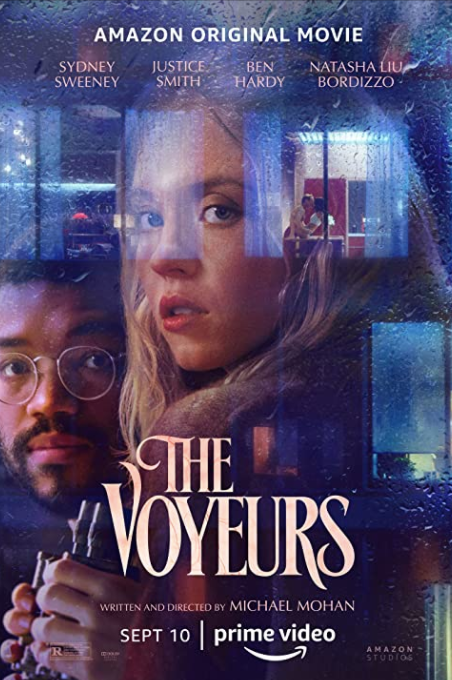
The Voyeurs: Not Rear Window, But Still Worth Looking Through


We caught The Voyeurs -- not real people, the movie that just went up on Amazon Prime Video -- and enjoyed it.  It's been compared by critics -- unfavorably, of course -- to Hitchcock's 1954 masterful Rear Window, but it's still worth watching, looking through, choose your metaphor.

And though The Voyeurs lacks the dramatically harrowing tension of Rear Window, it's a pretty enthralling, attractive mystery, with some good surprises, mostly stacked up near the end.  The cinematography, the ambience, and the bodies all work well.

[SPOILERS AHEAD ...]

I guessed the first big surprise, and that gets at the one underlying problem in the plot.  I had a feeling Julia wasn't dead, and she and Seb were just acting that out to amuse and ensnare Pippa and Thomas.  I was also a little not quite believing that Thomas took his life, though the funeral made it clear that he was dead.  But in both Julia's and Thomas's cases, taking their own lives seemed a little extreme.  Yes, they would have been hurt, even devastated, by the infidelity of their partners, but there wasn't quite enough psychological development to make their suicides plausible, at least to me.

That said, though, I was impressed with what Pippa was able to pull on Seb and Julia in revenge.  That effective twist, a good way to cap off the movie, was due to Sydney Sweeney's convincing portrayal of Pippa as a sweet young woman with a raging libido just waiting to be tapped.  In all the scenes prior to her turning the tables on her tormentors, she was able to convey an interpersonal and erotic vulnerability.

Back to Hitchcock -- he's in a class by himself.  His movies are peerless, and François Truffaut's Hitchcock/Truffaut (1966), an extended interview with Hitchcock in which he talks about his many movies, is far and away the most instructive book about film I've ever read.  (I'll review the 2015 HBO documentary here soon.)  So don't let the primacy of Rear Window get in the way of your watching The Voyeurs, and enjoying it, if you have a heartbeat.


Sunday, May 20, 2018

Fahrenheit 451: Updated for Fake News, Hate Speech, and DNA


I just saw the new Fahrenheit 451 - the HBO movie, based on Ray Bradbury's justly lionized 1953 novel of the same name, made into an excellent 1966 movie of the same name by François Truffaut.  The new HBO movie by Ramin Bahrani obviously had a lot to live up to with that kind of pedigree.  I'm here to tell you that it did - which puts me at odds with the numerous dyspeptic reviews it's already received on IMDb (at this point, 5.1/10), Rotten Tomatoes (32%), and Roger Ebert (2/4).  That's no surprise - I often find the established wisdom of professional and nonprofessional critics myopic.

But to the HBO movie - what I look for in a remake is something different, important, and if possible, more meaningfully current than in the original or earlier versions, while maintaining the best parts, including memorable details of the original.  Again, not an easy task.  But the new Fahrenheit 451 does it potently and beautifully.

The lie that Benjamin Franklin started fire brigades in America to burn rather than extinguish fires, with the truth that Franklin wanted fire fighters to put out fires being denounced as a lie, was one of the starkest parts of the original story.  It's in the new movie, too, but the truth is denounced as not just a lie but "fake" - a clear reference to our current crisis of fake news.

Another chillingly effective detail in the original is Captain Beatty extolling the "equality" of all books being burned, and holding up a copy of Mein Kampf as an example.  The scene is chilling because it tempts us to think that it's good if some books are burned - in this case, a book preaching hate, written by a monster who implemented that hate in the worst way. And the scene has special relevance to our struggle in 2018 with "hate speech" and what to do about it.  (See my The First Amendment in the Age of Post-Truth for my brief argument as to why we must not burn or censor it.)

But the new Fahreinheit also introduces something brand new to the story - which has gotten some critics crazy.  In the new ending ... wait, I won't tell you the ending, because I don't want to spoil it for you if haven't yet seen the movie.   But I can tell you the radically new element upon which the ending is predicated: our heroes do more than memorize books, so each person becomes a book, which is the inspiring, ennobling upshot of the original.   In the new movie, our heroes are also working on a plan to encode the text of every book, the digital code of every film, every piece of music, into DNA, where it can be stored and spread via biology. In other words, a good greater than any number of brave individuals.

Now I think that's a really cool departure from the original - and not just because I explored the biological potency and uses of information in my first novel, The Silk Code (reviewed here in The New York Times - one review I really liked).   But in the movie, this plan is brilliant and makes every sense.   After all, the villains are touting digital information (because it can be easily manipulated - another bow to fake news) over books, where the information is stable and reliable.  (The information in books has what I call "reliable locatability" - what's on page 77 of any book will be there on page 77 next week or next year or next century, as long as the book isn't burned.  See my New New Media, 2nd edition, p. 77 - not a novel - for more.)

Anyway - you needn't take my word for it.  See Fahrenheit 451 on HBO and see if you agree.


Monday, October 30, 2017

The Deuce Season 1 Finale: Hitchcock/Truffaut

Hitchcock/Truffaut, a 1966 book of interviews of film genius Alfred Hitchcock by film genius François Truffaut, is generally recognized as one of the best, if not the best, book about the strategies of film making ever published.  I certainly do, and just this term at Fordham had reason to cite in one of my classes Hitchcock's distinction  between surprise and suspense mentioned in the book.  (Surprise is when the viewer doesn't know what's going to happen - a bomb suddenly explodes on a crowded bus.  Suspense is when the viewer knows there'a a bomb ticking on a crowded bus.  Hitchcock correctly thinks suspense is usually a much stronger way to go.)

So, I was delighted to see Harvey compliment Candy and her film making natural savvy by saying what she was talking about was straight out of Hitchcock/Truffaut.  She of course hadn't read the book, and Harvey knows that.  So his compliment was high praise indeed.  And that's high praise for The Deuce, for mixing a little high culture into its pop culture of pornography.

It was also great to see Clarke Peters holding forth as a retired pimp.  There's of course a lot of The Wire in The Deuce, with David Simon involved, and that includes not only the flow and ambience but the actors.   Peters is having a good year - I was just enjoying his performance on The Tunnel, Season 2, on PBS.  I hope he's a regular character on The Deuce.

But the creme de la creme of this season finale was Harvey and Candy going to see a porn film which all but made the X-rated movie legitimate back then - Deep Throat.   Linda Lovelace played by Heather Cole was there, and I swear I saw the real Andy Warhol there, too, though of course that's impossible (on the other hand, people are saying this is Halloween weekend).

There's powerful, simmering material for a second season, and The Deuce has been renewed.  Count me in.

See also The Deuce: NYC 1971 By Way of The Wire and "Working with Marshall McLuhan" and Marilyn Monroe on the Deuce 1.7 

  
It all starts in the hot summer of 1960, when Marilyn walks off the set
of The Misfits and begins to hear a haunting song in her head,
"Goodbye Norma Jean" ..
InfiniteRegress.tv