
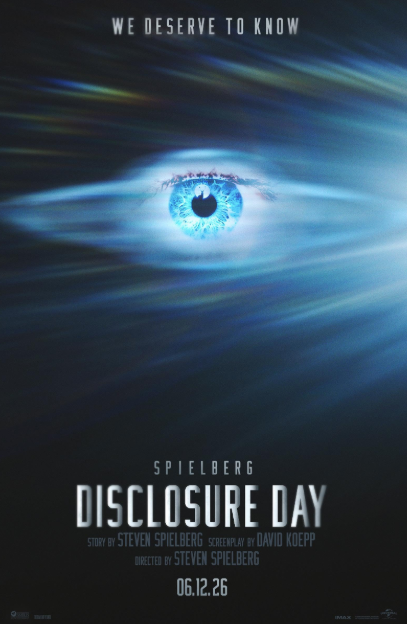
My wife and I just got back from seeing Steven Spielberg's Disclosure Day on its debut day at the Chatham Orpheum Theater. I thought it in many was a terrific, at times terrifying, tender, and sage movie, with a couple of flaws.
Here is some of what I especially liked about it:
- The action scenes, especially the ones with trains and cars, were outstanding. Edwin Porter, Alfred Hitchcock, and James Bond would have approved.
- Sister Maura (Elizabeth Marvel) was a persuasive and plausible source of wisdom. As I discussed in my 2020 essay The Missing Orientation, researchers have found that the organized religious group which finds the 1947 Roswell Incident (the first contact of the interstellar visitors in Disclosure Day) most likely a landing of travelers from somewhere beyond the Earth are Roman Catholics.
- Nixon showing off the interstellar bodies to a 1950s TV star (who looked like Jackie Gleason) was a perfect touch.
- The television news media were portrayed very well, at least as far as I know. Margaret Fairchild (Emily Blunt) asking for makeup before she makes her earth-shaking announcement is a good move for anyone who goes on any kind of television, for whatever reason: never say no to makeup.
- Mental telepathy plays a big part in the movie. I was just debating on Facebook the other day with Steve Davidson (publisher of Amazing Stories) about whether mental telepathy was still a bonafide science fiction feature. I said it was, and referenced Alfred Bester's 1956 The Stars My Destination. Steve said it was then but now wasn't. I said it still was. I thought Steven Spielberg made a good case for it in Disclosure Day.
- It's always great to see Colman Domingo on a science fiction screen. Colin Firth put in an especially fine performance, too.
- I love wildlife, especially birds. The idea that the interstellar visitors would masquerade as them so as not to unduly frighten we humans is sweet but a little ridiculous. I guess Walt Disney would've liked that, though.
- I thought the story took a little too long to find its wings. Maybe that's just me.
- I also thought the ending happened a little too quickly. There's a lot of profundity to unpack in this narrative. Maybe it would have been better told in a limited streaming series.


 I half binge-watched the third season of House of Cards this week - my wife and I wanted more time to savor the episodes on Netflix - but there was nothing half-hearted about this third series of 13 chapters. Indeed, this season was rear-end-over-teakettle volcanic political drama, with aspects that exceeded even the first two extraordinary seasons.


