I've always had a keen love of alternate history science fiction. Amazon Prime Video's The Man in the High Castle series (2015-2019), a mostly brilliant adaptation of Philip K. Dick's path-breaking 1962 novel, in which the Axis won the Second World War, was pretty much from the moment I started watching it easily the best drama I've ever seen on television, and still is. (Here's an interview I did with Rufus Sewell in 2021 about the leading character he played in the series, one who wasn't in Dick's novel.)
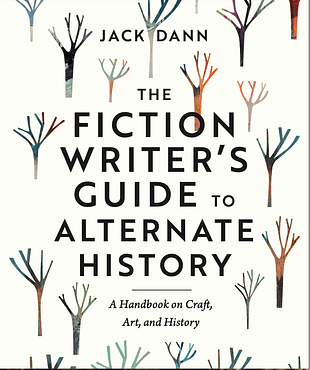
But as much as I love alternate history, I didn't really start writing it until "It's Real Life," a story in which John Lennon wasn't murdered and The Beatles were still together and making music in 1996. That story was a finalist for the Sidewise Award, bestowed today for the best "short form" published in 2022. An ideal time for me to read and review Jack Dann's Fiction Writer's Guide to Alternate History.
The heart of this remarkable book is a colloquium, conducted in the previous decade among the leading writers of alternate history. I heard of all of them, met some of the them, and have read something between between all and some of their alternate history fiction. They respond to Jack Dann's prompts, and I don't think they saw each other's responses. They differ on what the "rules"of alternate history should be, including about whether there should be rules at all, consciously or unconsciously followed. They of course draw upon their own works as examples, in seeming violation of I. A. Richard's warning against the "intentional fallacy," that is, relying upon what authors say they intended in their work, but this doesn't really matter, because the authors in Dann's book also talk about work by other authors in the book, as well as authors not in the book, and their arguments can be evaluated without reference to their work.
One of their points that most struck me is Bruce Sterling's (p. 119) that “Commonly they’re [alternate histories] about troubled times in which the author has some kind of solution to offer.” This is exactly why I wrote "It's Real Life": it always seemed to me that the world in which John Lennon was assassinated was a deformation of the way reality was supposed to be, and I wrote the story to give the world a taste of the way it was meant to be. Pamela Sargent (p. 121), makes a similar point, writing that “Back in the early 1990s, I gave a talk at one convention in which I said that I had the persistent impression that all of us were living in a weird variant that had branched off from the main continuum," as does Paul Di Filippo (p. 97), who tells us that “I think the best such [alternate history] stories arise from creating a world the author would like to at least explore or even inhabit."
These and numerous other insights and explications in Dann's handbook are invaluable to authors at any stage in their careers. If they're just starting out, it provides a blueprint -- which as Dann makes clear, they needn't follow if it goes against their grain -- and if you're an old hand, you'll find the comfort of better understanding just why you chose to do this or that in the narrative you just wrote, or maybe just finished, because you started it a long time ago, a crucial way of writing for many a writer, also discussed in Dann's book.
Another point of discussion of special interest to me, because I've written half a dozen books on media history, and that's a lot of what I teach as a professor at Fordham University, is what these authors of alternate histories think of our "real" history. I put "real" in quotes because, as George Zebrowski (p. 120) notes, and I agree, “Tentative history is all we have, and in science fiction we can rehearse as many as we can imagine.” Yet to make this issue even more provocative, while Kim Stanley Robinson (p. 90) agrees that "all history is a fiction, and as such, maybe it’s always an ‘alternative history,’” John Kessel (p. 83) insists that “I want the counterfactual to illuminate some element of real history,” and I agree with that, too. Indeed, I think for a counterfactual or alternate history to work (some of the authors argue these have two different meanings, I do not), the story has to have some number of real signposts, to keep our appreciation of the alternate history on track.
Jack Dann of course also writes tellingly about his own alternate histories. He talks about how Milton's Paradise Lost and John Martin's illustrations of them a century later were inspirations and building blocks for Dann's own Shadows in the Stone (2019). All authors need inspirations, they're obviously essential, but you can't create them. The best you can do is recognize them and then act upon them when you're ready. In effect, the whole of The Fiction Writer's Guide to Alternate History is a treatise, in part multi-authored, of what inspires the imagining and writing of alternate histories.
I realized the moment I started writing "It's Real Life" that I was inspired by Peter Jackson and his The Beatles: Get Back documentary. I saw its three parts the instant they were released on the Thanksgiving weekend in 2021, and wrote "It's Real Life" in January 2022. In a way, that documentary is both an alternate history and it epitomizes the interplay of alternate and "real" history that is one of the central themes of Dann's book. What were The Beatles really like as they stood on edge of disbanding in the history we all remember and most of us deeply regret. Jackson has hours of outtakes recorded when The Beatles were making the depressing Let It Be documentary that proves they were far happier than we've been told and we "remember". Or were they? After all, they did break up.
I was so energized by Jackson's documentary that I wrote an alternate history in which The Beatles didn't break up. I've expanded it into a short novel that I haven't yet shown to anyone, except my wife, who read an earlier draft. I'll no doubt go over it at least a few more times before I decide what to do with it. Will I be influenced by the exhilarating experience I just had reading Jack Dann's Fiction Writer's Guide to Alternate History? Will I follow or break some of the rules that Dann and many of the authors in that book say can and maybe should be broken? I don't know. But you can find out by reading The Writer's Guide to Alternate History now, and It's Real Life the novel whenever it's published.
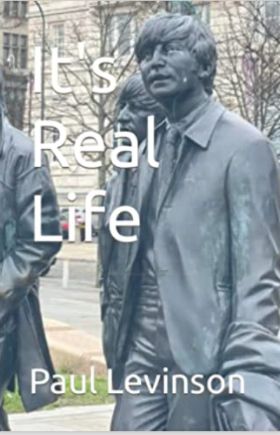
Get "It's Real Life" in paperback, or on Kindle, or read for free here.