Chuck Todd interviews me about alternate histories
Showing posts with label Clive Owen. Show all posts

Thursday, July 22, 2021

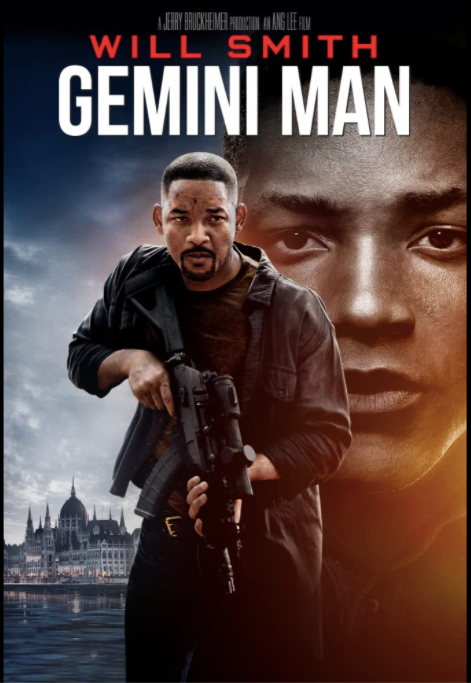
Gemini Man: A Missed Time-Travel Op


I saw Ang Lee's 2019 Gemini Man on Hulu last night.   Mainly because of what it could have been, but wasn't.  It had lots of star power with Will Smith and Clive Owen, and lesser-known Mary Elizabeth Winstead was good, too.  The action scenes were excellent.   As to the plot ...

Well, the story features Smith's Henry Brogan fighting a younger version of himself, sent to do him in by Owen's Clay Veris.   Smith not only acted well, but looked his younger self via a de-aging process I last saw in The Irishman, which worked very well.  My initial thought and expectation is this could amount to a good time-travel narrative, in which young Brogan has the advantage over his older self, in that the younger version could kill the older version, but not vice versa, since if the younger version were killed that would instantly erase the older version from existence.  (Of course, that time travel scenario would have had to account for why the older Brogan didn't remember being attacked by a younger version of himself, but that could have been fun to work out, too.)

Instead, the explanation for the older and younger Brogan is cloning.  Now, that has the advantage of certainly being possible in reality, in contrast to time travel, which (a) hasn't happened yet (as far I know), and (b) is likely to never happen, owing to the paradoxes involved (like the grandfather paradox: if you travel back in time and prevent your grandparents from meeting, how did you exist to travel back in the first place) and the "solutions" which are even more incredible than time travel (travel to past generates alternates realities, one in which the time traveler exists and one which the time traveler does not).  But, in my view, the cloning explanation for more than one Brogan makes for a more mundane, less intellectually challenging, even boring narrative.

But, hey, if I feel so strongly about that, maybe I should write a story with that time-travel mechanism, and get it to a Hollywood producer, rather than complaining about Lee's movie (for which Game of Thrones' David Benioff wrote the screenplay, with two others, so it's not even mostly Lee's fault).  Anyway, see the movie, if you haven't already, and see what you think.


Wednesday, January 23, 2019

Anon: Minor Work from a Great Writer and Director


Andrew Niccol's Gattaca in 1997 remains one of the surprise all-time best science fiction movies, surprise because Gattaca was Niccol's first.  His follow-up, The Truman Show in 1998, was even more lionized by some, but I didn't like nearly as much as Gattaca, which was stunning in its mix Brave New World totalitarian life and the yearning for space travel.  I've seen some of Niccol's subsequent movies, but I honestly can't recall them.

Anon had all the right ingredients for another great movie - Clive Owen and Amanda Seyfried in the cast, and a kind of Philip K. Dick Minority Report story, with a police force that can scan people's minds and therein nab criminals (not before but after the act), and hackers who can cut up and out those images.  Add to that a serial-killer hacker suspect (Seyfried) hunted by Owen (a detective who can mind scan), and they're sexually attracted to one another, and you could've had another great Niccol movie.

There were lots of good scenes, savvy dialogue, wonderful locales (my favorite: Sal's apartment on Wadsworth Terrace in Manhattan), and a pretty good twist at the end (which I won't tell you), but Anon nonetheless lacked, I don't know, a certain depth and profundity, even though that's exactly what it was trying to convey.   Anyone, especially police detectives, having access via your brain to what you see and do is a pretty traumatic and revolutionary development in human life, and for all the characters' remonstrating about that in the movie - or, in some cases, celebrating it - the ambience fell short of kicking you in the cosmic gut.   Probably there was a little too much emphasis on the murders and the police work.  Perhaps seeing scanning in other contexts a little more would have given Anon a more universal grounding.

As it was, Anon is a good film, worth watching, but a minor work from a great director and writer.  Hey, it's good enough that I'll definitely watch Niccol's next movie.


Sunday, May 6, 2018

Anon: A Good

Just saw Anon on Netflix, where it debuted just two days ago.  The movie's by Andrew Niccol, and I'd say it's better than The Truman Show but not as good as Gattica, for whatever that's worth to you.

The story's pure cyberpunk, or a mix of cyberpunk and police detective, though police are usually right in the middle of and never too far away from any cyberpunk story.  You could also say that Anon is part of the cyberpunk renaissance, along with the Blade Runner sequel and Altered Carbon, but that wouldn't be quite true, either, since cyberpunk never really went away.

What is true about Anon is that it's a well told and well played story, in near future New York (with scenes in places where I've actually spent time), about a homicide detective (Sal, well played by Clive Owen, who plays everything well) who is hunting an apparent serial killer (a nameless "girl," with one of Amanda Seyfried's best performances) who is hard to find, because she's created an algorithm that erases all of the digital records that police have of everyone, everything they do, and everything they see.   In that sense - police employing some kind advanced almost mental-telepathic system to eradicate crime, or at least keep it bay, Anon has a kinship with Minority Report, and indeed is as Dickian as it gets without actually being based on a Philip K. Dick story.

The plot is pretty tight, with some real surprises and twists.   There is one place in which the "girl" should have recognized Sal after he goes undercover to find her - given that he was just chasing her, in an excellent scene in which she eludes him by making him fall down a flight of stairs by distorting what they actually look like to him.  But, hey, that little glitch is ok with me, given that the stairs scene was so cool, as is the master hacker's power not only to erase records and thereby traces of herself, but also project false visions into any head she chooses to use as a screen.  It's a good thing Google pulled back from Google Glass a few years back, because seeing Anon would have done that product no good at all.

Though, I'd probably still go for Google Glass right now, and take my chances with Amanda Seyfried's character, since ... well, to tell you more would give away too much of the story.  Or maybe I can't relate that part of the story because the hacker removed it from my records ... though, in the narrative, biologically (naturally developed) memories are not affected by the hacking, so ...

Well, see the movie and see what you think.


Friday, December 25, 2015

The Knick Season 2 Finale: How Final?

The Knick shuttered its doors on its second season last Friday, and closed a lot more than the at-turns cutting edge, guerrilla medical establishment that we've come to know, love, and sometimes be repulsed by.

First and foremost is the permanent shuttering - for the season being over is not the same as the series ending - of Clive Owen's magnetic Dr. Thackery.  Why the other doctors in the room didn't move a little more quickly to disobey his repeated orders and intervene to save him is not clear, and not satisfyingly explained by their fear of going against his commands.   On the other hand, there was likely little if anything they could have done after he nicked so crucial an artery.  And so the anti-hero hero of The Knick dies of a nick self-inflicted.

The other big event was the marriage of Cleary and (former) Sister Harriet, which happened off-camera - actually, she put on his ring, which I suppose makes them married - but was the nonetheless a triumphant event.  Or, would have been, had not we learned a little earlier that Cleary, in his love for Harriet, had told the police about the abortions she had been performing, in the hope that exactly what happened did indeed happen - she would be thrown out of the sisterhood and into his arms.  On the other hand, it was an act of desperation born in true love, so perhaps there's a little nobility in it after all.

There's no nobility in eugenics, and the talk of taking the ocean liner to Germany to further that work was chilling indeed.   So was the the way people get away with murder in this narrative, not only in the finale but throughout this season.

But there's hope for Algernon, whose wounded eye will not let him resume his profession as a surgeon but leaves open a career in the new psychotherapy, which promises all kinds of possibilities for the next season.

Assuming there is a third season, which hasn't been formally announced as yet.   I'd certainly like to see one - and hey, given that no one cut Thackery's head off, it's even possible that we may see him alive again.

See also The Knick 2.1: Playing Off Our Present ... The Knick 2.4: Spirochete

And see also The Knick: Paean to Scientific Method ... The Knick Sneak Preview Review 1.8: Good Loving, the Fix, and Typhoid Mary ... The Knick Sneak Preview Review 1.9: Sacrifice ... The Knick 1.10 Sneak Preview Review: Fallibility

 
deeper history

#SFWApro

Tuesday, September 30, 2014

The Knick: Paean to Scientific Method

I've been watching and much enjoying The Knick, now in the 7th episode of its premiere season on Cinemax.  Like Banshee and Strike Force on that network, The Knick has a style, pace, and storyline all its own, like nothing I've seen any place else on television or the Internet.

The pace literally percolates, as the backing music before and during the show brings home.  The beginning of the 20th century was a pivotal time in our scientific and cultural history, the last stance of the sheer Victorian optimism in the power of rationality and science to better our lives - an optimism that would soon be irretrievably doused by the First World War, and the ensuing horrors of the next half of the century.   Our current digital age has brought back some of that optimism, and the hope of attaining the global village foreseen by Marshall McLuhan, but we're still far below where Dr. Thackery is in faith in the future.

Medical treatment was beginning to fully emerge out of the Dark Ages, when patients were treated with herbs, later chemicals and drugs, and little was done to directly intervene in their bodies by surgery.  Thackery sees things differently - willing, always, to try to a surgical technique that either makes sense to him, or he's read about in some journal, or both.   As such, this part of the narrative makes The Knick a paean to the scientific method in medicine.

There's an excellent treatment of social illnesses of the time, as well - in particular the racism which sadly afflicts us to this very day, and was always beyond the power of science and surgery to cure.   Thackery at first resists the addition to Dr. Edwards, an African-American, as second in command on his staff.   Edwards is called the worst racist names you can imagine, and by other doctors in the hospital, not just the white trash in the street.   But Thackery can't help but be impressed by Edwards' talent and genius, and comes to be Edwards' champion.

The physical ills that the two and their associates try to get on top of - i.e., cure or provide lasting assistance for - range from difficult pregnancies to aneurysms.   And, true to the newness of the procedures Thackery and Edwards are attempting, they not always succeed.

Clive Owen is just wonderful as Thackery, Andre Holland puts in a memorable performace as Edwards, and the rest of the cast is as much a pleasure to watch as the series.  Highly recommended!

 
deeper history

#SFWApro


InfiniteRegress.tv