Chuck Todd interviews me about alternate histories
Showing posts with label Tobias Menzies. Show all posts

Friday, November 29, 2019

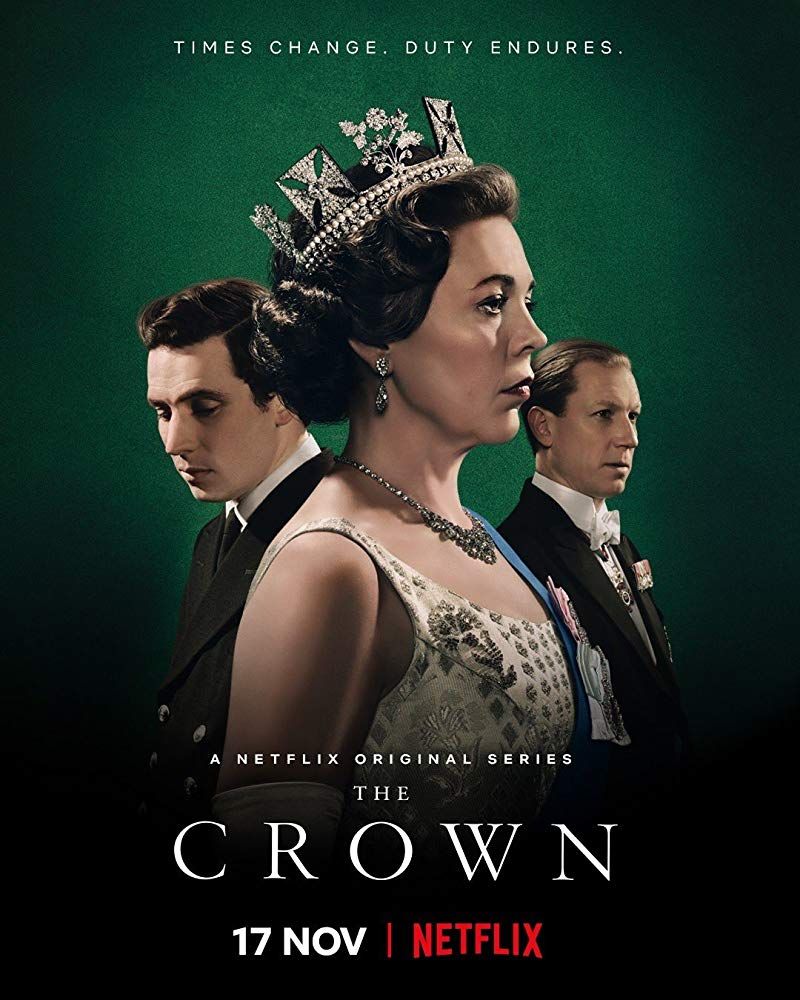
The Crown season 3: Outstanding Story, Worthy Chapters


The Crown is back on Netflix with a third season, and almost a completely new cast, with Olivia Colman as Elizabeth, Tobias Menzies as Philip, etc.  I liked the cast and the episodes even more than I did the first two seasons.

Among favorite storylines as episodes -

  • Prince Charles (very well played by Josh O'Connor) had at least two episodes devoted to his growing into full adulthood.  One finds him in Wales learning the Welsh language.  The other has him back in England, falling in love with Camilla Shand.  In both cases, we find Charles to be more thoughtful, almost philosophic and tender, than we might have thought.  And the second episode shows Elizabeth at first not against Charles marrying Camilla.  It's only when she learns that Camilla's other boyfriend, Parker Bowles, also slept with Princess Anne, that Elizabeth joins the rest of her family in opposing the marriage.  All in all, very sensitively portrayed.
  • Speaking of philosophy, there's an outstanding episode portraying Philip's reaction to the Americans landing on the Moon in 1969.  This event is expertly woven into Philip's midlife crisis, more specifically into Philip's need to find some greater meaning in life.  His idea that the astronauts, having been off this planet, may have experienced some greater meaning, and could convey it to Philip, makes perfect sense, and was the motive for my own anthology, Touching the Face of the Cosmos.  And it also made a different kind of sense that Philip, disappointed with what the astronauts told him, found a spiritual satisfaction of sorts right here on Earth.
  • The literally political stuff was also excellent, with Elizabeth adopting to and herding changes in Prime Ministers, from Churchill to Wilson to Heath to Wilson.  But where were the Beatles, and their "Uh oh, Mr. Wilson, Uh oh, Mr. Heath"?
  • Margaret, played to the saucy hilt by Helena Bonham Carter in two episodes, one bonding with the coarse Lyndon Johnson, the other trying to divest herself of her philandering husband, was also top drawer.
  • And, just good measure, let me throw in what a good job Charles Dance did as Mountbatten, first almost pulling off a coup, next steering Charles away from his true love.
So The Crown season 3 was outstanding in all kinds of ways, moving Elizabeth's story along - I forgot to say how effectively she was portrayed in the Welsh mining disaster, finding her tears and heart, at long last - and telling individual stories about love, philosophy, and politics which are worthy on their own.  I heartily recommend it.

Sunday, September 14, 2014

Outlander 1.6: Outstanding

Well, I've been watching and much enjoying Outlander - enjoying it as historical fiction not time travel - but tonight's episode 1.6 was just outstanding.

We finally see what Black Jack is made of, and it's ugly indeed.   I don't like half-hearted villains. One of the things that made Alfred Hitchcock's movies so memorable is that his villains were bad through and through, like Bruno Anthony in Strangers on a Train, who, dying, still points his finger to frame an innocent man.  Black Jack appears to be just as bad - he nearly whipped Jamie to death and came to enjoy it as art, and he's likely to do the same to Claire if she doesn't tell him what he wants and he can get away with it.

The question is what makes him so bad, especially given that he has some obvious connection, not yet revealed in the television series, to Claire's husband in the 20th century.   Is the message here that time mellows a bloodline, if Black Jack is Frank's ancestor?   Whatever the explanation, and whatever its resolution in subsequent episodes and seasons, Tobias Menzies has given this all-but-depraved character a sterling performance.

Meanwhile, Dougal's plan that Claire marry Jamie as the only way she can be legally protected from Black Jack and the redcoats is a good one, both for the logic of the story and because Jamie and Claire go so well together.   But if they have children, what role will their descendants play in the 20th century, where Claire is also alive?   At very least, it avoids the possibly incestuous consequences of Claire sleeping with Black Jack out of love for Frank.

Ah, but this goes back to the paradoxes of time travel, which so far Outlander has been little about.

What it is excelling at beautifully is a story of how a woman with future sensibilities and literal experience can fare in a wilder time two centuries before her.   I'm looking forward to the two final episodes of this inaugural season, and Season 2 and beyond.

See also Outlander 1.1-3: The Hope of Time Travel


podcast review of the first half season

 
Sierra Waters series, #1, time travel

#SFWApro


Wednesday, August 27, 2014

Outlander 1.1-3: The Hope of Time Travel

I was drawn to the Outlander series on Starz, because, as all of you devoted and casual readers of this blog well know, time travel is one of my passions, as a viewer, reader, and author.  In addition, the retooled Battlestar Galactica on the SyFy Channel a few years, by Ronald D. Moore, is one of my favorite series ever on television, period, and Outlander, based on the novels by Diana Gabaldon, is Moore's baby on television.

The story certainly is firmly situated in time travel.  Claire, a newly married nurse in Britain in 1945, somehow slips through time and finds herself in the tumultuous Scotland of 1747.   But, so far, in the first three episodes at least, there's little more than a dash of time travel in this excellent historical narrative.

Indeed, we actually get a double historical narrative in Outlander, because 1945 is after all history to us, too.   But almost all the action after the first episode has been in 1747, where we meet a bow-legged Laird, and all kinds of colorful characters.   Claire's being a nurse makes her a good character for a time travel scenario, given that she brings to 1747 the greatly evolved medical knowledge of 1945.  But the main time travel in the story so far, other than her falling through time, is her interior monologues, interestingly consisting of her musing about how she can apply her future medical knowledge without arousing too much suspicion.

Instead of time travel, we get an immersion in the politics of the time, and a brewing flirtation between Claire and a handsome Scot soldier.  This creates a significant tension, since Claire's happily married in 1945 - but it's worth pointing out that someone who looks just like her husband is a no-good Brit in 1747, played by Tobias Menzies of Rome and all kinds of other fame.  If all of this were Claire's dream, her husband being a bad guy in 1747 would say something about her marriage in 1945 - but presumably, this is real not a dream.   So, what's someone who looks exactly like her husband doing back in 1747?   Surely not coincidence.  Did he time travel, too?   But, if so, how come he didn't recognize Claire?

I'll keep watching Outlander, but more for the historical romance than the time travel, which at this point is more of a hope than a reality.


podcast review of the first half season

 
Sierra Waters series, #1, time travel

#SFWApro

Sunday, January 28, 2007

Rome Returns: Episode 3: The Exquisite Wheels of History

The wheels are inexorably turning in this third episode of Rome's return on HBO. Atia's on the brink of death by poison. (Atia of the Julii in HBO's Rome is only loosely based on the historical Atia Balba, so anything is possible - but our Atia's prospects do not look good.) Brutus, Cicero, and Antony are in downward spirals of one sort or another. Only Octavian, off stage and out of town, is looming more powerful with each episode.

You couldn't ask for anything more in the exquisite performances of Polly Walker (Atia), Tobias Menzies (Brutus), David Bamber (Cicero), and James Purefoy (Antony) in their roles. But tonight, for the first time in this second season of Rome, I found myself missing Ciaran Hinds' Caesar. He gave an irreplaceable center to the story - but what can you do, you can fool around with history only so much.

Meanwhile, in the fictional downstairs of the epic story, Vorenus and Pullo had one of their best nights of the entire series - meaning, for us, the viewers, the two split apart in a superbly rendered series of scenes. Kevin McKidd, especially, was extraordinary, given the transformation of his Vorenus from last year.

And he'll be due for a transformation again, when Pullo - played perfectly by Ray Stevenson - eventually reaches him with word that his children are alive...

I think we can assume that he will... But will that be in the last scene of the last episode of this series, or sooner? That is, soon enough to change whatever self-destructive course Vorenus is now undoubtedly on...

Simon Woods scored a victory tonight as the new Octavian. He had a difficult task - portray not just Octavian, but Caesar's heir as Max Pirkis had played him. And Simon Woods did it perfectly. He had the voice, the bearings, the mannerisms. And he bested Marc Antony.

Who was bloodied but clearly far from beaten. James Purefoy as Antony in a single scene practically stole the show tonight - as he has in the three previous episodes of Rome's second season on HBO.

And there was plenty of competition. The closing scene, in which Vorenus with Pullo's help finds his children brought tears to my eyes. It also was one of the best in the series - something I can keep saying just about every week.

And Atia, who escaped her poisoning by Servilia, had a powerful scene directing Timon to torture Servilia. There was lots of torture in this episode - those noble Romans had a taste for it.

And before I could let my breath out, the hour was over. The writing and acting and everything about Rome is so good, so powerful, that the months two millennia ago seem to fly by like seconds on the screen...


Rome - The Complete First Season

Rome: Music From the HBO Series

my latest novel: The Plot to Save Socrates

I, Claudius 1977 BBC-HBO series


InfiniteRegress.tv