Chuck Todd interviews me about alternate histories
Showing posts with label H. G. Wells. Show all posts

Sunday, December 1, 2024

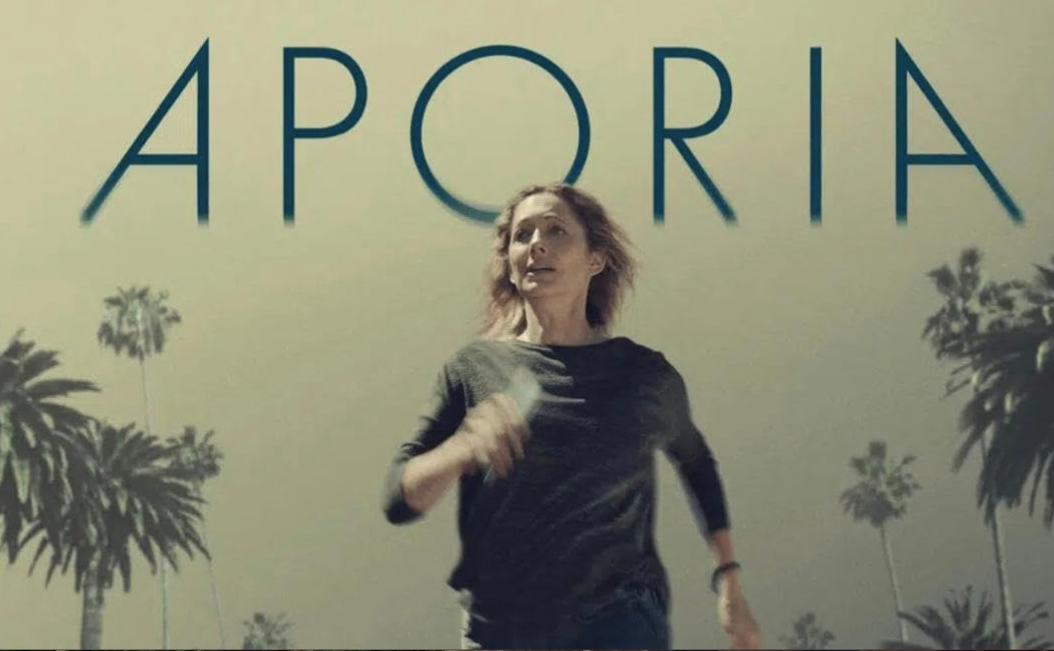
Aporia: Firing Back in Time


Readers of this blog will know that my favorite genre -- as a viewer, reader, and author -- is time travel, and its close relative alternate history.  You'll know this because I say it in just about every other post.  But you would also know this because, at least by my lights, excellent and even good examples are not easy to find (and, I'll immodestly or modestly say, as an author, to write).

But Aporia, a 2023 movie I saw last night on Hulu, is an excellent example.  The heart of its narrative is that a would-be inventor (later, inventors), of a time machine discovers that the clanky machine he's struggling to build in his home can't quite do it -- it's not powerful enough to hurtle a human back in time -- but it can send a subatomic particle back to a specific time and place (the time just a handful of years or a little bit in longer into the past), where it will cause a very minor explosion.  And the inventor realizes that if the place in the past where the subatomic particle lands is inside someone's head, well, what he the inventor has created is a gun that can reach back and kill someone in the past, by putting one of these time-travelling particles into the target's head.

[And I'll here I'll tell you that there will be spoilers ahead ... ]

So, there are three main characters in Jared Moshe's movie (which he wrote and directed): Jabir and Mal were working on the time machine in Jabir's home, when Mal was killed by a drunk driver.  This of course left his wife Sophie desolate.  Jabir is desperate to ease her pain, and restore her life, and comes up with a plan: send one of those lethal subatomic particles back in time, to land in the drunk driver's head, before he gets into the car and accidentally kills Mal.  And the plan works!

But that's when Aporia really gets riveting and ethically wrenching, as Sophie struggles with the fact that although she got her husband back, she had to take another human life to do it.  She reaches out to the drunk driver's widow.  They become friends, and so do their daughters. And here the movie excels in depicting how the people who know the original reality, and know that it has been altered, deal with the new reality they now inhabit.  (I tend to like this metaphysics of time travel -- that people who cause the changes in time are aware of the changes, even if the changes affect them -- maybe because I always employ such a narrative structure in my own works.)  As Sophie gets to know the drunk driver's family, she finds she can't bear the fact that she was responsible for killing the drunk husband and father, however much he may have deserved it ... but any attempt to change the past again by killing someone else with a time-traveling particle could have unforeseen consequences ...

Aporia resonantes in all kinds of ways.  The build-your-machine-at-home continues the tradition started by H. G. Wells' The Time Machine, and furthered more recently by Primer and just a few months ago Quantum Suicide.  The idea of sending something rather than people or living things back in time was put to good use by Gregory Benford in his 1980 award-winning novel, Timescape, in which information could be sent back in time.  And the idea of apprehending criminals, not because they committed a crime, but because you know they will commit a crime, was of course memorably developed by Philip K. Dick in his novel The Minority Report. 

But Aporia has a story and an ambience all its own, brought to life by really excellent acting by Judy Greer as Sophie, Edi Gathegi (who has been great in For All Mankind, and before that, StartUp) as Mal, and Payman Maadi as Jabir.  And all of this builds up to a top-notch ending, in which a smile tells us almost everything.


my interview with Jared Moshe
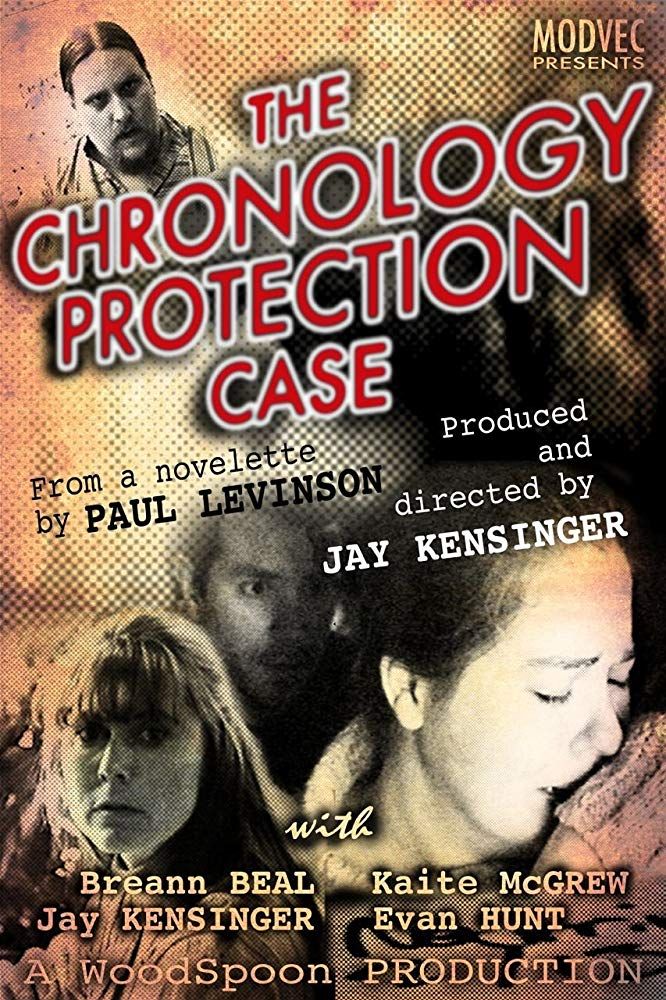


watch the movie on Amazon Prime Video -- read the novelette here


in Kindle, paperback, and hardcover


Friday, July 12, 2024

The Lazarus Project 2.5: The Status of Dr. Gray


The Lazarus Project 2.5 was all about Dr. Gray.  And she indeed deserves at least one episode of focus, being such a crucial character.

[Spoilers ahead .... ]

We already know she's building an old-fashioned H. G. Wellsian time machine.  And Wes wants to kill her before the machine becomes fully operational.  She sends Janet and Ross back to do the job.  But there's a lot more to this than meets the eye.

First, Robin seems to be a Gray supporter.  Good, Wes is clearly the villain in this second season, and Robin is the only one who can have at least some control over her.

Next, there are, of course, two versions of Janet in play here. The younger one who's sent back with Ross to kill Kitty Gray, and does.  And the older one who comes to know and respect and really care about Gray.  This older Janet knows that stopping her younger self from killing Gray will upset too many apple carts, but it's unclear if she can bring herself to stopping her younger self from doing the deed.  And we never find out what the older Janet would have done, because Wes sends the younger Janet back to kill Gray earlier than she was killed in the original reality (if it makes senses in this kind of time travel story to talk about an original reality).

I will say, again, that I think Gray (played by Zoe Telford) is a wonderful character.   Especially because, as we find out in this episode, her motive in inventing a time machine is true love.

See you back here next week with another review.

See also The Lazarus Project season 2.1: Shades of Gray ... 2.2: Shag in the Alley ... 2.3: The Plane Outside the Loop ... 2.4: 2018


And see also The Lazarus Project season 1: Time Travel Done Superbly Right

=====

my latest novel (with a touch of time travel)


“Paul Levinson’s It’s Real Life is an incredibly unique and captivating peek behind rock and roll’s mysterious curtain. The idea that the story delves into an alternate world adds to its page-turning intrigue. Highly recommended!” 

-– Steven Manchester, #1 bestselling author, The Menu


"Paul Levinson's It's Real Life is a page-turning exploration into that multiverse known as rock and roll. But it is much more than a marvelous adventure narrated by a master storyteller...it is also an exquisite meditation on the very nature of alternate history." 

-- Jack Dann, The Fiction Writer's Guide to Alternate History


get It's Real Life in paperback, hardcover, or on Kindle here


Tuesday, September 26, 2023

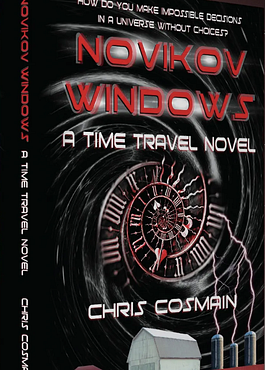
Review of Chris Cosmain's Novikov Windows

Novikov Windows


I'm going to here review a a very recently published, nearly 500-page time travel novel -- Chris Cosmain's Novikov Windows: A Time Travel Novel (that's the sub-title) -- I've just read, in two days.  That should give you an idea of how compelling I think this novel is.  

Because of that, I'm not going to give you any big spoilers in this review.  If you haven't yet read this novel, and doubt or would like further elaboration on any of the points I make below, my best advice is: read the novel.  (You can buy a copy over here.)

Now as to the narrative.  It has a 19th-century flavor.  In fact, important parts of the story take place back then.  But more than that, its style and pace feel as if it could have been written by H. G. Wells.  And it combines that ambience with all the mod-cons:  3-D printing, DNA and junk DNA, computers, and rockets all play a role.

I've said many times that I can't enjoy or take seriously any time-travel tale which ignores the paradoxes that time travel engenders, and gives the intellect (or at least mine) so much to deal with.  The one that comes up most often is the so-called grandfather paradox -- if I go back in time and accidentally kill my grandfather, before he sleeps with my grandmother, I wouldn't exist, so how have I gone back in time in the first place?  (By the way, that's not only so-called, but called in a way that's unnecessarily violent and sexist -- I can trigger the paradox by going back in time and obstructing either set of my grandparents from ever meeting.  The obstruction doesn't have to be death, and I don't need to divert one of my grandfathers, it could be one of my grandmothers.)  But Cosmain has a daring way of positing why this paradox would never arise.

Another favorite time-travel paradox is what I think of as the "where did it come from" paradox.  A man, somewhat older than me, who looks very familiar, knocks at my door with a package.  He advises me to open the package then walks away.  The package contains explicit instructions on how to build a time machine.  The instructions say it will take me ten years to build it, and after I build it, I need to travel ten years back in time and give myself the package.  So ... where did the package and its instructions come from in the first place?   That kind of paradox plays a crucial role in Novikov Windows.

Here are ten more specific elements I especially enjoyed in this novel (the enumeration reflects not where they appear in the story, but just the order I felt like putting them in):

1. Novikov Windows has one of the most ingenious time travel methods I've ever come across in a novel, story, movie, or TV series: the person or object is scanned down to the atomic level, the scan is sent back in time, in a device that recreates the person or object at the destination.

2. Vincent van Gogh makes an appearance. There's something about that Impressionistic Age and its love affair with light that just cries out time travel, isn’t there.

3. There's a refreshing, almost boyish, Tom Swiftian quality in the descriptions of the science and the tech necessary for time travel.  That's part of what I meant when I said H. G. Wells could have written this.

4.  The novel also has romantic passion ... deep kisses, deeper feelings, more.  That's why I didn't say the novel was Asimovian (my favorite science fiction author, but portraying love wasn't his strong suit).

5. Cosmain deals with the problem of not only traveling through time, but to the intended place.  You often don't find this in time travel stories.

6. The addition of new, important characters throughout the novel gives the characters we already know the need to explain to the new characters what's really going on, i.e., how the time travel works, its limits and specifications, which in turn provides us, the readers, another chance to understand this.  Yes, the science and effects of time travel in this novel are complex, but time travel that isn't is usually not worth reading.  And the time travel in this novel is something you likely haven't seen before, which also makes the story commendable, and worthy of Aristotle's advice to the teacher to teach the lesson three times: tell the students what you are going to teach them, teach them, then tell the students what you just taught them.  We all are students when it comes to time travel.

7. Speaking of education, we also learn some new words in this story, including the Australian larrikinism (rebelliousness) and the Japanese shouganai (a cross between the French c'est la vie and the Yiddish bashert).

8. Biology plays a major role in this novel (its author is a medical doctor), as indeed it should in a time travel story that transports living things across time. So does medical care.   If traveling in a plane can get you dehydrated, who can say what being scanned, sent back in time, and recreated would do to the body and mind.     

9. And time travel literally and figuratively becomes a bedfellow for these characters, often animating but also taking its toll, especially on the very composition of their families.

10. This story also has lots of nice little touches, including one involving Stephen Hawking and another the extinction of dinosaurs (well, that certainly doesn't seem nice, but you know what I mean, and it did leave our planet open for the success of mammals, including human beings).

I could go on, but I've already veered all too close to spoilers, and I don't want to spoil any of the fun for you.  Novikov Windows is a remarkable combination of hard science fiction, probing philosophy, ethical argument, and sheer adventure.  If you're not already a fan of time travel, chances are you'll become one after you read this novel.  If you are already a fan, this novel will go to the top of your list, and stay there as an accomplishment against which past and future time travel stories you may read will be judged.

====

My best-known time travel works:  The Plot to Save Socrates, Unburning Alexandria, Chronica (the Sierra Waters trilogy); The Chronology Protection Case; The Loose Ends Saga; Ian's Ions and Eons; Marilyn and Monet


And you can read my short story, "Slipping Time," free, any time!


Wednesday, August 23, 2023

Invasion 2.1: Tenuous Meeting of the Minds


Invasion -- the latest narrative that explores an H. G. Well's War of the Worlds scenario -- is back on Apple TV+ with the first episode of its second season.  It's entitled "Something's Changed," but I don't think all that much has changed, unless change is defined as zooming into elements that were already there in the first season, which is fine with me.

Episode 2.1 is indeed less crowded with simultaneous stories of the interstellar invasion that were happening all over the world, and I found myself missing that frenetic, often inchoate pace.  On the other hand, at least one of the remaining segments has some promise, and the other one coming into focus looks like a pretty good if less original story, too.

[Spoilers ahead ... ]

The mind-bending story, maybe literally, is Mitsuki's, who opts to go face-to-face, or mind-to-mind, with the interstellar intelligence mounting the invasion, although I guess we don't know that this billowy entity mounted the invasion for sure.  Significantly, Mitsuki is not so much brave as certain that she'll survive this encounter, because she already feels some undefined connection to the invaders.

How's that?  We'll no doubt find out.  But I'll hazard a guess and say that's because these destructive visitors have been here before.  In the one scene in which she and the extra-terrestrial have close to a physical but apparently not yet a figurative meeting of the minds, the two seem to know each other.  At very least, the star-traveler doesn't kill Mitsuki or destroy her mind, at least, not yet.

The other main story in this episode is Aneesha and her children, who come under the protection of the "Movement," a human para-military operation who are trying to help.  As I said, this is a far more conventional science fiction story, found not only in invaders from space narratives, but threats to the human species that come from Earthly pathogens.  But Aneesha and her kids are so appealing that I really don't mind seeing this kind of invasion story again.  

So, I'll be here watching and reviewing the second season of Invasion, and letting you know how I think it turns out.

See also Invasion 1.1-3: Compelling Contender ... Invasion 1.4: Three Out of Four ... Invasion 1.5: The Little Creepy Crawly Thing ... Invasion 1.6: Close Up! ... Invasion 1.7: Two Boys and their Connection to the Invaders ... Invasion 1.8: Contact! ... Invasion 1.9: Tables Turning ... Invasion 1.10: Peering Through the Opaque


Sunday, June 30, 2019

Minor Quibble with Kamala Harris: The Opposite of Science Fact is not Science Fiction

Although it's at most a minor quibble with Kamala Harris's superb performance in this past Thursday's Democratic debate - see my assessment of that over here - I thought, as a past President of the Science Fiction Writers of America (1998-2001), that I ought to weigh in on a concern which has made it all the way to The Washington Post.

The concern arises from Harris's point made during the debate that our response to climate change needs to be based on "science fact not science fiction".   Unfortunately, this contrast, likely the product of one of Harris's writers not what she herself may think, shows a woeful misunderstanding and ignorance of science fiction.  Anyone who has read any of Asimov, Heinlein, and Clarke, not to mention Verne and Wells, would know that science fiction does not deny or belittle science.  To the contrary, the essence of science fiction is to use science as a foundation to explore dramatic situations, including global catastrophes, and predictions of the future.

As a science fiction author myself - of novels and short stories - I have had the majority of my short stories (some 17) published in Analog Magazine, aka Analog Science Fiction and Fact Magazine.  Over the years, newer writers have asked me what I would recommend for enhancing their chances of getting published in Analog.  My answer: get your science right, and make sure it plays a decisive part in your story.

The fundamental connection between science fiction and science fact has been recognized by scientists such as Marvin Minsky, who said Asimov's robot stories inspired Minsky's life-long work in AI, and by Nobel Laureate Paul Krugman, who cited Asimov's Foundation series as inspiration for Krugman's work in economics.

And, to get back to Harris's inapt comparison, it's not that hard to find suitable opposites to science - pseudo-science, fantasy, conspiracy theory, all would have worked well in Harris's formulation.

But, as I said, this is a minor quibble, and now that I've gotten it of my system, I can return to thinking about who is the best candidate to beat Trump.  Harris's performance on Thursday makes her a major contender.


Sunday, October 15, 2017

Marilyn and Monet

Just published ...


It started in the hot summer of 1960, when Marilyn Monroe walked off the set of The Misfits and began to hear a haunting song in her head, "Goodbye Norma Jean" ...

Monday, March 13, 2017

Time after Time 1.3: The Red Heads

A strong third episode of Time after Time last night (the first two debuted back to back last week), which furthered the mystery, mostly due to two or three redheads.

One was the bearded guy we saw following H. G. and Jack the Ripper in contemporary New York last week.  He visits his elderly mother this week, says Wells and the Ripper are in New York as she said they would be, and goes off to kill Wells.  Fortunately for the fictional inventor and real-life author, unfortunately for this narrative (at least, as of now), he gets killed by one of Wells' great-great granddaughter Vanessa's body guards, before we have a chance to find out more. As Vanessa later says when Wells muses that maybe he met the redhead in Wells' future and redhead's past, that doesn't tell us anything about why the guy wanted to kill Wells.

But there's another redhead -  a neurologist well played by Hell on Wheels' Jennifer Ferrin - who's also in some way a part of this.  She knocks Jack the Ripper out with an injection just as he's about to stab her after the two have a great sex, and it turns out she knows more or less or who knows exactly what about what's going on, too.

And, just for good measure, Vanessa's boyfriend Griffin also knows about H. G. Wells and his time machine and who knows what else, after feigning shock when Vanessa brings him in to see Wells demo the repaired machine.  He, Griffin, has reddish hair, too, right?  Well, Will Chase did play Luke Wheeler on Nashville, and he's running for Senator in Time after Time, so he has that going for him and a lot of potential in this story.

And where does that leave us?  With a lot of simmering leads and possibilities, with all kinds of characters in New York in 2017 with knowledge of Wells and his time machine.  Who are these people?  Are they all connected in some way?  What and how do they know about Wells and time travel?  I'm looking forward to being surprised and amazed.

See also Time after Time: H. G. Wells Back in Action

 
not only H. G. Wells but Orson Welles in this tale


Monday, March 6, 2017

Time after Time: H. G. Wells Back in Action

With Frequency and Timeless concluded - the first seasons, I hope, not the series - I figured what better time to watch Time After Time, which debuted tonight on ABC with a two-hour episode.

The story is an adaptation of the 1979 movie of the same name, in which H. G. Wells, who in real life published The Time Machine in 1895 and went on to have an illustrious career as one of the grandfathers (along with Jules Verne) of science fiction, uses his machine to travel to our present day.  The 1979 movie creatively has Wells in pursuit of Jack the Ripper, who has absconded with Wells' time machine (which the story imagines Wells not only wrote about but actually built) into 1979, to save the future from the Ripper's depredations and get back sole control of the time machine.  The TV series does the same for the two main characters, except their terminus point is our present, 2017.

The series mines all sorts of opportunities for Wells to be amazed by Google and smartphones, just as the movie did for Wells and MacDonald's.  But the movie was far more serious than the series, which is maybe 70/30 drama and humor, in comparison to 90/10 for the movie.

The first two episodes have some cool time-travel wrinkles, including H. G. Wells and his great-great-grand-daughter in 2017, motivated to meet and help Wells because an older version of himself met a younger version of her years earlier, introduced himself, and gave her a brief letter and a request to give the letter to Wells when they met in 2017.   Wells, though young and at the beginning of his career, already understands the complexities and dangers of time travel and its paradoxes, including why it's perilous to travel too many times to the same time in the past (it could create "a hole in time," as Wells puts it),  which neatly explains why Wells doesn't just travel back to a little before the Ripper ripped off the machine, and nip that in the bud.  And there are some nice dabs of young Wells in 2017 seeing a library with his books, yet to be written.

Those kinds of touches happen all the time in time travel stories about real writers who travel through history, but they're good to see anyway, and the same can be said for Time After Time, which I'll definitely keep an eye on.


not only H. G. Wells but Orson Welles in this tale

Sunday, January 22, 2017

The Perversity of Things: review #8 of X: Definitions and Fake News

Continuing with my reviews (#8 of X) of The Perversity of Things: Hugo Gernsback on Media, Tinkering, and Scientifiction, edited by Grant Wythoff (University of Minnesota Press, 2016) - at a more leisurely place now, reporting here on two gems in pages 52-55 of Wythoff's 59-page Introduction to the 359-page volume.

Wythoff describes Gernsback's keen concern with the definition of science fiction - or scientifiction, as Gernsback usually had it - which in turn led to a thoughtful, even profound, analysis of how much science and truth needs to be in the science fiction.   There are several bells that this discussion rung for me.

First, I'm reminded about both Karl Popper's and Marshall McLuhan's dislike for definitions.  Popper held that they were a distraction, and McLuhan was fond of quoting French poet Stéphane Mallarmé that “To define is to kill. To suggest is to create.”  I generally agree with that, but Gernsback's quest to define science fiction was valuable.

As Wythoff points out, it led Gernsback to probe the evolution of technology, with the realization that the science in science fiction was a progressing target.   A century later, anyone familiar with science fiction knows that it predicted and even provided a template for everything from space travel to gene-splicing (H. G. Wells' The Island of Dr. Moreau).   In Gernsback's day, this was not as obvious, and he deserves credit for holding science fiction to the test of not only plausibility but physical possibility - which remains an important point of demarcation between science fiction and fantasy.(See this for my very brief definition of the two.)

Gernsback's focus on scientific possibility and truth led to what today is an astonishing example. Wythoff, writing before our current crisis regarding fake news, tells us about Gernsback's 1926 "The Moon Hoax," in an early issue of his Amazing Stories, which reprinted a series of articles in The New York Sun from 1835 which reported an intelligent civilization of the Moon.   Gernsback was confident, in 1926, that such a "hoax" would quickly be exposed by radio.   He of course missed not only Orson Welles "War of the Worlds" (thanks to my wife Tina for this example), but the way that our social media today not only unmask fake news but disseminate it.

I thought this example was so telling, that I just added it to my Fake News in Real Context.  That's what I mean about The Perversity of Things being a treasure trove to anyone who's interested in the evolution and impact of media.  And I'll be back here, sooner or later, with more.

See also: The Perversity of Things: review #1 of X: Gernsback as Philosopher of Technology ... #2 of X: Learning by Doing ... #3 of X: The Evolution of Media ... #4 of X: Gernsback and the The First Amendment ... #5 of X: Amateurs vs. Corporations ... #6 of X: Thought Experiments and Toys ... #7 of X: The Invention of Invention and the Advent of Science Fiction


Wednesday, August 17, 2016

Silvercup North in the Morning


I spent a wonderful hour this morning at the opening ceremony of Silvercup North - the spacious new, third motion picture and television production studio of Silvercup Studios in the Port Morris area of the Bronx - where New York Governor Andrew Cuomo was the featured speaker.

Everything about this ceremony was right.  I grew up in the Bronx, a little north of Port Morris around Allerton Avenue and White Plains Road.  I've been a professor at Fordham University (the Governor's alma mater), across the street from the Botanical Gardens and the Bronx Zoo, since 1998.

I grew up eating Silvercup bread.  The very sign makes me hungry and smells good.  "The Bronx is Back" looked good, too.   And although I moved up to White Plains from the Bronx with my family in the early 1990s, the Bronx was never really gone for me.

The is the first time I've had the pleasure of hearing Andrew Cuomo speak in person.  And it was a pleasure, indeed.  Our governor is articulate, humorous, and sharp as a whip.   Somewhere down the line, I'd like to see him run for President.  Bronx Borough President Ruben Diaz, Jr., who introduced Cuomo, also has a great future ahead.  Like the Governor, Diaz got involved in politics via his father, Ruben Diaz, Sr., who is currently a NY State Senator and took a bow from the audience.

The Suna Brothers, who brought Silvercup Studios to prominence in Queens in the 1980s, were on hand. Silvercup Studios has already made an enormous contribution to New York and the world's popular culture.   The studio was talked about on panels at The Sopranos Conference I organized at Fordham University in 2008 - lots of The Sopranos was filmed at Silvercup in Long Island City.

As many of you know, time travel is one of my passions - as a reader, viewer, and author. I was therefore delighted to hear, and consider it a most auspicious omen, that the first production in Silvercup North will be ABC-TV's Time after Time, based on the movie about the young H. G. Wells.  What more could you ask for! (Shameless plug, H. G. Wells makes an appearance in my Ian's Ions and Eons - the name of a time-travel agency located a little off Johnson Avenue in the Riverdale section of the Bronx.)

As icing on the cake of this morning, it was great to see Gary Kesner, Executive VP at Silvercup. Gary and my wife Tina were in class together many years ago at the Bronx High School of Science - there's the Bronx again - and we've stayed in touch all too sporadically over the years.

Thanks to Jim Jennewein, Artist in Residence at Fordham University, for inviting me to this event, and to Rachel Honan, photographer and our student at Fordham, who conversed with us before the speeches.

Good times for the Bronx on street and screen beckon ahead!


Saturday, May 28, 2016

Outlander 2.8: The Conversation

The most interesting part of the just-concluded Outlander 2.8 - for the devotee of time-travel - is the conversation between Claire and Jamie at the beginning.

Claire tells Jamie that "history dictates" that the Scots will fail in their battle against the English.  She of course knows this from her vantage point from the future - which says all of their work to break free of the English will be in vain.   But Jamie counters that Claire has already changed history - as when, for example, she stopped an outbreak of smallpox in Paris with her knowledge of the illness garnered in the future 20th century.

But the problem with such examples is that they are unknown to us - that is, the viewers.   We have no record of a smallpox outbreak in mid-18th-century Paris stopped by a woman wielding white magic or some kind of 20th-century knowledge of epidemics.   Thus, while Jamie's examples may be impressive - at least, somewhat - to Claire, they aren't to us, upon any kind of more careful consideration.

In order for a time-travel story to be truly impressive about changing the past to change the future, it has to show us a future different from what we know.  Otherwise, it can still be impressive, but it must do that in other ways.

As the conversation between Claire and Jamie continues, she says that their failures to change history and stop the English thus far, and their continuing to try, over and over again, is a sign of "insanity" - more precisely, Claire says "they say" it's a sign of insanity.   Jamie's clever retort is "they" likely never heard of time travel.

Now, in our reality, the definition of insanity as "doing the same thing over and over again and expecting different results" is most often attributed to Einstein.   Which is interesting,  since Einstein certainly knew about time travel - at the very least, of its appearance in H. G. Wells' The Time Machine, which is the effective grandsire of all 20th- and 21st-century time-travel stories, including Outlander - which deserves credit for at least delving into these fascinating metaphysical labyrinths, if not (yet) coming even remotely close to resolving them.  But that's ok - there's still time (travel).


See also Outlander 2.1: Split Hour ... Outlander 2.2: The King and the Forest ... Outlander 2.3: Mother and Dr. Dog ... Outlander 2.5: The Unappreciated Paradox ... Outlander 2.6: The Duel and the Offspring ... Outlander 2.7: Further into the Future

And see also Outlander 1.1-3: The Hope of Time Travel ... Outlander 1.6:  Outstanding ... Outlander 1.7: Tender Intertemporal Polygamy ...Outlander 1.8: The Other Side ... Outlander 1.9: Spanking Good ... Outlander 1.10: A Glimmer of Paradox ... Outlander 1.11: Vaccination and Time Travel ... Outlander 1.12: Black Jack's Progeny ...Outlander 1.13: Mother's Day ... Outlander 1.14: All That Jazz ... Outlander Season 1 Finale: Let's Change History


Sierra Waters series, #1, time travel

#SFWApro


Tuesday, May 10, 2016

12 Monkeys 2.4: Saving Time

A stunningly good 12 Monkeys 12.4 tonight, that touched all kinds of bases, and closed and opened all sorts of loops, just as a superior time-travel story should.

The action began with a bang, as Ramse, sent back in time to stop Cole and Cassandra from becoming untethered in time as we saw last week, gets hit in the road by a car just as he materializes in 1944.  This not only sets up the plausibly ensuing drama, but was satisfying if traumatic to see in itself in a time-travel tale.  I mean, there's no way that sooner or later that wouldn't happen to travelers who just materialize in the past out of thin air, in contrast to those who use a time machine that travels with them, as per FBI agent Gale's invocation of H. G. Wells, or, for that matter, in The Plot to Save Socrates by a much younger writer.

But Ramse being hit by the car is just the start of this outstanding episode, which also brings a paradoxically circular explanation for the emergence of the Pallid Man at the end, and Gale doing his bit to grease the wheels of time travel ala Cole and Cassandra to save the world.

Though, actually, in some ways the biggest reveal is that it's not the world that is the object of our heroes' saving in this story.  No, this is no save the cheerleader, save the world as in Heroes,  not even change the past to get the desired future as in Outlander, either.  This televised 12 Monkeys series, which now has exceeded and palpably transformed the 12 Monkeys movie, turns out to be about changing the past to save ... time itself.

That's a pretty daring proposition, and one not expected in a time-travel story, where the usual calamity to be prevented is anything from the end of a particularly important person to, as in the 12 Monkeys movie and the television series up until now, the world.

And if the end of the world seems almost a bit trivial compared to the end of time, that's because it is. The series now has some pretty steep philosophic terrain ahead.   But if the further revelation tonight that Jim Morrison was a primary, with psychedelics in the tradition of Timothy Leary having some insight into this, I'd say this series is on a pretty provocative and enjoyable track.

See also 12 Monkeys 2.1: Whatever Will Be, Will Be ... 12 Monkeys 2.2: The Serum ... 12 Monkeys 2.3: Primaries and Paradoxes

And see also this Italian review, w/reference to Hawking and my story, "The Chronology Protection Case"

And see also 12 Monkeys series on SyFy: Paradox Prominent and Excellent ...12 Monkeys 1.2: Your Future, His Past ... 12 Monkeys 1.3:  Paradoxes, Lies, and Near Intersections ... 12 Monkeys 1.4: "Uneasy Math" ... 12 Monkeys 1.5: The Heart of the Matter ... 12 Monkeys 1.6: Can I Get a Witness? ... 12 Monkeys 1.7: Snowden, the Virus, and the Irresistible ... 12 Monkeys 1.8: Intelligent Vaccine vs. Time Travel ... 12 Monkeys 1.9: Shelley, Keats, and Time Travel ... 12 Monkey 1.10: The Last Jump ... 12 Monkeys 1.11: What-Ifs ... 12 Monkeys 1.2: The Plunge ... 12 Monkeys Season 1 Finale: "Time Travel to Create Time Travel"

podcast review of Predestination and 12 Monkeys


 three time travel novels: the Sierra Waters trilogy

 photo LateLessons1_zpsogsvk12k.jpg
 photo lastcalls-thumb_zps0e5aro8w.jpeg photo LooseEnds-series.png_zpsvr6q50f0.jpeg
What if the Soviet Union survived into the 21st century,
and Eddie and the Cruisers were a real band?


The Chronology Protection Case movie 

~~~ +++ ~~~

#SFWApro

Monday, August 31, 2015

Falling Skies Concludes

Well, although everything up to the ending in this, the very last episode of Falling Skies, was more of the recent same - which is to say, not very interesting or original - the series managed to pull off a memorable conclusion in its last few minutes.

Memorable because, against all odds, there was real change and optimism in that last scene.  Tom giving a speech, maybe prelude to his becoming President, Weaver cleaned up, and everyone looking a little older and very good.  And Tom's last words, that we learned that we're not alone, were just right for the conclusion of this difficult series.

Difficult because, well, how many times, how many ways, can you tell the story of we humans somehow surviving against overwhelming, all but impossible odds?   And our success, based on the premise that if you can destroy the queen, you can wipe out the whole civilization, is not only cliche but was introduced out of the blue just a few episodes ago.

Still, Noah Wylie's acting, and his character Tom Mason and his three boys, and throw in Will Patton's Weaver, especially in this and the previous season, have made an indelible contribution to the science fictional genre of invasions from outer space.   It comes down from Wells' War of the Worlds, through Heinlein's The Puppet Masters and Clarke's Childhood's End  and Damon Knight's "To Serve Man," which was also a great Twilight Zone episode - all of which were much better stories than Falling Skies. But Falling Skies, because of somehow the realness, the uniqueness, of the Mason family, or the impact of this overwhelming invasion on this family, and its stubborn carrying of hope when everything was against them, deserves to be counted among those incredible narratives.

Perhaps we'll discover alien beings out there in the universe tomorrow - or, if our luck turns really bad, be attacked by them.  But till then, Falling Skies will be a fiction worth watching and recalling, with all of its flaws.

See also Falling Skies 5.1: Still Worthy of Viewing ... Falling Skies 5.2: Hybrid ... Falling Skies 5.7: Back Up There ... Falling Skies 5.9: Plummeting

And see also Falling Skies 4.1: Weak Start ... Falling Skies 4.2: Enemy of my Enemy ... Falling Skies 4.3: Still Falling ... Falling Skies 4.5: Cloudy ...Falling Skies 4.7: Massacre Indeed ... Falling Skies 4.8: Spike ... Falling Skies Espheni: How to Pronounce? ... Falling Skies 4.9: To the Moon, Anne, To the Moon ... Falling Skies 4.10: Lexi ... Falling Skies Season 4 Finale: Self-Sacrifice and Redemption

And see also Falling Skies 3.1-2: It's the Acting ... Falling Skies 3.3: The Smile ... Falling Skies 3.4: Hal vs. Ben ... Falling Skies 3.6: The Masons ...Falling Skies 3.7: The Mole and a Likely Answer ... Falling Skies 3.8: Back Cracked Home ... Falling Skies Season 3 Finale: Dust in Hand

And see also Falling Skies Returns  ... Falling Skies 2.6: Ben's Motives ... Falling Skies Second Season Finale

And see also Falling Skies 1.1-2 ... Falling Skies 1.3 meets Puppet Masters ... Falling Skies 1.4: Drizzle ... Falling Skies 1.5: Ben ... Falling Skies 1.6: Fifth Column ... Falling Skies 1.7: The Fate of Traitors ... Falling Skies 1.8: Weaver's Story ... Falling Skies Concludes First Season

#SFWApro


no aliens, but definitely insects

InfiniteRegress.tv