Chuck Todd interviews me about alternate histories
Showing posts with label Robert Heinlein. Show all posts

Tuesday, July 14, 2026

Project Hail Mary: Better Than Disclosure Day


Well, the wife and I saw Project Hail Mary last night on Amazon Prime (it just got there this month, after its release in theaters in March) and I  liked Project Hail Mary a lot more than Disclosure Day.  Which is not to say I didn't like Disclosure Day, and the two are not exactly the same exact genre, so maybe the comparison is unfair.   But they do have a lot in common: humans and interstellar intelligences, unlikely heroes, oddball humor, life and death situations on the planetary level.

But Project Hail Mary has a lot more soul in the story, more humanity in the best sense of the word, and a more memorable, lovable interstellar intelligence.   Ryland Grace (Ryan Gosling) is one of the best human emissaries to the stars -- Tau Ceti, in this case -- in all the movies and TV shows I've seen on that topic over the years, beginning with Captain Video and His Video Rangers in the 1950s on the shortly lived Dumont Channel.   Grace surprises us at numerous junctures, as does Rocky (James Ortiz), the intelligent being from the planet Erid (circling the real star 40 Eridani), who with Grace goes to Tau Ceti e (the planet named Adrian in the movie).  Rocky doesn't have a face, though if you look at Rocky carefully at certain times from certain angles, it almost seems he does (I say "he" because Ortiz does Rocky's voice).

Drew Goddard wrote the screenplay from Andy Weir's novel, not surprising given the excellent job they did with The Martian.  Like that movie, Project Hail Mary is a fine piece of science fiction that plays with the limits of scientific plausibility.   Indeed, because the threats and solutions in Project Hail Mary are interstellar, far wider in scope than Mars and Earth, its connection to science is stretched pretty far and thin.   But in the end -- and in the beginning and middle, too -- I felt I was seeing a riveting story that Isaac Asimov or Robert Heinlein could have written, unlike a central element of Disclosure Day which felt more in the province of Walt Disney.

I also had no idea about how Project Hail Mary would end, until the very end, which is always a big plus in a movie.   This derives from the complex, unusual character of Ryland Grace, astutely written and perfectly acted.   In addition, the cinematography was otherworldly convincing and topnotch.   If you're in the mood for a movie in which Earth is threatened by something from outer space, in a situation that unfurls in a way that Hugo Gernsback would have really enjoyed, you can't go wrong with Project Hail Mary.


Wednesday, January 25, 2023

In-Depth Discussion of Golden Age Science Fiction


If classic science fiction is your cuppa tea, you might enjoy this in-depth interview about  A. E. Van Vogt, Isaac Asimov, Robert Heinlein, Frank Herbert, capped off with a reading of my alternate history story about John Lennon, "It's Real Life", which can read in its entirety, for FREE, right here.

Sunday, June 30, 2019

Minor Quibble with Kamala Harris: The Opposite of Science Fact is not Science Fiction

Although it's at most a minor quibble with Kamala Harris's superb performance in this past Thursday's Democratic debate - see my assessment of that over here - I thought, as a past President of the Science Fiction Writers of America (1998-2001), that I ought to weigh in on a concern which has made it all the way to The Washington Post.

The concern arises from Harris's point made during the debate that our response to climate change needs to be based on "science fact not science fiction".   Unfortunately, this contrast, likely the product of one of Harris's writers not what she herself may think, shows a woeful misunderstanding and ignorance of science fiction.  Anyone who has read any of Asimov, Heinlein, and Clarke, not to mention Verne and Wells, would know that science fiction does not deny or belittle science.  To the contrary, the essence of science fiction is to use science as a foundation to explore dramatic situations, including global catastrophes, and predictions of the future.

As a science fiction author myself - of novels and short stories - I have had the majority of my short stories (some 17) published in Analog Magazine, aka Analog Science Fiction and Fact Magazine.  Over the years, newer writers have asked me what I would recommend for enhancing their chances of getting published in Analog.  My answer: get your science right, and make sure it plays a decisive part in your story.

The fundamental connection between science fiction and science fact has been recognized by scientists such as Marvin Minsky, who said Asimov's robot stories inspired Minsky's life-long work in AI, and by Nobel Laureate Paul Krugman, who cited Asimov's Foundation series as inspiration for Krugman's work in economics.

And, to get back to Harris's inapt comparison, it's not that hard to find suitable opposites to science - pseudo-science, fantasy, conspiracy theory, all would have worked well in Harris's formulation.

But, as I said, this is a minor quibble, and now that I've gotten it of my system, I can return to thinking about who is the best candidate to beat Trump.  Harris's performance on Thursday makes her a major contender.


Tuesday, June 11, 2019

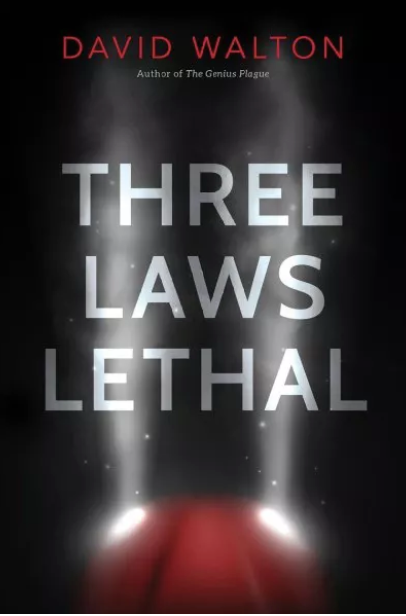
Review of David Walton's Three Laws Lethal: A Few Minutes and Decades Into the Future


David Walton's newest novel, Three Laws Lethal - title inspired by Isaac Asimov's three laws of robotics - begins with what certainly is an ethical quandary that typifies our increasingly AI-driven age, in this case, driven literally.  A mother with her children are passengers in an AI-driven automobile.  She can turn around and tell them to stop arguing, without risking an accident.  She marvels at being in the driver's seat with her hands off the wheel.  And then ...  A big tree falls in front of them.  To plow into the tree would risk the death of both mother and children.  The AI computes the deadly odds, and acts upon it, instantly swerving the car to the right to avoid the tree.  Unfortunately, there's a biker in that lane, and he's killed by the swerving car.

It's not that the AI didn't see the biker - the problem is that it did, and decided the mother and children's lives were more worth saving than the biker's.  Now, people driving in our reality make split-second decisions like this all the time.  They're maybe not quite decisions but instant gut reactions.  Would anyone for a moment think of charging a mother with vehicular homicide if she did what the AI did in the car?  Of course not.   But there's something deeply disturbing about an AI making this decision, any decision, that results in the loss of innocent human life.

This is the problem that opens David Walton's novel, just published by Pyr today.  It's a narrative that is as philosophically profound as it is breathtaking.   Asimov imagined/foresaw that all robots could and would be programmed with three laws:  1. A robot can never do harm, or allow harm to be done, to a human being.  2. A robot must follow all orders given to it by a human, except when following such an order would contradict the first law, i.e., harm or allow harm to be befall a human.  3. A robot must always act to protect itself, except when that would contradict the first or second law.  Asimov wrote great novels and stories that explored what could happen when these laws were bent or broken.  In that sense Three Laws Lethal is an extrapolation of Asimov, a meditation on how an AI programmed to protect human lives can end up taking a life - a life that threatens no one, but whose existence nonetheless must be ended to protect the people the AI serves.  The novel is also Asimovian in the sense that it is an un-put-downable read.

Exploration of driverless cars makes Three Laws Lethal not a story happening the day after tomorrow, as they used to say back in the 1950s, but maybe more like a few minutes from now.  An Uber driverless car already killed a woman in Tempe, Arizona in 2018.  This apparently was more a malfunction than a deliberate decision of the car to kill the woman (a pedestrian walking her bicycle in the street), so it didn't raise the kind of wrenching ethical dilemmas posed by Walton.   But Walton also explores, with the same panache and savvy, the corporate competition and intrigue that has characterized the digital revolution since it began in the 1980s.  In this case, we go from intrigue to outright assassinations, and self-driving cars to fleets that can work as an attack force.  Malignant AIs reminiscent of HAL (an Arthur C. Clarke not Asimov creation) also figure in this story, pitching it at least a few years and maybe decades into the future. 

All of this is played out by a memorable cast of characters all along the continuum of fundamental human decency, which at the bad end includes a willingness to do the aforementioned  murders to get desired results.   In as much Asimov's robot stories were also detective stories, this makes Three Laws Lethal an Asimovian story in yet a third, appealing sense.

Although Asimov defined the genre of sentient robots and therefore AIs, the other two titans of the golden age of science made important contributions to this crucial sub-genre.  In addition to Clarke's homicidal HAL, Robert Heinlein's self-sacrificing Mike has a permanent place in the AI pantheon.  No one can duplicate those achievements, but it's good to see that David Walton is carrying forward that tradition so well as we move to ever more AI in our cars and lives in the 21st century.


Sunday, June 9, 2019

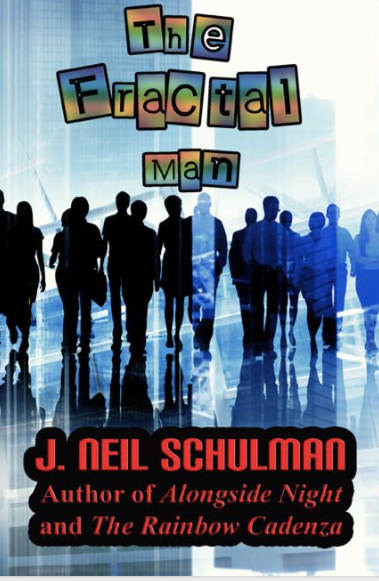
Review of J. Neil Schulman's The Fractal Man: Alternate Reality Autobiographies


Alternate realities have become something of a vogue in science fiction, especially on television with Fringe and Counterpart.  I've even tried my hand at it in a few short stories such as The Other Car.  But J. Neil Schulman has outdone all of this with his novel The Fractal Man, which for most of its 160 some odd pages - meant literally as well as a figure of speech here - is not only a masterpiece of alternate reality, but one of the best science fiction novels I've ever read, literally.

It's also a tour de force of meta-fiction and autobiography.  What do I mean by that?  Well, the main character - the narrator - is David Albaugh, a character in Schulman's 1979 novel Alongside Night, played by Schulman in the 2014 movie that Schulman wrote and directed.  In The Fractal Man, we meet Schulman - one of Albaugh's fractals, i.e., existences in an alternate reality - to the point of the character Schulman warning Albaugh about a danger that lies ahead, because, after all, Schulman wrote Albaugh's account of Albaugh's  alternate reality adventures which is the novel The Fractal Man.   I'd say I'm a sucker for that kind of science fiction, but if a I'm a sucker for delighting in that, then anyone with any appreciation for the finer tropes of science fiction, carried to their logical extents and well beyond, should be a sucker, too.

And the novel is chocked full of tidbits to delight the science fiction devotee and anyone with a taste for new ways of thinking about old things.   Distant galaxies that we see in our reality may be alternate timelines.   Arguments that a couple may have over whether an event unfolded this way or that way may reflect an alternate reality that one of the couple for some reason came from or has access to.   Everything from timeless music to time travel is woven into the undulating fabric.  It's all served up so well that I don't even mind that Schulman and most of his alternates are thorough-going libertarians, in contrast to me (I'm an absolutist only about the government keeping its hands off of all media and communication, i.e., the First Amendment)

Schulman sprinkles in some of his real libertarian friends as greater and lesser characters in this novel.   We know each other and have worked together, but I can't hold it too much against him that I didn't make the grade, because I'm not a close friend of his, and, as I said, I'm not an across-the-board libertarian.   And he makes up for this with some derring-do espionage escapades across realities, and a galactic scope that reminds of both Asimov and Heinlein, which is no mean feat  (Schulman, at least in this reality, did an important interview with Heinlein in 1973).

What I do hold against the novel is a long play within the novel, near the end, that has lots of relevance to the novel's philosophy and was excellent in and of itself, but comes out of left field, so much so that the reader is offered the option of skipping ahead.  This doesn't exonerate the play's inclusion.

But, hey, the rest of the novel is so bright and wonderful - such an intellectually exciting and satisfying ride - that I put it up there with David S. Michaels and Daniel Brenton's Red Moon and David Walton's Three Laws Lethal (to be published in two days, look for my review) as one of the best standalone science fiction novels I've ever had the pleasure of reading.   Is it a contradiction to describe The Fractal Man and its immersion in alternate realities as a standalone novel?  There's a sequel afoot - "The Metronome Misnomer - the title comes from a fractal version of the author in The Fractal Man, who wrote a book of that title in an alternate timeline" (this quote from Schulman's biography at the end of The Fractal Man) - so you may not need to answer that.


more alternate reality - "flat-out fantastic" - Scifi and Scary

Thursday, January 10, 2019

Project Blue Book 1.1: Science Fiction, Or?


Project Blue Book, the docudrama on the History Channel about Dr. Allen Hynek and his research into UFOs, couldn't have come at a better time.   I mean, a better time for me.  I read and reviewed Alec Nevala-Lee's Astounding, about John W. Campbell and the golden age of science fiction,  And Hynek's story - at least, as it begins on Project Blue Book - begins in 1952, which many people, including me, would regard as the peak of that golden age.  Asimov's Foundation trilogy, which had first been published as a series of stories in "Astounding" (the magazine), was smack dab in the middle of being published as three books.  Robert Heinlein had just published, a year earlier, his Puppet Masters, to this day one the very best books about an extraterrestrial invasion ...  But I digress.

Or maybe not.  Because Project Blue Book - the docudrama - is right at the nexus of strange-but-true and science fiction.  Hynek is called upon by the Feds to give his scientific imprimatur to their insistence that flying saucers were nothing more than natural phenomena like birds or human technological phenomena like weather balloons.  The perspective of the docudrama is that we the audience know better, and Hynek quickly comes to know better.

Unsurprisingly, the government apparently knows better, too.  The first episode leaves us with the impression that the government knew we (the Earth) were visited by flying saucers, but they (the government) did not want the public to know.  This is a familiar characterization of our government on many issues, and may or may not be true in real history about flying saucers.

Speaking of reality, I'll own up to being skeptical to agnostic on extra-terrestrial visits.  I'm a skeptic, because if we've been visited, are being visited, by beings from outer space in space ships, why don't they ever land on 58th Street in Manhattan in front of CNN so everyone in the world can see them?  Or, if they don't want us to know anything about them, they've been doing a pretty poor job of that.  But I'm ultimately agnostic on the question of UFOs because there's certainly no reason in principle that there aren't intelligences other than ours out there in the universe, some of them far more advanced than ours in their penetration of the cosmos.

Back to more mundane matters, it was good to Aidan Gillen (from Game of Thrones and many other memorable performances) in his portrayal of Hynek.  The first episode offered several phenomena - like damage on the pilot's plane - that weren't explicable by science, according to Hynek.   One of those, however, a pilot hearing a California radio station in Fargo, North Dakota (that's right) high in sky at night could be explained by the long distances some radio waves can travel at night.  I wanted to shout that across the screen to Hynek.  But if all of this turns out to be science fiction, that's more than ok for me to watch on television.  Hey, strange things do happen in Fargo, if memory serves.


here I am talking Ancient Aliens a few years ago on the History Channel


Thursday, December 27, 2018

Astounding by Alec Nevala-Lee: Transformative Treasure Trove


One of the joys of reading on a Kindle (or, in my case, a Kindle app) is the ease of bookmarking.  As one indication of how important I found Alec Nevala-Lee's Astounding: John W. Campbell, Isaac Asimov, Robert A. Heinlein, L. Ron Hubbard, and the Golden Age of Science Fiction, I bookmarked it ten times more than any other book I've read in the past few years.  (The runners-up are The Perversity of Things: Hugo Gernsback on Media, Tinkering, and Scientifiction by Grant Wythoff and Dreaming the Beatles by Rob Sheffield, though I read those two on paper.)

It's no surprise (at least to me) that Astounding had much more of an impact on me - a transformative impact - than The Perversity of Things.  I knew neither Gernsback or Campbell in person, or by any means other than their published writing.  In contrast, I knew and worked with Isaac Asimov, the high point of which was getting him to write a Preface for my first published book, In Pursuit of Truth: Essays on the Philosophy of Karl Popper in 1982.  It was a collection of essays (I contributed one) of which I was the Editor, and I didn't have to work very hard to get Asimov to write the Preface: we already knew each other (I'd sent him my analysis of the Foundation trilogy published a few years earlier in Media and Methods - here's his postcard response - and he quickly accepted Humanity Press's not overly generous offer of $100 to write the Preface for the Popper volume).  And, as President of the Science Fiction Writers of America from 1998-2001, and as a science fiction writer myself, I also knew or still know many of the secondary players in Astounding, including Harlan Ellison, Arthur C. Clarke, Hal Clement, Robert Silverberg, Sam Delany (I first heard about him from his mother Ruth, in the mid-1960s, in the George Bruce Branch Library in Harlem where she worked as a librarian and I as a clerk),  Ray Bradbury, David Kyle, Barry Malzberg, Greg Benford, Joe Haldeman, Janet (Jeppson) Asimov, and many others.  So seeing them in these pages was a tour through many significant conversations and interactions I've had in my own life.

And on being a science fiction writer myself, Nevala-Lee's book also tapped into another profound wellspring of my career:  I've been published in Analog 17 times (15 stories and 2 nonfiction articles - one story acquired by Trevor Quachri, all the rest by Stan Schmidt), and am a card-carrying member (well, pin-affixed) of the Analog Mafia.  Stan's editing philosophy continued the best of Campbell's.  In my case, for example, Stan urged me to not kill off Phil D'Amato (which I had in the first draft of "The Chronology Protection Case"), just as Campbell had urged Frank Herbert not to kill Alia in Dune, one of a plethora of winning details that Nevala-Lee puts in this book.  "The Chronology Protection Case" was made into a short movie, now on Amazon Prime, and Phil D'Amato's appearance in my first novel, The Silk Code, won a Locus Award for Best First Novel of 1999.

Ok, so I love Nevala-Lee's book.  But what about people without my professional history?  I can't say for sure, but I would bet that any science fiction writer, as well as any science fiction fan, would find this book riveting, and a treasure trove of context-setting scenes.   What follows, in rough order of their appearance in the book, are some of the highlights for me:

1. I knew that Paul Krugman was influenced by the Foundation stories, but not Elon Musk.  Given the latter's age, I wonder if he was reading Analog in the mid-late 1990s, when my stories first started appearing in its pages.

2. Campbell, as a kid, kept a garter snake in his pocket.  I wonder if Stan Schmidt, who had pet snakes, knew about this.

3. I was fascinated to learn that Campbell's favorite professor at MIT was Norbert Wiener.  I studied Wiener's Cybernetics when earning my PhD in Media Ecology under Neil Postman at NYU in the late 1970s.  Cybernetics also appears later in the book in its extensive discussion of dianetics - the least favorite part, for me, because I never related to Hubbard, dianetics, or Scientology, but it's an important part of the Campbell story.

4. It turns out that Campbell, like Gernsback, was in effect a media ecologist, presaging the kind of thinking that Marshall McLuhan made famous, by observing that unlike radio, television was very possessive, "you have to look at it," and "Man molded the machine, but the machine is going to mold Man". This difference between radio and television played a crucial role in my doctoral dissertation, Human Replay: A Theory of the Evolution of Media, and I often say that radio amply survived the advent of television if for no other reason than you can listen to radio, but can't (safely) watch television, when driving.  I'm grateful to Nevala-Lee for alerting me that Campbell made this point back in the 1930s.

5.  One thing I do have in common with L. Ron Hubbard: he was elected President of the NY chapter of the American Fiction Guild in 1935.  As I already mentioned, I was President of SFWA at the end of the 20th century.   That, and later being Chair of the Department of Communication and Media Studies at Fordham University in NYC, convinced me that elected office was no pleasure, and indeed took too much time away from writing.

6. A lot of the material about Asimov comes from his two-part autobiography, In Memory Yet Green and In Joy Still Felt, which I devoured as soon as they were published (1979, 1980).  But it was fun to read it all again - ranging from Asimov getting $64 for his first sale, "Marooned Off Vesta," to Amazing Stories not Astounding (my first sale of a science fiction story to a professional publication was also to Amazing Stories - "Albert's Cradle" in 1993 - and the first payment I ever received for any writing was $65 from The Village Voice for "A Vote for McCartney" in 1971) - to Campbell continually coming up with essential ideas for both the Foundation and the robot stories.   (I should also mention that, like Asimov, I have no intention of ever writing under any name other than my own.  Except Asimov eventually did, and I won't.  I want the girl who didn't laugh at my jokes in 5th grade to see the error of her ways when she walks into a bookstore - or, in today's world, when she's browsing on Amazon.)  And it was enlightening to read material about Asimov from other sources that I didn't know.

7.  I also studied General Semantics in the NYU Media Ecology PhD program.  I still give talks at some of their meetings, and therefore enjoyed Nevala-Lee's recounting of Heinlein's interest in the subject and movement.

8.  I do have something else in common with Hubbard:  when a potential recommender invited Hubbard to write the recommendation himself, Hubbard obliged with "This will introduce one of the most brilliant men I have ever known."  A reviewer once asked me to write a review of one of my stories, because he was pressed for time.  I did, and said it was the best example of this kind of story ever written.  I sent it to the reviewer for his approval and he decided to write his own review, after all.

9. It was great reading about Campbell's launching of the Probability Zero section.  That was where I had my first publication in Analog, in February 1995.

10.  Campbell and Nevala-Lee repeatedly refer to Heinlein as Astounding's (and science fiction's) best writer (until Asimov's The God Themselves in 1972, when Nevala-Lee says Asimov "finally pulled ahead" of Heinlein).  I disagree: Asimov was almost always the best science fiction writer, by virtue of his Foundation stories (at least, beginning with "The Mule" in 1945), his robot stories, and The End of Eternity for good measure.  But Heinlein was second, with no one even close behind him, until Philip K. Dick (who I learned in Nevala-Lee's book was published in Astounding/Analog only once).

11. I love this quote from S. I. Hayakawa: "The art [of science fiction] consists in concealing from the reader, for novelistic purposes, the distinctions between established scientific facts, almost-established scientific hypotheses, scientific conjectures, and imaginative extrapolations," from ETC, 1951. I was book editor of that journal in the late 1970s.

12. Nevala-Lee provides many examples of Campbell's astute - and not-so-astute - scientific thinking.  I'd say that his most accurate was his anticipation of the hydrogen bomb.

13. I hadn't known that Claude Shannon - co-creator of the Shannon-Weaver model of communications, fundamental to any study of the subject - was a neighbor of Campbell in New Jersey!

14. Nevala-Lee should have said more about The Puppet Masters (1951) - one of Heinlein's best novels, one of the best science fiction novels, period, and of which a good movie has yet to be made (unlike Starship Troopers).

15. I don't blame Asimov for long resisting acquiring an agent.  I've had mixed results with agents over the years myself.

16. I also loved learning that Campbell sent Heinlein a Tom Lehrer record as a "peace offering" after an argument (they would "never fully reconcile").

17.  I'm with Heinlein not Asimov in Heinlein's bristling at editors' instructions and revisions.

18. Heinlein's The Door Into Summer (1956) indeed ranks among his best work - and I'd say among the all-time best time-travel novels - but it comes in second, again, in my opinion, to Asimov's The End of Eternity, published a year earlier.  (Nevala does say that it's Asimov's "best single novel".  He doesn't say if Heinlein was moved to write his novel after reading Asimov's.)

19.  Campbell's rejection of Asimov's "Ugly Little Boy" was one of his worst mistakes - the story is one of Asimov's very best (and, as Nevala-Lee tells us, one of Asimov's favorites).

20. The material about Charles Manson being inspired by Heinlein's Stranger in a Strange Land strikes me as the same as Manson being inspired by the Beatles' Helter Skelter:  you can't blame a creator for what a lunatic gets out of the creator's work.

21. Apropos the mention of Marvin Minsky:  I should add that he's also on record as saying his work in AI was triggered by Asimov's robot stories.

22. Campbell's racism in the 1960s was indeed repugnant, as Nevala-Lee says, not to mention his critique of the demonstrators at Kent State in 1970.  Silverberg was right not to want to work him after the racism became apparent.

23.  I was (sadly) reminded that Mitt Romney said Hubbard's Battleship Earth was his "favorite novel".  Back in June 2007, that was one of ten reasons which led me to wonder if Mitt Romney was a cylon.

So there you have it - a sampling of the gems Nevala-Lee's book offers.  If you have any interest in science fiction, let alone knowledge of its history and authors, you'll find this book indispensable.  And, if you've ever written any science fiction, maybe transformative, too.  It had that exhilarating effect on me, because it made clear that what little I've done as a science fiction writer is tied to a genre, a tradition, that propelled us, and lit up our lives, in the 20th century, and still does.


Monday, January 15, 2018

Philip K. Dick's Electric Dreams 1.10 Kill All Others: Too Close for Comfort


The 10th and last episode of Philip K. Dick's Electric Dreams - which I've been reviewing here episode-by-episode (because each one is standalone), and which I hope will be the first ten of very many - is Kill All Others.  Although each story is different, they're deeply connected and intertwined by the central, galvanizing themes of all of Dick's work: it is real or an illusion, with the struggle to decide which is which always laced with paranoia.

Kill All Others has these characteristics par excellence, and is also the closest to the very time we're living in right now.  That makes it closer to Black Mirror than The Twilight Zone, though it feels a lot like a Twilight Zone episode, too.  Philbert Noyce sees a political candidate on television - the only candidate running for President - introduce a slogan, "Kill All Others".   At first it seems he's the only one who saw this - the real vs. illusion quandary - but soon confirms that others have seen this, and inevitably comes to think of himself as an "other" and then becomes an "other" himself.   This is where the paranoia comes in, with the inevitable Dickian question of whether what Noyce is feeling and seeing is real, or his over-active mind - a reversion, as often happens in Philip K. Dick's stories, to the "is it real" dilemma, which never really goes away.

The story for television, well written and directed by Dee Rees, departs from Dick's original 1953 story, "The Hanging Stranger," replacing nefarious aliens who have taken over the bodies of humans (as in Invasion of the Body Snatchers and Heinlein's Puppet Masters, also the theme of episode 1.7 of Electric Dreams) with just us humans as both villain politician and "others" in Kill All Others.   The near-future setting gives us "Yes Us Can" and "Mex Us Can" as government slogans - a good example of how fascism can co-opt democracy by twisting its words - and Royce saying "Kill All Others" is "hate speech".  But there's no one who looks like Trump in power - likely because this was written before he was elected, but still unfortunate.  The single candidate is a woman, which puts Kill All Others in league with the new season of Homeland and even Claire in House of Cards, with women in charge with dictatorial tendencies.  A shot against Hillary Clinton?   You can decide.  All I'll say is I would have rather seen a Trumpian in this role, since his polices are indeed getting closer and closer by the day to the xenophobia towards everyone around us in Kill All Others.

Good acting by Mel Rodriguez as Noyce, Glenn Morshower (24!) as one of his co-workers, and Vera Farmiga as the nameless candidate.

With the 10-episode anthology concluded for now, I always like to pick a favorite episode.  The choice is tough - there are so many superb ones.  I guess I'd go with 1.3 Human Is.  But I loved almost everything about this series, including the great opening sequence.  And I'll be back here with more whenever Electric Dreams continues.

See also Philip K Dick's Electric Dreams 1.1 Real Life: Mutually Alternate Realities ...  1.2 Autofac: Human v Machine ... 1.3 Human Is: Compassion or Alien? ... 1.4 Crazy Diamond: DNA Batteries ... 1.5 The Hood Maker: Telepathy and Police ... 1.6 Safe and Sound: This Isn't A Drill ... 1.7 Father Thing: Dick from Space ... 1.8 Impossible Planet: Eye of the Beholder ... 1.9 The Commuter: Submitted for Your Approval


Wednesday, December 20, 2017

Synchronicity: Primer meets Predestination

There's something about the end of the year that gets me especially in the mood for time travel.  Fortunately Netflix came along to feed that urge.

I'd say Synchronicity, on iTunes since January 2016 and then Netflix - i.e., for almost two years, so how did I miss it? maybe I was in a parallel universe? - has elements of two classic time travel movies, Primer and Predestination (well, I'm not sure Predestination is yet a classic, but it's based on a stone classic of a science fiction story, Robert Heinlein's "All You Zombies," which makes it based on his earlier "By His Bootstraps," too).  Synchronicity starts out and for a bit and here and there captures that college-kids-build-a-time-machine ambience of Primer, but goes on to pretty decently and with sufficient tension and intellectual complexity get that time-traveler-chasing-his-own-tail story of Predestination.   And just for good measure, there's also something of the time-traveler-chasing-his-own-tale, too.  Really.  (I also have to mention that there's a little tale called Synchronicity which I know well because I wrote it - Buzzymag published in 2014 - but it has nothing to do with time travel.)

Now one of the things about chasing your own tail/tale through time - even just accidentally running into yourself - is you have to be careful when telling the story (making the movie) to sooner or later account for everything the time-traveler encounters in the early and middle parts of the story.  Jacob Gentry (who directed, and also co-wrote this with Alex Orr) did an excellent job of this.  There's a good romantic element, and a bad guy played by Michael Ironside, whom you can't go wrong with in these kinds of stories.

One thing I wasn't wild about was the meme that meeting yourself in the past or the future is bad for your health and even worse.  Obviously, that could and should cause what could be severe psychological trauma, as new memories suddenly start pouring into your later version's head.  But the idea that such meetings are physically destructive is a trope that the 12 Monkeys TV series as well as Synchronicity the movie use as a given, without much real explanation.

All in all, though, I enjoyed Synchronicity, and give it credit for presenting time travel seriously and entertainingly.  Give it a shot if you're a time traveler in fiction like me.


It started in the hot summer of 1960, when Marilyn Monroe walked off the set of The Misfits and began to hear a haunting song in her head, "Goodbye Norma Jean" ...


watch The Chronology Protection Case FREE on Amazon Prime


read time travel stories FREE on Amazon Prime

Tuesday, December 19, 2017

Why Is Time Travel So Pleasurable?


time-travel stories about Orson Welles, John Lennon, David Bowie, more

Why is time travel so pleasurable?  I mean to read or watch on the screen or listen to in a radio play or an audio book - and, in my case, to write - because I am sure I've never actually time traveled (living into the future a moment at a time is not actually time travel, in my book, which would entrail traveling to the future faster or slower than in normal time or traveling to the past at all).  And I'm almost as sure which is to say very sure that no one else has ever time traveled, or will time travel, either.

And that's why time travel is my favorite kind of science fiction, which makes it my favorite kind of fiction, period - precisely because it’s almost certainly impossible. Not like travel to other planets, which makes great science fiction, but we're already beginning to do in reality. Or artificial intelligence and robots, which also makes for great science fiction, but we're also already beginning to do, a least little. But time travel is different because it's so likely impossible - as far we know, we're not doing any of it today, and have never done it. As far as we know, no one from the future has yet to pay us a visit. And because time travel is so likely impossible, seeing how time travel stories can work, can make sense, anyway, is a special kind of enjoyable.

Why is time travel impossible? Well, if you travel to the past to change whatever event, and you succeed, how would you have had knowledge about the event you went back to change in the first place? This is often called the grandfather paradox – if you go back in time and accidentally kill your grandfather, then you wouldn’t have been born, so how could you have gone back in time in the first place? But actually there’s no need to kill anyone in your ancestral family for this paradox to be upon you, the time traveler. Anything you do, when you travel back in time, that invalidates the reasons or necessary ingredients for the trip, would trigger the paradox.

There are lots of ways out of this, such as the multiple-worlds interpretation, which works like this: Time traveler 1 (TT1) from World 1 travels back in time, and accidentally prevents either set of grandparents (or parents) from meeting. So TT1 is never born. And in that world - call it World 2 - since TT1 doesn’t exist, there may never be any time travel. But that’s ok, because it was TT1 from W1 who went back in time, stopped the grandparents or parents from meeting, which resulted in W2 with no TT1 or TT2. So: no paradox at all with these multiple worlds.

But if our existence really consisted of an infinite number of multiple worlds or realities, with a new one triggered with every drop of the time traveler's figurative hat, that would make for an existence far more insane than just our normal world would be with time travel, right? I mean, a new world created with every drop of the time traveler's hat, or even if no hat is dropped, by the time traveler just catching someone's eye at just the right or wrong time, and distracting that person for some kind of crucial instant - well, hey, that's even crazier than time travel, right?

All right, but what about travel to the future? No grandparent paradoxes there, but we run into other serious problems. If I travel one day into the future, and I see you wearing a blue hat, what does that mean for you? That you have no choice but to wear a blue hat? Well I don’t know about you, but I think I have a choice about what color hat to wear tomorrow, or not wear any hat at all. We call that free will. Don’t you think you have that ability too, or do you think everything you do from now on is available to the scrutiny of anyone in your vicinity who travels into the future, which would result in your doing just that, and only that, whatever other ideas you might have between right now and tomorrow about what to wear on your head or otherwise do tomorrow?

Time travel is such a pleasurable exercise for the mind that I get a kick just thinking about it, making the impossible seem possible, and writing stories and novels with those paradoxes and loops. But reading a great novel like Isaac Asimov’s The End of Eternity or Robert Heinlein's The Door Into Summer, or seeing a movie like Back to the Future (any of the three) or 12 Monkeys or Primer, or a new television series like Travelers (back next week for its second season) or Dark or Erased (all on Netflix) – well, that’s always a big treat indeed. If you’ve read this far, I’d bet that at least some part of your brain agrees … at least, in this timeline.

 
It started in the hot summer of 1960, when Marilyn Monroe walked off the 
set of The Misfits and began to hear a haunting song in her head, 
"Goodbye Norma Jean" ...


watch The Chronology Protection Case FREE on Amazon Prime


read time travel stories FREE on Amazon Prime

Monday, August 31, 2015

Falling Skies Concludes

Well, although everything up to the ending in this, the very last episode of Falling Skies, was more of the recent same - which is to say, not very interesting or original - the series managed to pull off a memorable conclusion in its last few minutes.

Memorable because, against all odds, there was real change and optimism in that last scene.  Tom giving a speech, maybe prelude to his becoming President, Weaver cleaned up, and everyone looking a little older and very good.  And Tom's last words, that we learned that we're not alone, were just right for the conclusion of this difficult series.

Difficult because, well, how many times, how many ways, can you tell the story of we humans somehow surviving against overwhelming, all but impossible odds?   And our success, based on the premise that if you can destroy the queen, you can wipe out the whole civilization, is not only cliche but was introduced out of the blue just a few episodes ago.

Still, Noah Wylie's acting, and his character Tom Mason and his three boys, and throw in Will Patton's Weaver, especially in this and the previous season, have made an indelible contribution to the science fictional genre of invasions from outer space.   It comes down from Wells' War of the Worlds, through Heinlein's The Puppet Masters and Clarke's Childhood's End  and Damon Knight's "To Serve Man," which was also a great Twilight Zone episode - all of which were much better stories than Falling Skies. But Falling Skies, because of somehow the realness, the uniqueness, of the Mason family, or the impact of this overwhelming invasion on this family, and its stubborn carrying of hope when everything was against them, deserves to be counted among those incredible narratives.

Perhaps we'll discover alien beings out there in the universe tomorrow - or, if our luck turns really bad, be attacked by them.  But till then, Falling Skies will be a fiction worth watching and recalling, with all of its flaws.

See also Falling Skies 5.1: Still Worthy of Viewing ... Falling Skies 5.2: Hybrid ... Falling Skies 5.7: Back Up There ... Falling Skies 5.9: Plummeting

And see also Falling Skies 4.1: Weak Start ... Falling Skies 4.2: Enemy of my Enemy ... Falling Skies 4.3: Still Falling ... Falling Skies 4.5: Cloudy ...Falling Skies 4.7: Massacre Indeed ... Falling Skies 4.8: Spike ... Falling Skies Espheni: How to Pronounce? ... Falling Skies 4.9: To the Moon, Anne, To the Moon ... Falling Skies 4.10: Lexi ... Falling Skies Season 4 Finale: Self-Sacrifice and Redemption

And see also Falling Skies 3.1-2: It's the Acting ... Falling Skies 3.3: The Smile ... Falling Skies 3.4: Hal vs. Ben ... Falling Skies 3.6: The Masons ...Falling Skies 3.7: The Mole and a Likely Answer ... Falling Skies 3.8: Back Cracked Home ... Falling Skies Season 3 Finale: Dust in Hand

And see also Falling Skies Returns  ... Falling Skies 2.6: Ben's Motives ... Falling Skies Second Season Finale

And see also Falling Skies 1.1-2 ... Falling Skies 1.3 meets Puppet Masters ... Falling Skies 1.4: Drizzle ... Falling Skies 1.5: Ben ... Falling Skies 1.6: Fifth Column ... Falling Skies 1.7: The Fate of Traitors ... Falling Skies 1.8: Weaver's Story ... Falling Skies Concludes First Season

#SFWApro


no aliens, but definitely insects

Friday, January 16, 2015

12 Monkeys series on SyFy: Paradox Prominent and Excellent

The 12 Monkeys series which just debuted on the SyFy Channel had a lot to live up to, at least in my book.  I've long considered the 1995 movie the best time travel movie ever made, because it respected the paradoxes of time travel so well, which is to say, wove them into an at once thrilling but plausible - by the logic of time travel - story.  Indeed, the only competition to the 12 Monkeys movie arrived just recently - last week, in my viewing - in the form of the movie Predestination, of Heinlein's "All You Zombies," which I reviewed here, saying it, too may be the best time travel movie ever made.  So now I have two favorites - two very different movies and two stories - both brilliant.

A television series is a very different thing from a movie - much longer, obviously, which means much more time to roll out a story, which gives the television series more opportunities but also more potential pitfalls.   So how did the 12 Monkeys series fare, based on the first episode?   Quite well - in fact, I would say it was excellent.

I'm not going to dwell on or even mention the differences between the movie and the series so far, because that's boring.  For example, I'll mention this - the Brad Pitt character in the movie is a woman in the television series.   See, what does that really matter, that Jeffrey Goines has become Jennifer Goines? Of much greater interest to me is how the TV 12 Monkeys tells the story of the attempt to stop a plague by going back in time, to pretty much our present, to stop the plague from ever happening.

The first episode seems well informed of the paradoxes and satisfyingly almost but not completely hobbled by them, which is just the right mix.   Cole the time traveler speaks constantly of avoiding them, because "nature doesn't like its furniture rearranged," and especially abhors the same entity from two different times - whether people or objects - finding itself right next to itself, because of something done by the time traveler. This includes especially the time traveler, which is why Cole can't travel into the past or the future in short jumps, lest he run into himself, and set off who knows what destructive consequences for all concerned.

The fact that no paradox in triggered by Cole's killing of the senior Goines also works well.  In a high dramatic moment, Cole kills Goines, engendering who knows what kind of results, but all worth it if the plague is stopped.   And when nothing happens, this tells Cole and us that Goines wasn't the source of the plague.

So 12 Monkeys the television series is off to a fine start.  The action is fast, the crucial chemistry between Cole and Railly strong, and the twisted, fascinating, dizzying paradoxes of time travel embraced and acted upon.  Unless someone from the future comes back to stop me,  I'll be watching and reviewing every episode.

See also 12 Monkeys 1.2 Your Future, His Past ... 1.3: Paradoxes, Lies, and Near Intersections ... 1.4: "Uneasy Math" ... 12 Monkeys 1.5: The Heart of the Matter ... 12 Monkeys 1.6: Can I Get a Witness? ... 12 Monkeys 1.7: Snowden, the Virus, and the Irresistible ... 12 Monkeys 1.8: Intelligent Vaccine vs. Time Travel


podcast review of Predestination and 12 Monkeys


 three time travel novels: the Sierra Waters trilogy

 photo LateLessons1_zpsogsvk12k.jpg
three time travel stories (with more to come)


The Chronology Protection Case movie 

~~~ +++ ~~~
InfiniteRegress.tv