
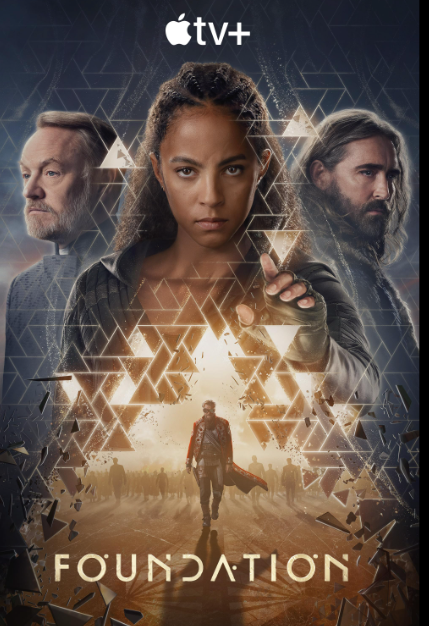
As I've been saying in all of my reviews of this season so far, it adheres to enough essential elements of Asimov's trilogy, and its sequels and prequels, to be immensely enjoyable, at least to me. And it's been doing this while deepening and broadening the original story, as it's been doing and did again in 3.7 to our understanding of Demerzel.
[Spoilers ahead ... ]
But 3.7 did something that Asimov never did. In his narrative, The Mule was a power-hungry mutant, who had the power to literally change people's minds. We readers were supposed to assume, I guess, that the Mule was just born that way. But episode 3.7 has finally given us a much narratively better explanation, by telling us The Mule's backstory.
The Foundation preyed upon The Mule's parents, by allowing them just one child. The Mule's parents had two, and the Foundation representative gave them until its next soon-to-come visit to divest themselves of one of their children. The father decided to save their baby and kill their son, I guess about 11 or 12 years old. As the father was attempting to drown him, the boy discovered that he had the power to mentally direct his parents to drown themselves.
The whole scene was revolting to see. (Seeing or reading a science fiction story in which children are hurt, or worse, is something I never want to do.*) But the whole scene did raise the profound ethical quandary: if you could travel back in time, and eliminate Hitler as a baby, would you do it?
And now, after all these years, we have an answer as to how The Mule arose. Had he not been nearly a victim of the worst kind of violence as a boy, perhaps his mental power would not have arisen. Or, if it had, perhaps he would have used it for good, not evil.
And one last spoiler: the brief conversation The Mule has with Hari in the last moments of the episode -- that's with live Hari not his hologram, since we saw last week that the hologram has no knowledge of The Mule. In a way, that's a happy ending. It's good to see Hari Seldon alive.
*I guess a partial exception is the movie adaptation of Ray Bradbury's "The Last Night of the World" in The Illustrated Man.
Note added August 26, 2025: I discussed this episode in depth the other evening on the Stars End Podcast:
See also Foundation 3.1: Now We're Talkin'! ... 3.2: "The Fault, Dear Brutus, Is Not in Our Stars" ... 3.3: Dawn and The Mule ... 3.4: Cleon Knows His PKD ... 3.5: Cleaving Closer to Asimov's Trilogy ... 3.6: Finally! But ...
And see also Foundation 2.1: Once Again, A Tale of Two Stories ... 2.2: Major Players ... 2.3: Bel Riose and Hari ... 2.5: The Original Cleon and the Robot ... 2.6: Hari and Evita ... 2.7: Is Demerzel Telling the Truth? ... 2.8: Major Revelations ... 2.9: Exceptional Alterations ... Season 2 Finale: Pros and Cons
And see also Foundation 1.1-2: Mathematician, Man of the People, and Cleon's Clones ... Foundation 1.3: Clonal Science Fiction, Hari Seldon as V. I. Lenin ... Foundation 1.4: Slow Hand, Long Half-Life, Flipped Coin ... Foundation 1.5: What We Learned in that Final Scene ... Foundation 1.6: Folded Variations ... Foundation 1.7: Alternate History/Future ... Foundation 1.8: Divergences and Convergences ... Foundation 1.9: Vindication and Questions ... Foundation Season 1 Finale: Right Up There


6 comments:
Any thoughts on who the baby might turn out to be? I think there some hints that it is Magnifico. The obvious choice of the child to sacrifice in that instance would be the newborn rather than the one the parents had come to know and presumably love for several years. Also, just pragmatically, the family could benefit from his ability to help on the farm.
I think there is another subtle clue, though, with the candy being taken from the older child's "secret" hiding place. The parent said he didn't have any secrets that he didn't know about, but maybe that was baby Magnifico's thought rather that the parent's. A precious infant to be sure.
Yeah, I was also thinking the baby could be Magnifico. I certainly agree that the baby must be someone important -- otherwise why would The Mule (if the current Mule is The Mule) let the baby live. But, I don't know, Magnifico currently if anything looks older to me than The Mule, and certainly not a decade younger (and his oldness seems more than a consequence of his age). On the other hand -- the idea that The Mule's powers were in evidence even in his infancy is indeed intriguing.
Great to hear you on Stars End again. I have one question, though, about Hari at the end. Why do you think it's not the AI Hari we've seen before in the Vault? Sure, he was surprised by the Mule in the moment seen in the previous episode, but he's had time to update his program with the knowledge of him, and has been listening carefully to the Mule's story as well as taking in other information about what has been happening since the Mule's invasion and is now fully aware of the outlier he had failed to predict.
I take it as it was presented, that the flesh and blood Hari on Ignis died there after helping Gaal to establish the Second Foundation. Holo Hari is all we have left, and he's located on Terminus in and outside of the Vault, exactly where he was in his brief conversation with the character claiming to be the Mule. As for the digital copy that became instantiated on Oona's World and traveled to Ignis, I assume Kalle kept a backup and could make another Hari with skin in the game if necessary, but I'm not sure it would have much to contribute to the story at this point.
Good question, Joel. I would say which explanation, applying Occam's razor, seems more plausible: (a) a multitude of holograms have knowledge or don't have knowledge of diverse events (including one -- conveniently for fidelity to the original trilogy -- who doesn't know about The Mule when he attacks Terminus), or (b) one or a limited number of holograms, with the living Hari being the one we saw on Terminus? The only thing that contradicts that is when Hari says goodbye to Gaal -- we don't see him die, and we have no further evidence of his death. And also, in episode 3.8, we see a Hari inflict physical damage on The Mule -- we can a hologram do that? Until I see a clear explanation of how we can see so many Hari holograms that can know so many different things, with at least one of them able to have physical impact on the world, I think a live Hari in the mix is more plausible.
I think that vault Hari is "alive" but not flesh and blood. The molecules of his body and brain were used to construct the vault and we have seen it to have some pretty amazing properties bordering on magic (insert Arthur C Clarke quote). If holo Hari, using the Vault, can whisk the entire populace of a planet to safety as it is exploding into fragments, I think he can also do some nasty physical tricks to the man calling himself the Mule. He could pretty clearly have killed the Mule the way he killed the warden in season 2 - or was that way back in S1? I think he did not kill him only because he believes him to be a front for the real nemesis he needs to identify and keeping him alive is his best chance to extract the truth. That's why he was so skeptical of "the Mule"'s story.
I think we can consider vault Hari to be essentially a powerful robot like Demerzel and Kalle/Prime Radiant. This is something far beyond Asimov's idea of the holographic simulation of Hari Seldon.
Right, but giving the killing that the currently presumed Mule is doing, removing him from the board would be a good, ethical move, if only because it would give the real Mule the job of choosing a new pawn, or maybe revealing himself. As for the new holo Hari -- since he's so far beyond what any currently known hologram could do, he/it should be given another name (that is, a Hari, who is neither flesh-and-blood human or projected hologram).
Post a Comment