
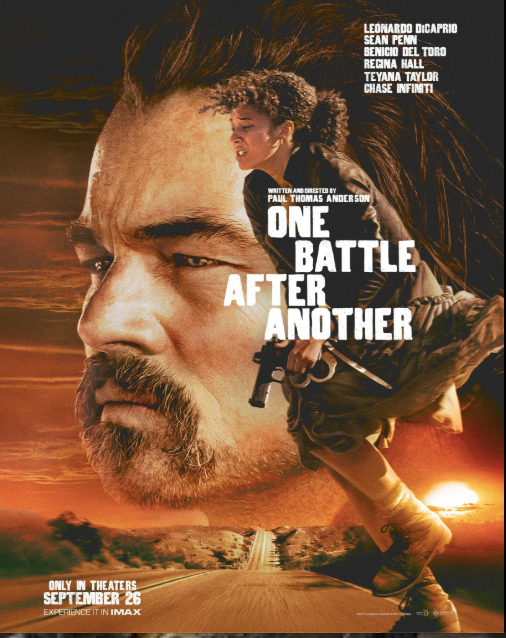
My son (Simon Vozick-Levinson, Deputy Music Editor at Rolling Stone) invited me to see One Battle After Another with him (he wanted to see it a second time), and I'm sure glad that I just did. Paul Thomas Anderson's movie (based on Thomas Pynchon's 1990 novel Vineland, which I haven't read) opened in New York City and around the country last month, on September 25. It tells the story of resistance to a fascist United States of America, a story which is becoming ever more like the reality of ICE and government agents pepper-spraying clergy, pulling innocent American citizens off the street for deportation without a hearing, that we see every day on television and social media.
The only difference is Federal police in One Battle After Another fire real bullets not pepper-spray. But the dystopian movie -- this fictional film of a Hitlerian dystopia that is nearly here -- gives us a frightening portrayal of the racism and xenophobia of the rich white men and military who order ICE to go out and do their worst. At the same time, the movie portrays those who are driven to violence to oppose what they rightly see as the destruction of America.
One Battle After Another indeed shows us two generations of opposition to fascist government in the USA. This has two narrative dividends. First, it enriches the narrative, exploring the family dynamics of the revolutionaries. Also first, it provides a truthful historical depth to the story: in our offscreen reality, fascism and its attendant racism didn't originate in the past ten or twenty years. It has roots that go back centuries not decades to the birth of America, and its acceptance of slavery.
The movie is also brilliantly acted. Leonardo DiCaprio, Sean Penn, and Benicio Del Toro never disappoint, and they all were outstanding in this movie. Chase Infiniti, who was memorable in the TV series Presumed Innocent, was powerful in One Battle After Another, as was Teyana Taylor. It was also great to see Wood Harris (The Wire) and Tony Goldwyn (Law & Order) and Brooklyn Demme on the big screen. (Demme was interviewed on the Being Frank podcast this past April, in an episode that ended with Frank LoBuono playing my song "Alpha Centauri").
Speaking of songs, there was some excellent music, across a diversity of times. My favorite was "Soldier Boy" by the Shirelles, which was eerily satisfying to hear, given that it was on Top 40 radio in 1962, the happiest time in politics in my recollection, a time that sparkled with promise and progress, in such stark contrast to this wrought movie and our country today. And there was indeed some gallows humor that was pretty funny in One Battle After Another, which was also a tonic for what was happening on the screen.
The action scenes were excellent, too. One of my favorite was Del Toro’s character Sensei Sergio St. Carlos escaping via a tunnel under his house, something I’ve always wanted to construct, and one thing I’ve admired about El Chapo. The car chases were exceptional, with one blockbuster chase involving three cars driving at lightning speed in hilly terrain, each driver having a separate agenda, something I've never seen before, even in a James Bond movie.
But the undeniable strength of this movie is its warning against what America is becoming before our very eyes -- a sober warning delivered with all manner of quirks and idiosyncratic characters that all too often border on gonzo -- which couldn't have been delivered at a better, more necessary time.
=============
Simon Vozick-Levinson's A Guide to the Revolutionary Music in ‘One Battle After Another’ in Rolling Stone, September 29, 2025
=============


No comments:
Post a Comment