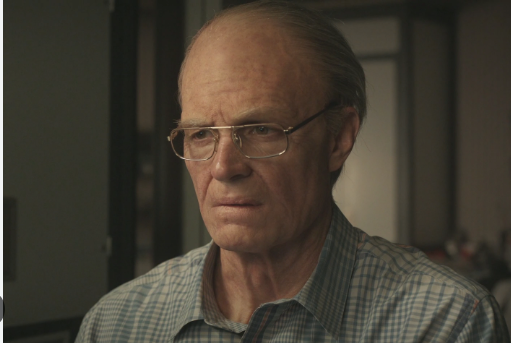
Chuck Todd interviews me about alternate histories
Showing posts with label Star City. Show all posts

Saturday, July 11, 2026

Star City 1.8: Sacrifice and Relevance

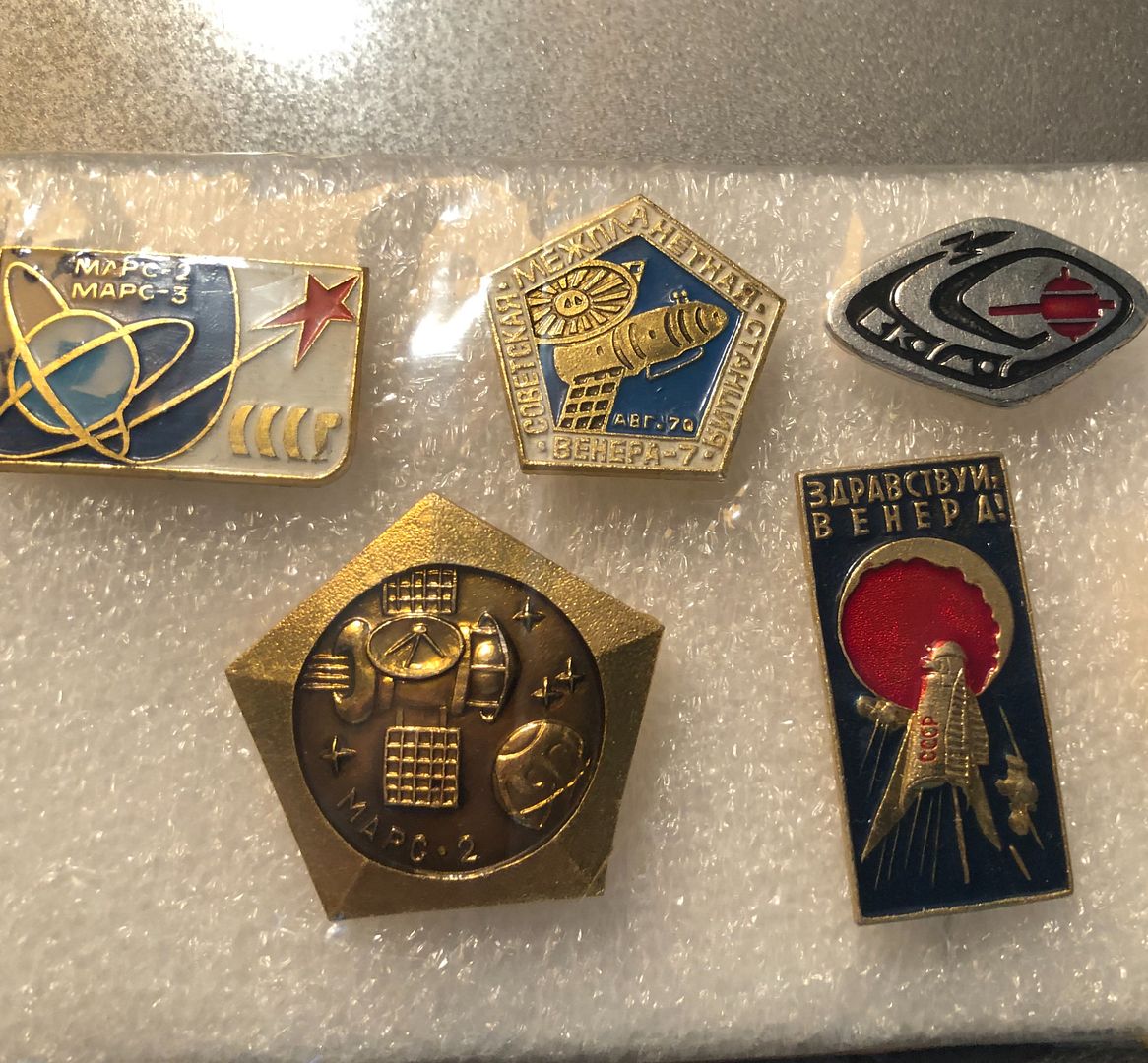
from my collection of Soviet space medals

Well, the season one finale of Star City -- episode 1.8 -- was one of the best finales of any season of any series I've ever seen.   It fired on so many cylinders -- ethical, personal, and sheer human accomplishment.  Here are some of them (and there will be spoilers ahead):

  • Valya actually landing on Venus -- the end of his "one-way" trip (as he put it) to our neighbor planet between us and Mercury and the sun.  He did this because he had to be in the bathysphere, firing off Venerus, so Venerus could get back to Earth.  Also, because he knew the Soviets would hunt him down and kill him if he got back to Earth.
  • Belikova, the first woman to land on the Moon, doing her best to stop the Soviet fascist monsters from killing Sasha and Lakshmi.  She knew those fascist soldiers would stop for a least a few seconds before they shot her down -- she was known to everyone in the Soviet Union -- and indeed they just took her into custody, without harming her.
  • Sergei working with Chief Engineer Korolev to get Venerus back to Earth safely, which in this alternate history is Finland, not the Soviet Union, whose lunatics in power would kill their own people.
  • Not completely a sacrifice,but nonetheless very admirable: Sasha not going with Lakshmi into Finland, but staying in the Soviet Union, so he could in some way be closer to his wife Belikova, whom he’s come to love.
I know I keep talking about the Nazi-like government that existed in the Soviet Union.  Korolev says none of that really matters, the important thing is "We sent human beings to Venus."   As usual, he has the best lines.  He sees the deepest truths.   But, for me at least, the fascism of the Soviet Union -- the murder of anyone who gets in the way of their agenda, even heroes who have risked their lives to go to Venus and back -- is also a deep truth, and very dangerous.  And its depiction in Star City, as I keep saying, is especially relevant -- fortunately for the series, unfortunately for us living in the United States and therefore the world at large.   I look forward to its continuing depiction in Star City, and its reduction in relevance to what is happening in the real reality unfolding in the United States.

Saturday, July 4, 2026

Star City 1.7: Return Voyage

I always say that unless you see a character's head blown off, or dissolved in a vat of acid, he or she may still be alive.  I learned this watching 24.

[And there will be spoilers ahead ... ]

It apparently happened again at the end of Star City 1.7.   Last week, in episode 1.6, we saw Colonel Raskova of the KGB ordering the murder of cosmonauts Sasha, Valya, and Lakshmi, by depriving them of their oxygen on their way to Venus -- after Sasha and Lakshmi disobeyed Raskova's order to do that to Valya --and Chief Engineer Korolev quit in fury and disgust as a result.  This week, in episode 1.7, we learn that the Venera (the Soviet ship to Venus) is returning to Earth as per schedule.

Now, that does not necessarily mean that the three cosmonauts are alive.  For all we know, the Venera was designed to move through space to and from Venus and even send messages back to Earth automatically.  And I guess the KGB and their lackeys in Star City could explain the three cosmonauts dead on the ship as due to a malfunction. But from what we've already seen on Star City, the cosmonauts, like our astronauts in that period of time, were more than spam in the can, as our real astronauts used to say.  They had work to do, making sure the voyage was on track, and all the tech was operating as it should.  So chances are the fix we saw Sasha attempt to put in at the end of 1.6 indeed got working to save at least one of the three, and I hope even more.

As I've already said here in earlier reviews, the battle between science and paranoid fascism in Star City is an excellent metaphor for the battle the U.S. is going through right now, with RFK, Jr and his anti-vaccine policy in our Department of Health, and much more.   I'm very glad to see science perhaps gaining the upper hand in Star City, and I'm hopeful it's beginning to happen right here in America on this Fourth of July.

See also Star City 1.1-1.2: Fascism and Space ... 1.3: Sadness and Joy ... 1.4: Venus in Blue Genes ... 1.5: The Spy Who Went to Venus ... 1.6: "You're A Monster"

in Kindle, paperback, and hardcover


Saturday, June 27, 2026

Star City 1.6: "You're A Monster"


We come again in Star City 1.6 to the paradoxical collision of fascism and space travel so brilliantly and harrowingly portrayed in this at once triumphant and tragic series.  Triumphant because in this alternate history, the Soviet Union has managed to send a spacecraft with three humans on its way to circle around Venus.  Something the fascist Communist regime has managed to do.  And yet, paradoxical, because ...

[And there will be spoilers ahead.]

It looks, at the end of episode, that this paranoid government is very likely killing these three cosmonauts in mid-flight.  We'll see next week if that's what happens.  But even if it doesn't, the point is made.  On the one hand, we have geniuses like Korolev, the Chief Engineer, who got us humans to the Moon before the United States, and now in a momentous world-changing accomplishment is sending three humans to Venus.  On the other hand, we have KGB Colonel Lyudmilla Raskova ordering the three cosmonauts' death as their ship makes its way from Earth to our sister planet.  Korolev speaks plain, transcendent truth, when Raskova puts him under arrest, after he refuses to follow her insane order. He tells her, "you're a monster".

For all we know, in our offscreen reality, this could be why the Soviet attempt to beat the US to the Moon failed so grandly in the 1960s.  But we in the US were no angels then either.  Nearly 4 million people died on both sides of the US war against Vietnam, at the same time the US was preparing to land on the Moon and successfully retrieve six Apollo crewed spaceships there.  The Vietnam War was undeclared, a blatant violation of our Constitution.  Maybe one of the reasons we humans have not gone further into space is too many countries have monsters in too much power.  (Our current President and Federal government are defying the Constitution in multiple ways every day.) Maybe, until we rid ourselves of this human perversion, or learn to curb by it by not giving these monsters such power,  we'll never really get very out into the huge cosmos.

I'm an optimist, as you know, so I still fervently hope that we do.  In the meantime, watching Star City is as much a soul-searing, crushing experience as it is an inspiration for what our better selves can do.

See also Star City 1.1-1.2: Fascism and Space ... 1.3: Sadness and Joy ... 1.4: Venus in Blue Genes ... 1.5: The Spy Who Went to Venus

in Kindle, paperback, and hardcover


Saturday, June 20, 2026

Star City 1.5: The Spy Who Went to Venus


It could have the first hour of a James Bond movie, made back in the 1970s.  Star City 1.5, that is. There wasn't any space flight until the very end, but what we got was a rather brilliant, tightly woven espionage story.  All on behalf of Korolev's, aka the Chief Designer's, secret Soviet mission to Venus.  A fine piece of Bondian science fiction.  Q would have been proud.

The KGB hunt for the Russian cosmonaut or worker in the Soviet space program who was giving crucial information to the Americans already caused the death of a cosmonaut in a previous episode.  The stakes are double life-and-death -- the KGB or Soviet police could kill the cosmonaut who was a spy, and of course he or she could perish in a space mission.  In case you haven't seen this episode, I won't tell you how this all played out, except to say again that we were treated to an excellent piece of espionage fiction. Although there were elements of this in For All Mankind, there was little that was as edge-of-your-seat exciting and ingeniously resolved as what happened in episode 1.5 of Star City.

There's also a bit of romance thrown in.   Sasha's letter to his wife, the first woman on the Moon, was touching.   On the one hand, men and women are thrown together for political reasons in this fascist, paranoid society.   On the other hand, we human beings can love and fall in love whatever the factors and forces that brought us together.  The humanity rising to the surface, and motivating people in this razor's edge story, is one of the highlights of this new series.

To get back to the alternate reality, if the portrayal of Korolev in Star City is even minimally accurate, I'm sorry the real man didn't live a lot longer.  If he had, I'd wager we would be a lot further out in space, with settlements on Mars and Venus, then we actually are today.

See also Star City 1.1-1.2: Fascism and Space ... 1.3: Sadness and Joy ... 1.4: Venus in Blue Genes

in Kindle, paperback, and hardcover


Saturday, June 13, 2026

Star City 1.4: Venus in Blue Genes


The most exciting thing in Star City 1.4 -- at least, to me -- is Chief Designer Sergei Korolev moving ahead with his plans for a ship with cosmonauts to go to Venus.  This, of course, never happened in our reality, because the real Korolev had died by this time (the early 1970s), and the Soviets pretty much had lost interest in bigtime expeditions into the solar system.

In Star City the series, the Soviets are still gung ho about space, and Venus is a nice counterpoint to Mars as a focus in For All Mankind, after everyone got to the Moon.  But Korolev has to contend with not only the exquisitely difficult engineering, but the excruciatingly intrusive Soviet KGB, which are breathing down his neck, and everyone else in the successful space program, every minute of the night and day.

In the Soviet Union, everyone's under observation, anyone could be spying for the Americans, and anyone could be working for the KGB.  On the one hand, the Soviets are justified in their concern about the Americans stealing some of the ingredients that got the Soviets so far thus far, and could to lead to far greater accomplishments -- like Soviets on Venus -- in the very near future.  On the other hand, the KGB are always on the verge of doing serious damage to the Soviet space program, and as we just saw last week, their meddling -- which it turns out was justified -- already got one cosmonaut killed. 

Star City has done a good job at portraying this volatile pressure cooker, and at this point, it's every bit as much as a good espionage thriller, as it is a significant piece and counterpoint to the alternate history space travel saga being done so well by For All Mankind.

See also Star City 1.1-1.2: Fascism and Space ... 1.3 Sadness and Joy

in Kindle, paperback, and hardcover


Saturday, June 6, 2026

Star City 1.3: Sadness and Joy


Apologies for reviewing Star City 1.3 a late evening later than I expected -- I was busy listening to the New York Yankees lose to the Boston Red Sox  (not happy that, in the Cape Cod area, TV coverage of the game was blacked out, plus I'm a big Yankee fan) and watching the New York Knicks win (happy I could see that on TV, and I'm a Knicks fan).   But I was nothing but happy about the Star City nightcap.

Not that the story was happy -- the Soviet Union was a tough, paranoid place to live, especially if you were a cosmonaut or otherwise connected to their space program.  The cosmonauts and their private lives were monitored, and the paranoia about the Americans trying to sabotage the Soviet program was by no means completely or even partially crazy.  A large part of the fun of this episode was figuring out who the U.S. collaborator was, and their identity was suitably surprising, as the cost to the Soviet space program of stopping this traitor was not.

But there was an underlying joy, for me at least, in seeing the Soviets work so hard to get ours species off this planet, albeit in their fascist way.  In our offscreen reality, no spacecraft with humans aboard has landed on the Moon since the final Apollo mission in the early 1970s.  In the alternate reality of For All Mankind and Star City, the Soviet Union has already landed on the Moon, and Korolev aka the Chief Engineer is already in the early stages of working on a trip to Venus.  Writing this now seems like science fiction.  And that's of course what For All Mankind and Star City are.  But they could easily have been reality.

For All Mankind excelled in exploring the lives of the human beings who made these voyages, and eventually came to live on Mars.  Star City looks like it might be beginning to do that for Venus. If you'd like know more about the human beings who have actually made it beyond this planet -- beginning with Yuri Gagarin, the first person to orbit this planet, a Soviet -- I highly recommend Deana Weibel's The Ultraview Effect, just published.

And I'll be back here next week with my review Star City 1.4.

See also Star City 1.1-1.2: Fascism and Space

in Kindle, paperback, and hardcover


Saturday, May 30, 2026

Star City 1.1-1.2: Fascism and Space


Just watched the first two episodes of Star City on Apple TV.   I think it's a powerful, exciting, politically potent narrative so far, and looks to be a worthy successor to For All Mankind.

Let's talk a little about the politics first.  The Soviet Union in the 1960s was one of the two most powerful countries in the world.  Unlike the United States, it was a fascist state.  Though it had been allied with the world's two leading democracies in  World War II -- the U.S and Great Britain -- the Soviet Union under Joseph Stalin had more in common with Nazi Germany, and indeed had been Germany's ally when the two nations carved up Poland.  And though Stalin had died by the time Khrushchev and his successors took over, the Soviet Union in the 1950s and 1960s was still a fascist, deeply undemocratic state.  It was that brutal state which beat the US to space with Sputnik, and got the first human being into orbit in space with Yuri Gagarin in our reality.

[And there will be spoilers ahead ...]

In the alternate history that began with For All Mankind, the Soviet Union goes on to also beat us to the Moon, and that set in motion a competition to get out into space from our world, Earth, whose human inhabitants would reach Mars and beyond in the decades that followed.  Star City tells us the Soviet side of that story.  It's a tale, very likely based on the way the Soviet Union really was, in which lives are expendable.  The Soviet woman chosen to be first female on the Moon is thought to be in cahoots with the West.  Turns out she isn't, but she's killed anyway. As KGB Colonel Lyudmilla Raskova (played by Anna Maxwell Martin) explains, we don't make mistakes.

Women, in general, play a major role so far in Star City, at this point, more so than in the equivalent first season of For All Mankind. Anastasia Belikova (played by Alice Englert) becomes the first woman on the Moon, but she's no slave to political pressure, and tows the line only after Raskova and a higher-up operative threaten to replace her with a look-alike. Irina Morozova, who has continued to play a semi-major role in For All Mankind, is a major character as her younger self (played by Agnes O'Casey) in Star City.  We see her progress from being unable to kill a prisoner when commanded by Raskova, to throwing scalding water in the face of a prisoner to get him to talk, and thereby saving his life -- at least, temporarily.

The most important male character, so far, is the Chief Designer or Chief Soviet Engineer (played by Rhys Ifans) -- we don't know his name.  He's the brains behind the Soviet space program, and is likely based on Sergei Korolev, the real-life genius who suffered a heart attack in 1962 and died under somewhat mysterious circumstances in our reality in 1966.  The alternate history series begins in 1969.  (I've always thought maybe the CIA had something to do with Korolev's death.  See also David S. Michaels and Daniel Brenton's novel Red Moon for another, related take on the Soviet space program in the 1960s.)  But whatever the real story of Sergei Korolev, I don't get why the Chief Designer in Star City, as of the first two episodes, is deprived of his name. 

To return to the dramatization of fascism that is the salient backbone of Star City so far, the timing couldn't be better in terms of what's really happening in Russia and the United States these days.  In Russia, after a brief taste of freedom that barely lasted a decade after the Soviet Union fell apart, Putin has done and is doing his best to re-establish a Soviet-like state, which is what his war on Ukraine is all about.  In the U.S., the reelection has Trump has brought this country into an escalating embrace of lies over truth, and governmental prosecution if you object to the lies, which are the hallmarks of fascism.  

For that reason, in addition to its excellent narrative, it's good and important to see Star City exploring the fascistic dynamic, and I'll be reviewing every episode.

in Kindle, paperback, and hardcover


Monday, May 25, 2026

For All Mankind 5.9: Penultimate Episode of Penultimate Season


In case you think "penultimate" is some kind of compliment, it pretty much isn't.  This is the 5th season of a 6-season series, and the next-to-last episode of this 10-episode season.  It wasn't even a close-to-great episode of a close-to-great season, though I think the overall series is a memorable triumph in alternate history, about a crucial aspect of our existence: the need and attractiveness of getting off this planet to discover what place we have in the vast and (as far as we know) infinite universe.

But this season, with a couple of shining exceptions, didn't do much to further that alternate history or the metaphysics of existence beyond our planet.  As I've said in prior reviews, the battle between humans on Earth and on Mars is old hat in science fiction.  Episode 5.9 gives us yet another rendition of that, as the forces of our home planet strive to rip our brave pioneers on Mars to shreds.  And, indeed, there isn't much alternate history in any superior military force laying waste to a limited band of pioneers.

The action on Titan, on other hand, was riveting, as that story has been from the beginning.  The discovery of extraterrestrial life, in Ringo's words, don't come easy.   Kelly and her three-person crew, including the former captain, seemed fixed on finding it.  I wish them luck, and hope we see them getting at least a glimpse of it in the upcoming season finale later this week.

That finale will be up on Apple TV this coming Friday -- along with the Star City debut, another alternate history about the human sojourn into space, this time from the Soviet perspective, i.e,, the view from the victor of the race to get to the Moon, which is the basis of For All Mankind.  I'll certainly be reviewing that, humming "Back in the USSR", one of my Beatles' favorites, more recently done justice by The Analogues in our real history.

See also For All Mankind 5.1: On the Intersection of Alternate and Real Histories ... 5.2: Actor Reunions ... 5.3: The Newton, the First Amendment, and ... Last Breath ... 5.4: Robots Replacing Us In Space? ... 5.5: ICE on Mars ... 5.6: Earth vs. Mars ... 5.7: Titan! ... 5.8: Firing On All Cylinders

And see also For All Mankind 4.1: Back in Business and Alternate Reality ... 4.2: The Fate of Gorbachev ... 4.3-4.4: The Soviet Union in the 21st Century, On Earth and Mars ... 4.5: Al Gore as President and AI ... 4.6: Aleida and Margot ... 4.7: Dev on Mars ... 4.8: Sergei and Margot ... 4.9: Progress ... 4.10: Earth vs. Mars

And see also For All Mankind 3.1: The Alternate Reality Progresses ... 3.2: D-Mail ... 3.3-3.4: The Race

And see also For All Mankind, Season 1 and Episode 2.1: Alternate Space Race Reality ... For All Mankind 2.2: The Peanut Butter Sandwich ... For All Mankind 2.3: "Guns to the Moon" ... For All Mankind 2.4: Close to Reality ... For All Mankind 2.5: Johnny and the Wrath of Kahn ... For All Mankind 2.6: Couplings ... For All Mankind 2.7: Alternate History Surges ... For All Mankind 2.8: Really Lost in Translation ... For All Mankind 2.9: Relationships ... For All Mankind 2.10: Definitely Not the End


Friday, April 3, 2026

For All Mankind 5.2: Actor Reunions


It's great to see Joel Kinnaman as Admiral Baldwin in For All Mankind Season 5 still flying morally high, still shaking things up, defying authority to do the right thing, still causing good trouble (as John Lewis put it so well down here on Earth in our off-screen reality), in his advanced age.   Kinnaman is especially impressive in the role, given that he's now also playing a character much closer to his real age in Imperfect Women, which I'll review as soon as its first season is over.

[And there will be spoilers ahead ... ]

Baldwin in Season 5 of For All Mankind has stage-three cancer, and is not supposed to fly.   All the more the impressive that he risks his life in this condition to save Lee Jung-Gil (played by C. S. Lee -- Vince Masuka from Dexter old and new!).  And episode 5.2 concludes with Baldwin's plan to save Lee on the way to working, though as that happens, Mireille Enos's character Celia Boyd -- Enos starred with Joel Kinnaman in The Killing around the same time the original Dexter was concluding -- finds Baldwin unconscious at the controls.

Now if For All Mankind were made by Taylor Sheridan, this might be the end of Baldwin.  But given that Ronald D. Moore is its creator, I'd be stunned if Baldwin didn't survive until at least the end of this season.  In fact, given that Joel Kinnaman has been reported to return as Baldwin in the final season 6 of the series, and though, again, apropos of Sheridan, this could be in flashbacks, I'm thinking we'll see Baldwin in real current time in the final season.  (And while we're at it, in the alternate history spin-off Star City to debut in May, though probably at a younger age.)

Anyway, Celia Boyd is a great new character, so is Leonid played Costa Ronan (from Homeland and The Americans), and all the continuing characters are good to see in this 5th season of For All Mankind. And I'll see you back next week with my review of the next episode.

See also For All Mankind 5.1: On the Intersection of Alternate and Real Histories

And see also For All Mankind 4.1: Back in Business and Alternate Reality ... 4.2: The Fate of Gorbachev ... 4.3-4.4: The Soviet Union in the 21st Century, On Earth and Mars ... 4.5: Al Gore as President and AI ... 4.6: Aleida and Margot ... 4.7: Dev on Mars ... 4.8: Sergei and Margot ... 4.9: Progress ... 4.10: Earth vs. Mars

And see also For All Mankind 3.1: The Alternate Reality Progresses ... 3.2: D-Mail ... 3.3-3.4: The Race

And see also For All Mankind, Season 1 and Episode 2.1: Alternate Space Race Reality ... For All Mankind 2.2: The Peanut Butter Sandwich ... For All Mankind 2.3: "Guns to the Moon" ... For All Mankind 2.4: Close to Reality ... For All Mankind 2.5: Johnny and the Wrath of Kahn ... For All Mankind 2.6: Couplings ... For All Mankind 2.7: Alternate History Surges ... For All Mankind 2.8: Really Lost in Translation ... For All Mankind 2.9: Relationships ... For All Mankind 2.10: Definitely Not the End

in Kindle, paperback, and hardcover


InfiniteRegress.tv