
YC Torah Library
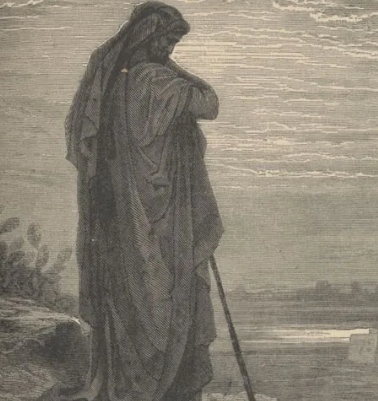
My favorite part of the Passover seder -- we had a wonderful seder last night at our in-laws in Manhattan -- is when we welcome Eliyahu HaNavi (Elijah the Prophet) to our gathering. He was a real person in 9th-century BCE Israel, but over time he's become a mythical, magical figure who manages to visit every table across the world where a seder is being conducted. We appreciate his visit, leave a glass of wine out for him -- but he's a gentleman, and drinks so little that it seems to remain filled after his visit -- but my favorite part of this event is singing harmony to welcome him, for as long as I can remember.
Eliyahu also appeals to my taste for science fiction, or at least fantasy. And my wife mentioned that Santa Claus also picks up on this power to be in so many, innumerable places almost at once. Marshall McLuhan's co-explorer of media Edmund Carpenter -- they co-edited the journal Explorations in the 1950s-- also channeled Eliyahu and his omni-presence, noting in Oh, What a Blow That Phantom Gave Me (p. 3) in 1973 that "Electricity has made angels of us all." Not, alas, that it made us all good, but incorporeal images of us human beings everywhere at once, back then on national television, soon on global TV like CNN, and now on the Internet and social media.
McLuhan thought this point was so important, he even made it posthumously, noting with his co-author Bruce Powers in The Global Village (1989, p. 70) how "Lowell Thomas [the radio broadcaster] used to say, 'On the air, you're everywhere'". The global village, of course, is a centerpiece of McLuhan's work, his second most famous probe "The new electronic interdependence recreates the world in the image of a global village" (p. 31), in his second most famous book, The Gutenberg Galaxy (1962), exceeded only by "the medium is the message" in Understanding Media (1964, p. 7). My Digital McLuhan (1998) was devoted to showing how the Internet was turning the global village from a metaphor into reality.
And social media continues doing this every day. A few days before the seder, I talked to my classes at Fordham University about something new I had just discovered on X (formerly Twitter). A new feed, "Japanese Twitter" that had showed up on my page, likely because I have a number of colleagues and fans in the Land of the Rising Sun. For the first time I've seen, we here in America can read, in English, what the Japanese are saying about everything, including us, in their Tweets. And we don't need to wait for the translation, because AI does it almost instantly. With every step forward, everyone on this planet is becoming more like Eliyahu, everywhere at once.


No comments:
Post a Comment