
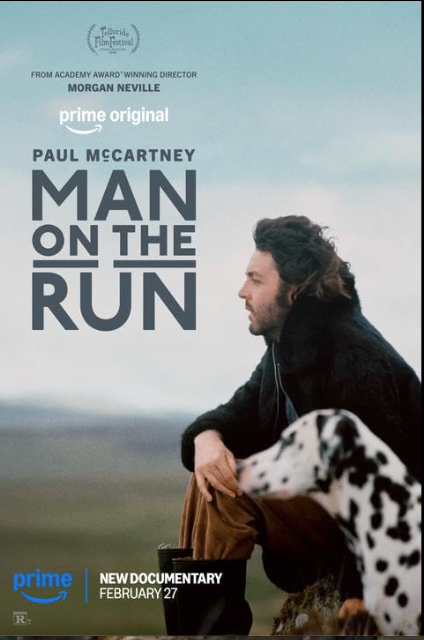
My wife and I saw Man on the Run, a nearly 2-hour documentary on Amazon Prime, about Wings, Paul McCartney's group that flew around the world from shortly after The Beatles broke up in early 1970 to shortly after John Lennon was murdered at the end of 1980, making a Beatles reunion forever impossible.
Let me say that I've always thought Wings at their best -- "Let Me Roll It," "Band on the Run," "Jet," "Mull of Kintyre," and "Live and Let Die"-- was every bit as good as The Beatles at their best, which is actually a huge lot better than good. And like all the recent Beatles documentaries, the sound in this documentary was great, and an outright pleasure to hear.
The story, though, was no pleasure to see. A sadness hung over the movie, and not just because we knew it would conclude close after Lennon's assassination. But we see Paul McCartney's struggle, beginning with his attempt to get the world to see, back then, and continuing now, that Lennon had announced to the band much earlier than McCartney did to the world that The Beatles were over. In part, McCartney's problem was the way in which he made that announcement, in an interview he conducted with himself, in which he even took a shot at poor Ringo, proclaiming McCartney wouldn't miss him.
The result was a lot of people -- fans and critics -- listened to McCartney's efforts, before he created Wings, with a lot less than a kindly ear. The myopic critic Robert Christgau was especially harsh, missing completely the affectionate brilliance of Uncle Albert/Admiral Halsey, and many of McCartney's other solo efforts, literally solo in that he played all the instruments and sung all of the parts either by himself or with Linda. I've been complaining about Christgau for decades, but I guess I should thank him, because The Village Voice published my response to Christgau's article, which I sent to the weekly newspaper as a letter to the editor, and they published as an article -- my first published article -- for which they paid me $65.
McCartney created Wings in large part in response to such criticisms, and the group succeeded splendidly. They started out playing to small audiences, but in a few years played to sell-out crowds teeming with shouting fans with a great line-up that consisted of Paul, Linda, Denny Lane, and an evolving variety of musicians. McCartney was happy about that, but continued to be plagued by public misunderstandings. I recall how I felt, when I heard McCartney's response to Lennon's murder -- "it's a drag" -- thinking that Paul must've been in shock when he gave that seemingly shallow reply to a journalist's question, but one of my students (I was teaching then at Fairleigh Dickinson University) came up to me after, in sheer disbelief that McCartney had said this. It was good in the documentary to hear that Paul had said a lot more than the drag line in his response to that question -- the media as they often do just broadcast the most provocative line -- and heartening and soothing to hear Sean Lennon say recently in the documentary that he always understood how much his father and Paul had loved one another.
My wife and I continue to love The Beatles, and Paul and his music. One way I tried to deal with how much I miss them was the novel I wrote, It's Real Life: An Alternate History of The Beatles. Seeing Man on the Run didn't have too much of a healing effect, but I guess that's the problem with reality.
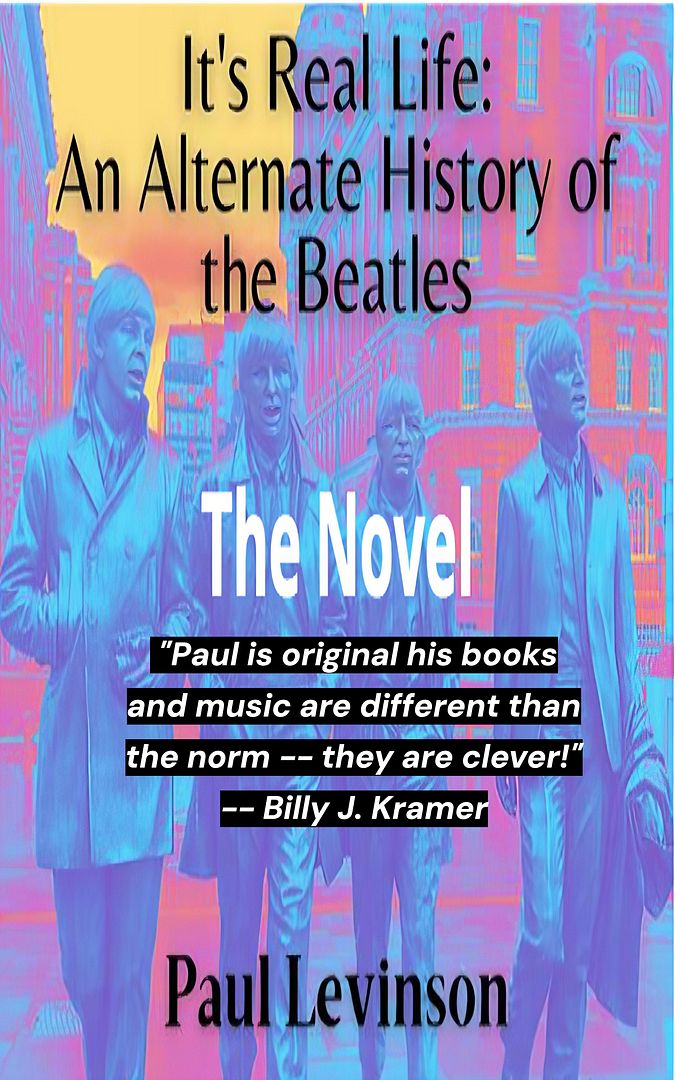
more about the novel here


No comments:
Post a Comment