Chuck Todd interviews me about alternate histories
Showing posts with label Solvej Balle. Show all posts

Thursday, May 21, 2026

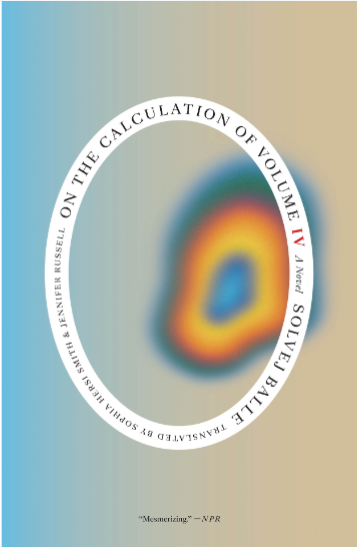
On the Calculation of Volume (Book IV): Death and Life


Well, I entitled my review of the third book in the seven-volume On the Calculation of Volume series "Multiplication", but after reading the fourth book of the series -- I just finished it a few minutes ago -- I think I might well have been premature with that title.  The number of people trapped in November 18 in the fourth book multiply faster than bunnies, and as I said in my review of the third book, this gives author Solvej Balle the avenue to explore a myriad of angles and theories about what happened to her and her temporal siblings as each of them offer their evolving views.

These range from the nature of time to multiple universes to the nature of everything, organic and manufactured, in their lives and throughout history.  Everyone has an opinion, and a shade of opinion, sometimes as mundane as Tara herself wondering "weren’t our vehicles first and foremost a form of protection?" That struck a chord in me, because it reminded me of something Marshall McLuhan once said to me, as we strolled the streets of Toronto, on one of my visits, with my wife, in the late 1970s:  "You know," he said, "the automobile retrieves the knight in shining armour," as a flashy Chevy Impala from the 1950s with fins and all drove by.

Sometimes the insights were so recondite that they didn't make sense, at least, not to me.  One of the new character inmates of November 18, Milly, shares her opinion that "we’re the ones who can kill in the eighteenth, not them [i.e, we the readers]. When they kill, their actions vanish overnight. When we kill, we end lives. Irrevocably." Then she adds, "We were both more dangerous and more vulnerable than those who moved through the world believing that the eighteenth was simply a day between the seventeenth and the nineteenth, because no matter what happened to them, they would wake up to the eighteenth again." So ... I don't quite get this -- I and I assume you move through a world in which the 18th of any month is simply a day between the 17th and the 19th, and if someone in our world died, we would not wake up the next day and find them alive, again, right?  Maybe an error crept into the translation.  Maybe an error in my scrambled brain.  If not, maybe I'm living in a world which is somehow even more science fictional than I thought.

But life and death do play a very significant role in this fourth volume.  For some reason, a few plants begin to bud and grow indoors in this repeating day.  I wondered, at that point, what would happen if someone became pregnant, or was pregnant when she entered the time loop, and sure enough, another character, Sonia, reveals she is carrying a baby.  But, sadly, she loses the baby -- it just disappears.  

As usual, there is a potential game-changer in the closing pages of this book, and I won't tell you what it was, except that I was thinking about something like that as I read this fourth volume.  There are seven volumes in this series, as I already mentioned, and only the fifth is available in English in the US, in paperback.  I'm sorely tempted to get it, but I've been reading this metaphysical adventure so far in Kindle, and I'd like to keep doing that.  Amazon says the Kindle will be up this coming November, but we'll see if I can wait that long.

See also On the Calculation of Volume (Book I): The Irreducible Metaphysics of Time Loops ... (Book II): Life in the Loop Lane ... (Book III): Multiplication

in Kindle, paperback, and hardcover


in Kindle and paperback


Monday, May 4, 2026

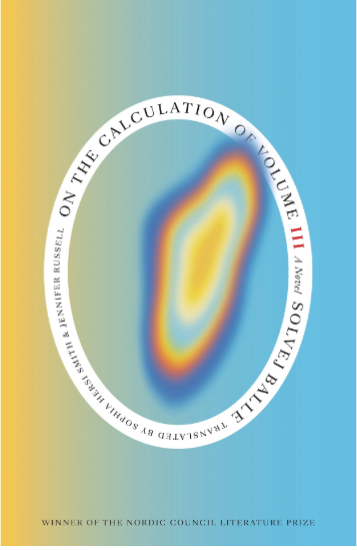
On the Calculation of Volume (Book III): Multiplication


Well, I told you at the end of my review of On the Calculation of Volume (Vol II) that I'd be back with a review of Vol III very soon, and here I am.  Volume III, unlike Volume II, changed everything in this mega-story, and was every bit as powerful as Volume I.

The key new ingredients were fellow travelers/inmates of November 18.   Henry joining Tara was signaled in the teaser at the end of Volume II, and before Volume III is over, the two are joined by Olga and Ralf, and a new teaser at the end alerts us to more people who live over and over in November 18.

Henry, Olga, and Ralf arrive in the story at different times.  Ralf's introduction is the most packed with possibilities.  Tara learns about him in the first place from Olga, who is desperate to find him -- he went missing after he and Olga connected.   I initially thought Ralf was missing from November 18 because he had found a way out, which I assumed made him unavailable for some reason in the November 18ths Olga -- joined later by Tara and Henry -- was searching.   But he turns up, and the voices of Henry, Olga, and then Ralf give author Solvej Balle the opportunity to explore the metaphysics of loopism more widely than she did with just Tara. 

Ralf sees his and the other three's endless presence on November 18 as a way they "can alert people on the brink of disaster".  It's a logical and lofty goal -- if you know a car is going to crash in a particular place on November 18, you can prevent the crash by arranging for a road block on a subsequent November 18, or better, if the crash is due to something wrong with the car, by fixing it (assuming those kind of changes stick with November 18).  Further, to do this on as massive a scale as possible, Ralf wants "to develop an interspace: a kind of high-speed bridge between the analog and digital worlds, capable of converting vast volumes of data back and forth with minimal effort, with no information loss and fast enough to save lives."  A time-looped man with a plan indeed!   We could use a "bridge" like that in our off-page real life world.

There are lots of other goodies in this third volume of Tara's adventure, including books by fictitious authors, focus on the city of Bremen where the four come to live (Cora Buhlert, a Hugo Award winner, lives there, too, and that's not fiction), and Raphael’s famous "School of Athens" fresco, which always reminded me of the cover of The Beatles' Sgt. Pepper.  And I'll be back here with more as soon as I finish Vol IV in this magical mystery tour through revolving time.

See also On the Calculation of Volume (Book I): The Irreducible Metaphysics of Time Loops ... (Book II): Life in the Loop Lane


in Kindlepaperback, and hardcover


Friday, May 1, 2026

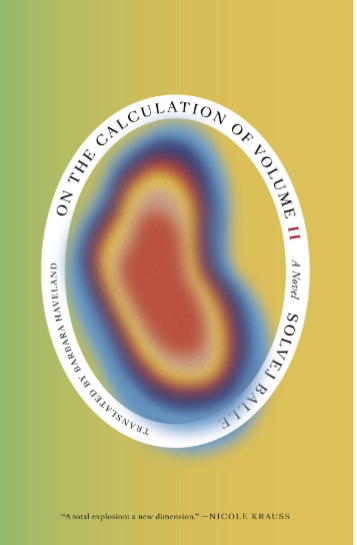
On the Calculation of Volume (Book II): Life in the Loop Lane


I just finished the second volume of Solvej Balle's seven-volume On the Calculation of Volume time loop series (translated into English by Barbara J. Haveland).   It picked up where the first volume left off, but was noticeably different in its pace, emotional valence, and mode of story telling.

The first half was reminiscent of Canterbury Tales, as Tara travels around Europe, in pursuit of weather conditions and climates that mirror the seasons.  This is a good idea for someone who is trapped on a single single day, November 18, happening over and over.  But with the exception of a visit to her parents and a harrowing car ride in Finland, the stories Tara encounters and constructs are less than enthralling.

To be clear, the writing is sharp and evocative.  Tara on her travels meets someone named Jeanette. "I told her my name was Tara. She didn’t think that sounded French or Belgian.... I didn’t think her name sounded particularly Norwegian either, but I didn’t say that." It's fun to read piquant little observations like that amidst the huge distortion of time, but I yearned to see more of the constesting of those distortions we saw so vividly in the Book 1.

Tara settles down in the second part of the book, but with the exception of the theft of her bag, we get long internal disquisitions from Tara on the hopelessness of her situation -- at times, I thought I was reading Thomas Hardy's Jude the Obscure -- relieved at least partially by the realization the she has not been "betrayed, rejected, forsaken", she can go back to her husband Thomas any time, albeit on the time encased on November 18.

The final part of Book II finds Tara in pursuit of all the knowledge she can find about the Roman Empire and its decline.  In that pursuit, Balle has something in common with Asimov, who's Foundation series was jump-started by Edward Gibbon's The History of the Decline and Fall of the Roman Empire.

There are five more novels in this series.  I would be reading them anyway, but the totally out of left-field development at the end of Book II makes it sure a sure thing I'll dive into Book III very soon. 

See also On the Calculation of Volume (Book I): The Irreducible Metaphysics of Time Loops

Sunday, April 26, 2026

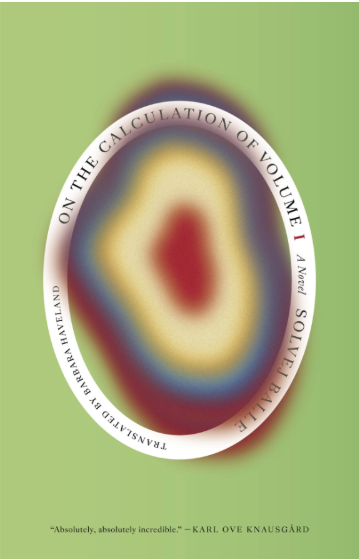
On the Calculation of Volume (Book I): The Irreducible Metaphysics of Time Loops


Time loop stories -- about a recurrent, involuntary, often daily trip to the past -- have been well represented in movies like Groundhog Day, Source Code, and Palm Springs.  This subset of time travel in science fiction and fantasy has been less represented in novels, which would make Solvej Balle's seven-volume On the Calculation of Volume series (!) (this first volume translated into English by Barbara J. Haveland) welcome in any case.  But it has additional treats for the mind.

My friend Dirk Vom Lehn told me about this series yesterday.  I bought the first volume, finished reading it in the wee hours of the morning, and bought the other three (vols II, III, and IV) that are now available in English.  I'm going to review each volume as soon as I finish reading it.

Tara and Thomas Selter are antiquarian book dealers in France -- which makes them appealing already.  Tara travels to Paris to buy some books, and that's when (November 18) the time loop commences.  She wakes up the next morning, and discovers that the rest of the world around her is waking up on November 18.  When she returns home, she finds that Thomas is with the rest of the world.  They're living their lives in a world in which the days progress as they do for you and me.  Tara lives through November 18 over and over, and we're off and running.

As is the case with most other time loop stories, Tara has the advantage of knowing what's going to happen, hour by hour, minute by minute, as she lives in November 18 every day.  And of course, as is also the case with most other time loop stories, this advantage soon become a burden and a curse.  This sets up the heart of the story, as Tara struggles to understand what is going on, so she can surmount the steel grip of the time loop.

She tells Thomas what's happening -- the same story plus what happened on the previous day -- and he by and large tries to help. They visit a library to read up "on parallel universes and multiple worlds".   (I wondered if that library had a copy of It's Real Life: An Alternate History of The Beatles?)  But the metaphysics of time loops, fun as they may be for the reader, are a kind of hell for the character.   Tara struggles to understand what's up.  But nothing adds up.  Her hair grows, because her body is progressing even as the world is on daily replay --  and she notes "I cut my nails, or rather, I cut them again, slowly, over the sink in the bathroom, because they had grown, as if time existed and I was snipping tiny slivers of time into the sink, then I turned on the faucet and washed them down the drain" -- but other things in the November 18 world keep reappearing, exactly as they were/are, and still other items get consumed and disappear.   And those vexing inconsistencies resist being washed down the drain or anywhere.

I don't know if Solvej Balle intended to write a seven-volume series when she wrote the first volume, but such metaphysical complexities are grist for the mill of multiple volumes, and I'll be back here with my review of the second and succeeding volumes as soon as I've had the pleasure of reading them.

See also On the Calculation of Volume (Book 2): Life in the Loop Lane


in Kindlepaperback, and hardcover


InfiniteRegress.tv