Chuck Todd interviews me about alternate histories

Wednesday, October 20, 2021

Call for Essays and Science Fiction Stories for Volume 2 of Touching the Face of the Cosmos


It’s been almost six years since we brought out Touching the Face of the Cosmos: On the Intersection of Space Travel and Religion, an anthology of essays and science fiction stories, assembled with the purpose of jumpstarting the human movement into space by connecting it to the sense of wonder, the need to know what we are doing here in the universe, that is the basis of religions and spiritual thinking.


Since 2015 and especially recently space exploration has gained momentum:, Richard Branson, Jeff Bezos, and William Shatner have gone very briefly into space. Elon Musk has sent a ship with people into orbit for three days. The United States has sent robots to Mars, and the Chinese have put a crew in Earth orbit for months.

But we as species have not lifted off this planet in the way that many foresaw when people first walked on the Moon in 1969. We are still in need of a more robust connection to that spiritual sense of wonder to lift us beyond our home planet.

We therefore think the time is right for a second volume of Touching the Face of the Cosmos. As with the first volume, we are looking for both essays and science fiction stories, 500 (five hundred) to 7000 (seven thousand) words in length (but query us if you have something that you think would be perfect for the anthology, but is shorter or longer). We would like original essays and stories, but will consider a very limited number of already-published science fiction stories.

-- Paul Levinson and Michael Waltemathe

Deadline for receipt of submissions is 1 February 2022.

Please send to:

Levinson@Fordham.edu 
and michael.waltemathe@rub.de

Podcast Review of You seasons 1-3


Welcome to Light On Light Through, Episode 198, in which I review all three seasons of You on Netflix.

Blog post written reviews of You 1, You 2, and You 3.


Check out this episode!

La Brea 1.4: Expanding Horizons


Well, I predicted last week that there was more than one sinkhole than just the one in La Brea and Gavin's special vision would show him that Levi was alive after his plane seemed to burn up in the La Brea sinkhole, and I was right.  I was also figuring that La Brea would continue to be a series worth watching, and I was right about that, too.

We indeed learned in La Brea 1.4. that there was more than one sink hole, including one in Mojave.  Sophia's associate, a new character, knows all about it, and she's ready to have her special plane take a trip back 12,000 years, despite Sophia's reservations.  I hope she takes Gavin along -- on the other hand, if Gavin goes, who can tell the people in our present what's happening back then?

Not much in the prehistoric monster catalog in this episode, though some kind of big, underwater snake did do its best to pull Riley under.  Fortunately, Levi dove in and shot the snake, freeing Riley.  Must have been one effective shot, underwater, a feat we alas didn't get to see.

The drug story in the past is trite, and doesn't add much to the narrative.  But the expanding number of sinkholes has real possibilities.  How many of them are there?  How long have they been there?  How long have we known about them?  Who is the "we" -- are the sinkholes just in California, all across America, all across the world?

La Brea clearly has the makings of a rich science fiction series, and I look forward to cashing in as a viewer.

See also La Brea 1.1: Pros and Cons of Falling Into the Past ... La Brea 1.2: Deepening Horizons ... La Brea 1.3: Descending Into the Maelstrom


Monday, October 18, 2021

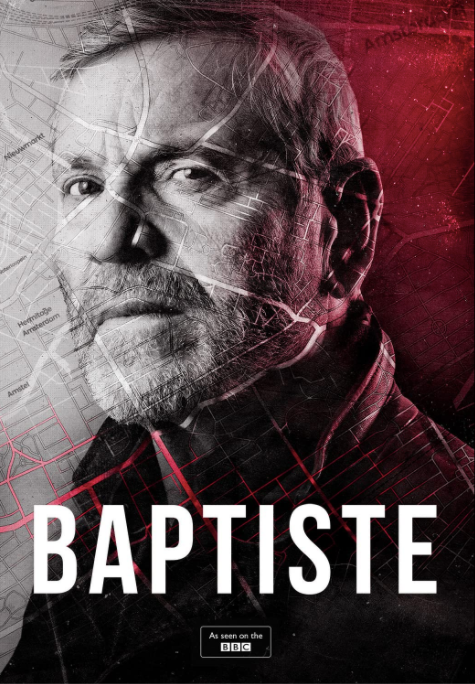
Baptiste 2.1: Souls on the Edge

Baptiste is back for a second season on PBS, starring Tchéky Karyo as Julien Baptiste, the quirky genius of an investigator who has a dogged, uncanny talent in finding missing people, as amply demonstrated in two seasons of the prior series aptly entitled The Missing.

The first Baptiste season saw him applying his talent with a weakened brain, which turned out more than sharp enough to do what was needed.  The new season shows Julien in top shape, beginning to help a woman (Emma Chambers, played by Killing Eve's Fiona Shaw) whose husband and two sons have suddenly and unaccountably gone missing -- and Julien in not such good shape, a year later, when Emma, also not in such good shape, in a wheelchair, comes to see him to plead for his help.  Julien has long hair, which actually looks pretty good, but he's unkempt and almost dissolute.

So, in addition to where are the missing sons -- we learn before the episode concludes that the husband was murdered -- the big questions are how did Emma wind up in that wheelchair and why is Julien in such ragged condition?  The veering back and forth between the present and a year earlier works well, and adds to the harrowing quality of the narrative.

Actually, all of Julien Baptiste's attempts to find the missing have been harrowing, but there's something especially desperate, souls on the edge of the precipice, in this second or fourth season, depending on how you're counting.   This keenness makes me only keener to see what the next five episodes have in store for us.  If I have a chance, I'll try to report back here with a review of each episode.  

See also Baptiste 1: Logic, Passion, and Unflappability ... The Missing 1: Worth Finding and The Missing 2: Unforgettable


CSI: Vegas 1.2: My Half-Joking Suggestion for the Villain


Circling back, maybe stepping up, with a review CSI Vegas 1.2, which is actually a continuation of the original CSI, then and now on CBS.  I'm still liking it.

The modus operandi appears to be one ongoing case involving David Hodges, who stands accused of forging evidence in who knows how many earlier CSI cases, and another case which will likely change each week.  For 1.2, I enjoyed seeing both unfold, but I'll confine my review to the profoundly important (for CSI) David Hodges case.

Sarah and husband Gil disagree strongly on Hodges' guilt.  Sara feels in her bones that Hodges is innocent, framed by some nefarious player.  Gil can't go by feelings, not even by Sara's logic.  He has to wait for evidence, to tell him how he feels. 

[Spoilers ahead ....]

Good news for Gil's reliance on evidence and Hodges' innocence at the end of the episode.  Gil finds that someone was silencing Hodges' neighbor's dog.  Since Hodges has no reason to do that, Gil concludes that Sara's instincts and logic are right:  The person who framed Hodges must have been responsible for the neighbor's dog,

The question still remains of who and why?  I'm half jokingly thinking that a good candidate would Nick Stokes, played by George Eads, who was with CSI from the beginning until almost the end, leaving after he had some kind of altercation with a writer for the show.  He'd have a big grievance against CSI, right?

In any case, it's very good to see Sara and Gil back in action, and I'm liking the new characters, too, so I'll likely be back here with another review or more.

See also: CSI: Vegas 1.1: CSI on Trial


Sunday, October 17, 2021

Hightown 2.1: Switching Ups and Downs


Last year, Hightown was especially welcome, because, with the lockdown where we live, Hightown was the most we saw of the Cape.  This year, we were back on the Cape a whole bunch of times, and Hightown is off to such a good start it's looking to be more welcome than ever.

Jackie is back and before the episode is over she's working full time for the real police.  Ray remains out of the police, bartending, because some cop from his past testified against Ray at the hearing that could have put him back on the force.  Frankie's out of prison, and Renee may be pregnant (not a hundred percent clear if Frankie is the father -- could be Ray, maybe?)

The most interesting new character is Jorge, Frankie's cousin, played by Luis Guzman (great to see him again).   Osito (Atkins Estimond) is in prison, and always interesting.  And here's the nub of the plot: three kids on Nauset Beach die of an overdose.  The "Great White" drug they took was laced with something that killed them.

By the way, I don't get why these drugs are so often laced with something that kills their consumers.  Don't the people who sell drugs want to keep their sources of money alive?  As the characters in Hightown realize, it's clearly bad for business when the people who buy drugs die.

But it makes for excellent drama.  It's good to see Monica Raymund and James Badge Dale back in their primary roles, and their screen personas in effect switching places.   Jackie's up and Ray is down.  But one of the charms of Hightown is that neither character is ever down and out.  Welcome back Hightown -- see you again next week.

American Rust 1.6: The Debts

I don't usually title my reviews with the given title of the episode of whatever I'm reviewing, or even with a title that resembles the official title of the episode, but the story in tonight's American Rust episode, 1.6, was so deeply about debt, in at least two ways, that I had no choice.

First, Del's former partner from Pittsburgh, Chuck, calls upon Del to pay his debt -- in this case, murder some guy who committed a heinous crime years ago, and got away.  The backstory: there's a "brotherhood" of Pittsburgh police who kill bad guys who've evaded the law, the killer cop apparently not being the cop who was investigating the crime, so the original investigating cop can have an alibi?  (I'm not completely sure of that.)  Anyway, unsurprisingly, Del can't pull the trigger.  (But then Chuck goes in and does the deed himself, and then turns the gun on himself, and I'm not quite sure why Chuck killed himself, either.   Because Chuck knew he could no longer rely on Del to back him up?  My wife thinks it was to give Del a haunting memory as pay-back for Del not killing the bad guy.  Maybe both explanations played a role in Chuck's ultimate motivation.)

Meanwhile, Billy almost pleads guilty out of loyalty to Isaac.  There's some kind of debt in there, too. But, like Del, Billy can't bring himself to do that.  He pleads not guilty at the last minute.  He's off to a hardcore prison with bail denied, but he still has a chance of a good life.

Not many if any of the characters in American Rust seem to have much of a chance at that.  Lee's husband Alejandro realizes that Lee has been sleeping with Billy, after Grace all but tells Alejandro so.   No one's very nice in American Rust, either.  Grace gets her just deserts soon after, though: someone (likely someone who doesn't like her unionizing) burns and blows up her car.

I haven't even mentioned what happened to Isaac.  A grim but powerful episode indeed.

See also American Rust 1.1-2: Pennsylvania Noir ... American Rust 1.3: Highs and Lows of Life at the Same Time ... American Rust 1.4-5: Tightening Noose and Fraying Relationships


Looking Back at “The Missing Orientation”: One Year Later


Abstract: Space tourism has received four literal liftoffs in the past year, and science fiction about space travel is flourishing, with new Star Trek seasons and Isaac Asimov’s Foundation series streaming this Fall. All of these both kindle and express our sense of wonder, but the pathways to space are still expensive and dangerous, and they need to be connected to the taproots of our sense of wonder In religion and science fiction, so those pathways stay open and strong.

Key words: space tourism, science fiction, religion, sense of wonder, Star Trek, Foundation, Richard Branson, Jeff Bezos, Elon Musk, Joe Biden, William Shatner

======

It’s been nearly a year since I wrote “The Missing Orientation” (Levinson, 2021), and its call for enlisting our religious or spiritual sense of wonder about our place in the universe in our continuing efforts to expand our existence off this planet and out into space.

Billionaires Richard Branson (Chang, 2021) and Jeff Bezos (Rincon, 2021) touched space in July, albeit briefly, kissing the cosmos in their spaceships and laying the equivalent of groundwork for tourism off this planet. William Shatner aka Star Trek’s Captain Kirk him went up to space in Jeff Bezos’s Blue Origin in October (Pereira, 2021; Roulette, 2021). And Elon Musk’s Space X literally brought four civilian tourists into space for three days in September (Duffy, 2021). But Branson’s Virgin Galactic apparently had a problematic re-entry (Wattles, 2021), showing how dangerous space flight still is, and seats on the Space X’s Inspiration 4 are estimated as costing some $50 million per seat, putting that flight beyond the reach of most tourists (Kelvey, 2021).

Meanwhile, the sense of wonder intrinsic in science fiction has been firing on all cylinders. Paramount+ will be streaming new seasons of Star Trek: Discovery and Picard in the months ahead, and Isaac Asimov’s Foundation series at long last found expression on the screen when Apple TV+ began streaming Foundation in September. As I mentioned in “The Missing Orientation,” it was the original Star Trek series in the 1960s that ignited my interest in space travel, and the Foundation trilogy got me thinking about humanity in galactic terms when I was a boy in the 1950s.

Star Trek always emphasized the inherently international nature of space travel and exploration. In 2021 and the years ahead, China is promising a robust space program (SCMP Editorial, 2021). And U. S. President Joe Biden’s 2022 budget request for NASA is the “2nd-best budget proposal for the space agency in 25 years,” supporting projects on the Moon, Mars, and Jupiter’s moon Europa (Dreier, 2021).

But, as the vacuum in the American space program for decades after humans walked on the Moon in 1969 and a few years after so vividly shows, budgeting for space exploration, especially in democracies, is unreliable. And space tourism needs to drastically lower its price before it becomes a part of our lives. Tourism is rooted in our sense of wonder, and as long as that sense remains strong, and connected to space via the ancient and more modern channels of religion and science fiction, our path to space will remain open and expand.

References

Chang, Kenneth (2021) “A Ride to Space on Virgin Galactic? That’ll Be $450,000, Please,” The New York Times, 5 August https://www.nytimes.com/2021/08/05/science/virgin-galactic-ticket-price.html

Dreier, Casey (2021) “Biden's 2022 NASA Budget Says Yes to Pretty Much Everything,” The Planetary Society, 4 June https://www.planetary.org/articles/nasas-fy2022-pbr-analysis

Duffy, Kate (2021) “SpaceX's all-civilian crew chatted with Elon Musk and shared photos of Earth from the spaceship's glass-dome bathroom on their first full day in space,” Insider, 17 September. https://www.businessinsider.com/spacex-civilian-inspiration4-elon-musk-spaceship-shared-photos-earth-2021-9

Kelvey, Jon (2021) “Inspiration4: How Much Does a Ticket to Space Cost?” 16 September. Inverse. https://www.inverse.com/science/inspiration-4-how-much-is-a-ticket-to-space

Levinson, Paul (2021) “The Missing Orientation,” Religions. 2021;12(1):16. https://www.mdpi.com/2077-1444/12/1/16/htm

Pereira, Ivan (2021) “How William Shatner's Blue Origin space trip can reignite passion for science,” ABC News, 12 October. https://abcnews.go.com/Entertainment/william-shatners-blue-origin-space-trip-reignite-passion/story?id=80404356

Rincon, Paul (2021) “Jeff Bezos launches to space aboard New Shepard rocket ship,” BBC News, 20 July https://www.bbc.com/news/science-environment-57849364

Roulette, Joey (2021) “In a Blue Origin Rocket, William Shatner Finally Goes to Space,” The New York Times, 13 October. https://www.nytimes.com/2021/10/13/science/william-shatner-space-blue-origin.html

SCMP Editorial (2021) “The sky is the limit for the emerging Chinese space industry,” South China Morning Post, 24 July https://www.scmp.com/comment/opinion/article/3142412/sky-limit-emerging-chinese-space-industry

Wattles, Jackie (2021) “FAA grounds Virgin Galactic, says it's investigating problems with Richard Branson's flight to edge of space,” CNN Business, 2 September. https://www.cnn.com/2021/09/02/tech/richard-branson-virgin-galactic-space-danger-scn


Saturday, October 16, 2021

Spoiler-Free Review for You 3


 Here's my specific-spoiler-free review of the third season of You, just up on Netflix yesterday, and superb:

1.  Joe and Love make an excellent killer couple, literally, with true love for their baby.

2.  Joe continues his literary panache, working in a library.

3. There are a plethora of people in the suburbs who could be Joe's undoing, or, at very least, many more than usual.

4.  The dialogue and ambience are hipper than ever.  At some point, someone remarks that "no one uses Tumblr" any more.  (Well, I still use it, but I'm not that hipt.)  Love's mother also says she's taking a Lyft (not an Uber).

5. You won't be able to predict the ending, unless you make a very lucky guess.

6. I don't think I said this in my reviews of You 1 and You 2, but Joe's self-narration reminds me a lot of Dexter's.  Speaking of which, I'm very glad that series is coming back on Showtime on November 7.  I'll definitely be reviewing it here.

7. As in the first two seasons, the acting in You 3 was outstanding.  Penn Badgley is great again as Joe, and Victoria Pedretti perfect as Love. I also especially liked Tati Gabrielle as Marienne and Dylan Arnold as Theo.   All of these performances ranged from charming to frightened to in some cases frightening, which in effect is the essence of this series.

Netflix has already commissioned a fourth season -- I'll see back here shortly after it starts streaming.  See You then.


See also:  You: Review from an Unconflicted Fan ... You 2: Killer Charm


Friday, October 15, 2021

Podcast Review of Foundation 1.5


Welcome to Light On Light Through, Episode 197, in which I review the fifth episode of Foundation, just up today on Apple TV+


Check out this episode!

Foundation 1.5: What We Learn in that Final Scene


I knew it!  How many times have you read here in my reviews of television series and movies, how many times have you heard me say this on panels at science fiction and other popular culture conventions , that if you don't see a character's head literally blown to pieces, well, he or she may still be alive.  I said this about Tony Almeida on 24 and I was right.  I'm still saying this about Tony Soprano -- that he wasn't killed, indeed, wasn't even shot -- and I still think I'm right.

[Big spoilers ahead ... ]

And I thought it after the end of episode 1.2 of Foundation.  But I was too upset to say it.  I didn't want to cheapen that likely loss of such magnitude by making my off-made point. And the murder did "amply demonstrate the unpredictability of individual behavior" -- that is, Raych's -- that is one of the cornerstones of psychohistory, so I said that, and let it go at that.

But now, after just watching episode 1.5, I can say that, unlike in the past two episodes (1.3 and 1.4), my favorite part was not the triple Cleon clones.  And not because the clones weren't in episode 1.5 at all.  It's because my favorite part of 1.5 was at the very end, where it looks like Hari maybe wasn't killed, and survived Raych's stabbing.

Now, typically for this riveting, tempting series, we can't be sure of that, either.  Only that apparently Hari was alive after Raych and Gaal left the room where he had been stabbed.  It's not 100% clear to me what Gaal saw in that last scene.  As far as I can tell, not Hari beamed through time to where Gaal was, so maybe she can save him -- we've seen no other evidence of Star Trek-like beaming in the Foundation series, right?  So what Gaal and we saw at the end of 1.5 was presumably a holographic recording of Hari alive after the stabbing.   

Where is he now, i.e., at the time that Gaal is seeing this?  Well, she realizes she's on her way to Helicon, Hari's home planet.  She's very worried that she'll be apprehended and killed there, because the people on Helicon know that she murdered Hari.  But if Hari wasn't murdered,* Gaal will be ok there.  In fact, I'm looking forward to Hari greeting her in the flesh in the next episode.

Which I look forward to watching, and reviewing here.   The rest of the galaxy, certainly Cleon's Clones, think Raych murdered Hari.   It's good to know that likely we know better.

*Note added 16 October 2016:   I'd say Hari wasn't dead when Gaal and Raych left him -- even though the computer's voice on the ship announced his death (maybe Raych programmed it); Raych deliberately stabbed Hari in a way that didn't kill him


See also Foundation 1.1-2: Mathematician, Man of the People, and Cleon's Clones ... Foundation 1.3: Clonal Science Fiction, Hari Seldon as V. I. Lenin ... Foundation 1.4: Slow Hand, Long Half-Life, Flipped Coin


Wednesday, October 13, 2021

La Brea 1.3: Descending into the Maelstrom

A good solid third episode of La Brea on NBC tonight, in which Levi, an accomplished pilot and old friend of Gavin, with a real relationship to the family, flies into the sinkhole.   The plane is engulfed in flames and [spoilers ahead ...]

Levi survives!  This in itself changes everything.  The people stranded in 10,000 BC have a way out.  The only problem is how can the people in their future and our present know about this -- know that Levi survived and therefore there's a way out?

Gavin's visions, or course.  But the question remains: will Dr. Sophia Nathan believe him?  Well, she already believes in Gavin's visions enough to take him and them seriously. But will she risk another mission and another pilot sent to the past?  My prediction, she might if the pilot is Gavin.  And if she doesn't, Gavin will somehow get a hold of a plane.

Meanwhile, the most interesting thing that happened in the past is discovering the dead guy with a modern shirt or sweatshirt in the cave.  This flat-out means that our cast of characters were not the first to be sucked into the sinkhole.  Or, if they are, maybe there's another sinkhole not too far away.  The shadowy figure we saw in an earlier episode is not an extra-terrestrial, but someone in or close to our present who traveled to the past.

The past itself, by the way, continues to be fun.  I especially liked the giant sloth at the beginning of the episode -- it did take the candy bar and the food that the cop in the past assembled, but it didn't cause any big harm, and thanks to Eve everyone enjoyed some mushrooms known as chicken of the forest for dinner.  Of course mushrooms have none of the protein of chicken, but they're probably a lot better for you then a candy bar.

Anyway, I would have put the sloth in the title of this review, but it didn't really work with the Poe reference.  I'll keep it in mind, though, for future reviews, and  I'll be back with one next week.

See also La Brea 1.1: Pros and Cons of Falling Into the Past ... La Brea 1.2: Deepening Horizons


The Guilty: Scalding Tour de Force


My wife and I just The Guilty, a scalding tour de force of a movie on Netflix.  I'm not going to give away much if any of the plot, definitely not the crucial parts.  I will say that nothing quite seems like it is.  And you've got to stay with this movie til the end.

Here's what I can tell you: almost all of the movie occurs on the phone.  Other than Jake Gyllenhaal, who puts in what may be the performance of his career as Officer Joe Baylor, on 911 phone duty because he did something wrong in the street on his job, we see just a few other minor characters.  Otherwise, everyone else, including some very major characters, are voices on the phone.  This easily could have been a powerhouse play -- a play for the ages.  Just like the movie (based, according to IMDb, on a Danish movie).

Joe fields a variety of nuisance and crackpot calls.  And then gets a call from Emily, voiced by Riley Keough (The Girlfriend Experience and more).  We also get to hear from Abby (Emily's daughter), Henry (Emily's husband, voiced by Peter Sarsgaard), Rick (Joe's partner, voiced by Eli Goree who played Cassius Clay in One Night in Miami), Bill (Joe's boss, voiced by Ethan Hawke) and other notables.  But it's all pulled together -- and apart -- by Gyllenhaal's stunning performance, vaunting from exhausted sarcastic to high voltage shatter for a range of reasons.

Kudos to Antoine Fuqua for directing and Nic Pizzolatto for writing this unforettable package of narrative, Gyllenhaal on the screen, and other star power by voice.  I'm no particular friend of police on the edge, given what has been happening for multiple decades and is finally getting some long due attention.   But, well, see this movie and add it into your personal equation.


Tuesday, October 12, 2021

Podcast Review of Squid Game


Welcome to Light On Light Through, Episode 196, in which I review the Netflix runaway smash hit Squid Game.

Written blog post review of Squid Game


Check out this episode!

Squid Game: Riveting Action and Profound Lessons


Well, I binged the nine episodes of Squid Game the runaway smash hit on Netflix the past few nights, and I really liked it.  A lot more than Hunger Games, which  the Korean Squid Game has been frequently compared to, though I'll admit none of the Hunger Games movies were ever high up on my favorites list.

What Squid Game has going for it is an at once subtle and brutal take on human nature.  People from all walks life sign up to play these games, even though this could and will for just about all of them cost these people their lives.  Tens of billions of dollars is a powerful inducement even if you're not desperately poor, as most of the contestants are.   Gender, socio-economic class, age, attitude all mean little when so much is at stake, and the reward could make you an instant Elon Musk or Jeff Bezos.

[spoilers ahead ...]

The lure even has appeal even to an old man dying of cancer.   Amazingly, a combination of his wits and the kindness of others (mainly Gi-hun, except when his own life is jaggedly on the line) get Il-nam the old man pretty far in the game.  Of course, we learn at the very end of the narrative that he is in fact the creator and director of the game, and, realizing that participation is a more satisfying experience than observing, he decides to masquerade as a player.   This was an excellent twist, and in no way dilutes the lessons that we learned about the extent and limits of Gi-hun's kindness.

Gi-hun, the lead character, himself evolves during and most profoundly after the games, when he walks away with 45 billion dollars in his account.   The money restores and strengthens his kindness, and empowers him ultimately to seek to confront the evil that is the idea and the practice of the games.  With any luck, we'll see how this plays out in a second season.

Other characters I especially liked are Sang-woo (the intellect), Sae-byeck (the pickpocket), and Ali (the Pakistani immigrant).   All their beliefs are put to the test, and you won't able to predict the results, meaning the series always commands your attention.  Creds to Lee Jung-jae (as Gi-hun), Oh Yeong-su (as Il-nam), Park Hae-soo (Sang-woo), Jung Hoyeon (as Sae-byeck), and Anupam Tripathi (as Ali), and indeed all the actors gave fine performances.  

It's rare indeed for a story to have such riveting life-and-death action as well as profound lessons about human nature.  Squid Game abundantly has both, and I look forward to the sequel.


recorded 25 October 2021


Monday, October 11, 2021

American Rust 1.4-5 Tightening Noose and Fraying Relationships

Catching up with my reviews of American Rust, which continues to be one of the best shows now on television, right up there with Mare of Eastham and Your Honor from last year.

Episodes 1.4 and 5 saw the noose tightening around Billy.  Despite Del's best efforts, he's hauling Billy off to custody at the end of 1.5.  At least Billy has a chance to shave and get his hair cut by his mother Grace, though I think he looked better beforehand.

Lee's best effort to help also reaches a dead-end, at very least we don't know what she told her would-be lawyer after she (the lawyer) informed Lee that she'd have to choose between her brother Isaac and Billy, because she (the lawyer) couldn't ably and ethically defend both.  And however that conversation ended, Lee's situation regarding Billy only got much more difficult with the unexpected arrival of her husband from New York.

It's still not completely clear (as indeed it shouldn't be) what happened inside that mill where the former cop  Novick was killed.  Billy punched him, Isaac hit him in the head with a pipe, but we still don't know if that was the cause of death.  I'm still betting on Bobby Jesus -- but, how did he do it?  Go back to the mill after Billy and Isaac left, and hit Novick in the head, in the same place, again?  I can't quite see that happening.  But I still think Jesus did the deed.

I also wanted to mention that I think Steve (played by Rob Yang) is a great deputy to Del, one of the most savvy and loyal I've seen in a deputy on television in a while.  Del has his demons, and though he fights to keep them in check, he's not always 100% successful.  Plus loves he loves Grace, and therefore understandably is quick to want to protect Billy.  He's lucky to have someone like Steve at his side.

Last, for now, I hope we and Isaac haven't seen the last of Jojo (Nicole Channel Williams).  She's good with and for Isaac, and though I get that Isaac realizing that Jojo was not really talking to Zoe shattered the illusion that Jojo was working so hard to project, I'm hopeful she'll see the wisdom in continuing her partnership or whatever it is with Isaac.

And I'll be back here continuing next week with a review of the next episode.

See also American Rust 1.1-2: Pennsylvania Noir ... American Rust 1.3: Highs and Lows of Life at the Same Time


Friday, October 8, 2021

Podcast Review of Foundation 1.4


Welcome to Light On Light Through, Episode 195, in which I review the fourth episode of Foundation, just up today on Apple TV+


Check out this episode!

Foundation 1.4: Slow Hand, Long Half-Life, Flipped Coin


Well, once again, I thought the narrative on Terminus in Foundation 1.4 ended much too soon, almost in mid-action.  I suppose I should get used to it.  And once again, my favorite part of the episode were the scenes with the clonal Cleons.  I suppose I should get used to that, too.  Yet episode 1.4 was because of those clones my favorite so far.

Send in the clones: I liked that we learned that "the aura repels kinetic energy" -- that is, the aura around the clones, which allows Brother Dawn to jump off a ledge to an outdoor pavilion and survive with just a pain in the shoulder.   And lovers of any of the clones need to move slowly, so they can touch the Brother.  Bring on The Pointer Sisters and their "Slow Hand".

Also, the continuing dynamic among the Brothers is very instructive.  New Day finds fault with Old Day/Current Dusk's assessment of Seldon.   The clones are learning.   But, so far the learning is way too slow to get ahead of the curve, aka, what Seldon saw in the future via psychohistory.

Speaking of which, we see Hari again, in a hologram, no less.  But he's not in the Vault on Terminus. He's in the heart of the Empire, on Trantor, a recording including part of what we saw in an earlier episode and, I don't know.  Why, after seeing  Hari murdered at the end of 1.2, have we still not seen any holographic sign of Hari on Terminus?   No impressive explanation of what would happen in his future, in our present viewing of that story, just a recording of what already saw part of before.  I have no problem at all with the changes in Asimov's story that just didn't exist in his stories and novels.  Like the three-fold clones.  I think they're brilliant.  But I don't get why we've seen nothing of Hari since he was killed, other than what he said back on trial on Trantor. 

I suppose this interlude in tonight's episode may be signaling another fundamental shift between page and screen in the Foundations, in which Hari makes all of his impressive predictions of the future back in his trial, in the equivalent of holographic Court TV on Trantor, just for the clones.  And I suppose that could work.   We do get an excellent line about Hari after his testimony from current Brother Day:  "Martyrs tend to have a long half-life."

And so the best scene on Terminus was not the Vault, but the coin, which Salvor flipped.  As an occasional coin collector, I'd like to get one of those coins, a spaceship on one side, a cat on the other.  It's a nice little gem of a detail, in which the Foundation series seems to excel.  But, as for the story, let's just say that it's not yet exceling, at least not in the outer reaches of the galaxy.

The Hollywood Reporter reported that Apple TV+ publicly announced today that the Foundation series had been renewed for another season.   Good news indeed.   But I hope it doesn't take that long to get the story moving on Terminus.  As Hari told us, the Empire won't last forever.


See also Foundation 1.1-2: Mathematician, Man of the People, and Cleon's Clones ... Foundation 1.3: Clonal Science Fiction, Hari Seldon as V. I. Lenin


Thursday, October 7, 2021

CSI: Vegas 1.1: CSI on Trial


My wife and I saw and enjoyed most of CSI and a smattering of the myriad spinoffs, so we figured we'd watch the CSI reboot -- now CSI: Las Vegas -- which debuted tonight on CBS.   It was good.  Much like original.

Here's the set-up: someone tries to kill a retired and partially blind Jim Brass.  He's played by Paul Guilfoyle, whom I saw not too long ago as The Guardian of Forever (yes!) on Star Trek: Discovery.  I last saw him in the CSI 2015 series finale in the hospital, recovering from a bomb blast.  Good to see him and his character again.

Sara Sidle (Jorja Fox) is also back in Vegas, called in by Brass to help with this case.  Gil Grissom (William Peterson), whom Sara ran off to join on a boat and a lifetime relationship in the original series finale, is also back in town, as we see at the very end of this first new episode, which is part 1 of a two-part or longer story.   Also at work on this case is the current CSI head Maxine Roby (Paula Newsome, last seen by me in Chicago Med) and Joshua Folsom (Matt Lauria from Friday Night Lights).

So the cast looks good (but one suggestion: bring back Nike Stokes/George Eads), as do the lights in Las Vegas and the gleaming new equipment in the lab.  And the plot has promise.  David Hodges (Wallace Langham), a major character in the original CSI, in umpteen episodes from 2003-2015, is being framed to look like he forged the evidence in God knows how many cases in which he played a pivotal role.   Sara and Gil are of course convinced of his innocence.  Maxine and the newbies of course are not so sure.  And what's at stake are countless convictions in those very 2003-2015 span of years -- in other words, the very status of CSI itself.

I'd say that's a pretty significant set-up for the new series, more than enough to keep me watching.


Wednesday, October 6, 2021

La Brea 1.2: Deepening Horizons


A strong second episode of La Brea on NBC last night, in which the situation of the narrative -- x number of people suddenly sucked 12,000+ years into the past, and x number of people in the present knowing something about this and trying to do something about it -- is clarified, deepened, and fleshed out with characters who are beginning to come into sharper focus.

In the present, Dr. Sophia Nathan and her DHS Associate know a lot more about the time-bending sinkhole than we realized in the pilot episode.  She takes Gavin and his visions of prehistoric La Brea very seriously, and I thought there was even an implication that the sinkhole was not a natural occurrence, but caused by something the government did, or perhaps by some other deliberate act that the government knows about.   Those actors could be humans from the future, extra-terrestrials, who knows, but all of this is good grist for the future of the series.

Meanwhile, back in the past, the episode begins with a saber-tooth tiger attack, and concludes with Scott saving a bunch of camels from a tarpit, which, as he says, may change the future, and that's always a nice provocative touch in a time travel story, too.  There is also evidence of human habitation back then -- people were definitely here 12,000 years ago -- and I have a feeling that they may have some powers we don't yet know about.  Again, all kinds of intriguing possibilities emerge.  Did they -- the prehistoric humans or who knows what kind of sentient beings -- have a role in opening up the sinkhole?  Are the government officials in the present, and maybe Gavin (though his visions) in touch with them?  Are they the source of Gavin's visions?

All of this makes for a science fictionally promising season, which I'm looking forward to seeing and reviewing.

See also La Brea 1.1: Pros and Cons of Falling Into the Past


Saturday, October 2, 2021

Podcast Review of The Many Saints of Newark


Welcome to Light On Light Through, Episode 194, in which I review The Many Saints of Newark, the Sopranos prequel movie just up on HBO Max yesterday.


Check out this episode!

The Many Saints of Newark: You'll Enjoy It Immensely


After all of these years -- 21 or 14, depending on whether you count from the beginning or the end -- The Sopranos is arguably still the best series ever on any kind of television screen.  What's beyond argument is that The Sopranos started it all, and opened the gates, paved the way, for all the great television that ensued on cable and streaming screens.

It certainly changed my life, all for the better, not only as a viewer but a media scholar thinking and writing about television.  The late David Lavery asked me to write an essay about The Sopranos just a few years into the series for an anthology he was putting together.  The result was "Naked Bodies, Three Showings a Week, No Commercials: The Sopranos as a Nuts-and-Bolts Triumph of Non-Network TV" in This Thing of Ours: Investigating The Sopranos published by Columbia University Press and Wallflower Press in 2002.   His next good idea was to organize a conference on The Sopranos, which I did at Fordham University with David and Douglas Howard's help in 2008.  Lots of important things came out of that conference, including a nice long interview with Dominic Chianese, and another anthology, The Essential Sopranos, chock full of essays, including my "The Sopranos and the Closure Junkies," published by University of Kentucky Press in 2011.  And just for good measure, I was interviewed for "Defining a Landmark," a documentary on The Sopranos included in The Sopranos: The Complete Series, brought out by HBO on blu-ray in 2014.

So now that we've got my creds out of the way, what about the movie?

Well, with The Many Saints of Newark, just up on HBO Max for the month of October, that 2014 package is no longer complete.  The two-hour movie thus had everything to lose for David Chase, if it didn't live up to the extraordinary series to which it has the temerity of being a prequel.  Anything short of loving it would have made it a disappointment.

And I just saw it, and I loved it.  For lots of reasons.

One of the great joys in seeing a prequel is getting to know the younger selves of characters you came to know and prize in their primary presentations.  Michael Gandolfini was an inspired choice to play Tony Soprano as a teenager.  Not only did he look and sound like the adult Tony played by his father James, Michael had a perfect presentation of lines, the mix of mischief and disappointment, and the beginning of that short fuse to anger that animated his father.

And Michael Gandolfini is by no means the only actor who delivered memorably recognizable performances in The Many Saints of Newark.  Among my favorites are John Magaro, whose young Silvio not only had the toupe (of course, and preceded by a comb over for his even younger self) but had the scowl and literally walked the walk as well as talked the talk.  The same for Corey Stoll as Uncle Jun, not the toupe (of course) but in every way the bespectacled uncle of Tony.  And Vera Farmiga was so convincing as Livia -- the intensity of her gaze, the angle of her head -- she was recognizable as Tony's mother before anyone spoke her name.

And there was great work in this movie as well by actors playing characters who weren't in the original series.  My favorite of these was Alessandro Nivola, who did a stand-out job as Dickie Moltisanti, Christopher's father.

Now as to the plot.  It was strong, believable, and fleshed out in classic Sopranos detail.  And there's a stunning revelation at the end, which I won't say anything about except it was thoroughly plausible given what we know of the character in later life on The Sopranos.   

I'll also mention that the movie was studded with gems of fine touches, like baby Christopher Moltisanti crying when he sees Tony as a pouty young boy (William Ludwig), and an old biddy remarking that some people think that newborns have knowledge of "the other side" (as Christopher in a narration from the grave reminds us earlier in the film, Tony killed him).  It was also a nice touch saving the iconic "Woke Up This Morning" for the closing rather than the opening of the movie, since the song was an entree to The Sopranos.

So here's my recommendation: If you've seen The Sopranos, see The Many Saints of Newark, you'll enjoy it immensely.  If you haven't seen The Sopranos, see the entire series, then see the prequel movie.  You'll enjoy it immensely.


Friday, October 1, 2021

Podcast Review of Foundation 1.3


Welcome to Light On Light Through, Episode 193, in which I review the third episode of Foundation, just up today on Apple TV+

Hari SeldonV. I. Lenin

Hari Seldon                           V. I. Lenin

Check out this episode!

Foundation 1.3: Clonal Science Fiction, Hari Seldon as V. I. Lenin

I said in my review of the first two episodes of the Foundation series on Apple TV+ last week that the relationship among the Cleon clone triumvirate -- Brothers Dawn, Day, and Dusk -- was fascinating, and "one of the best parts of the TV series not in the Asimov stories".  Tonight in episode 1.3 that relationship took up at least the first third of the narrative, and it was easily the best part of the episode.

It began at the beginning, with a revealing conversation between Cleon the First and Demerzel.  But it quickly pivoted to the day before Brother Dusk's death, or the day when he would become Brother Darkness and turned to dust by some kind of futuristic ray.  We see Brother Dawn from the previous episodes grown into a vibrant young Day, played of course Lee Pace. The former Day is now Brother Dusk, but more youthful than he was in the first two episodes.  And the clone baby Brother Dawn is held in Demerzel's arms.  All in all, a quite impressive and effective set piece of clonal science fiction.

The rest of the episode takes place on Terminus, and suffers from not being enough of the story.  It ended too quickly, and could have benefitted from the Vault being opened and Hari giving his holographic advice/appraisal of the situation.  Salvor Hardin's story seemed to stop in the middle.  Now, that might have worked if the 4th episode had been viewable, but it wasn't.

In fact, my favorite scene in the Terminus part of episode was the statue of Hari Seldon (left), which I noticed in one of the trailers for Foundation last month.  It's somehow reminiscent of the famous statue of V. I. Lenin (right), isn't it?  Which makes sense, given that Hari Seldon is to the Galactic Empire as Lenin was to the Russian empire.


Anyway, I'll be back with my audio podcast review of episode 3 later today, and of course a review of episode 4 next week.


See also Foundation 1.1-2: Mathematician, Man of the People, and Cleon's Clones ... Foundation 1.4: Slow Hand, Long Half-Life, Flipped Coin

InfiniteRegress.tv